CGL 2026 Tier 1EzSSC Practice
Learn › General Intelligence & Reasoning

Pattern Completionपैटर्न पूर्ति

21 questions from all 53 shifts of SSC CGL Tier 1 2026 · Reasoning

⏱ Take a timed quiz on this topic

Tap an option to check your answer, or use “Show answer”. Switch to Hindi with the हिं button at the top.अंग्रेज़ी के लिए ऊपर EN बटन दबाएँ।
Q113 Oct 2026 01:30 PM (Shift-2) · Q13Arrow and Colour Alternation Patternhard
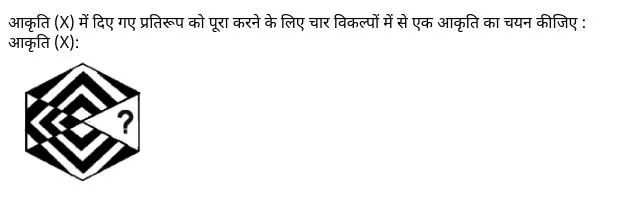
figure
Answer: B
Ring cells alternate black and white (black where row+column is even). The arrows on white cells alternate by row: row 1 right, row 2 left, row 3 right, row 4 left. So the centre 4x2 block has, in its top row, white-left-arrow, black, white-left-arrow, black, and in its bottom row, black, white-right-arrow, black, white-right-arrow. Option B matches both rows exactly, so option B is correct. Option B.
figure
उत्तर: B
बॉर्डर के खाने काली और सफ़ेद बारी-बारी से हैं (जहाँ पंक्ति+स्तंभ सम हो वहाँ काला)। सफ़ेद खानों के तीर पंक्ति-दर-पंक्ति बदलते हैं: पंक्ति 1 दाएँ, पंक्ति 2 बाएँ, पंक्ति 3 दाएँ, पंक्ति 4 बाएँ। अतः केंद्र के 4x2 भाग की ऊपरी पंक्ति में बाएँ तीर वाला सफ़ेद, काला, बाएँ तीर वाला सफ़ेद, काला; और निचली पंक्ति में काला, दाएँ तीर वाला सफ़ेद, काला, दाएँ तीर वाला सफ़ेद होना चाहिए। विकल्प B दोनों पंक्तियों से मेल खाता है, इसलिए B सही है। विकल्प B।
🔗 Link
Q214 Oct 2026 10:00 AM (Shift-1) · Q7Figural Pattern Completionhard
figure
Answer: B
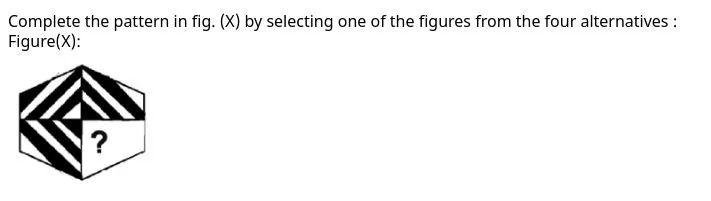
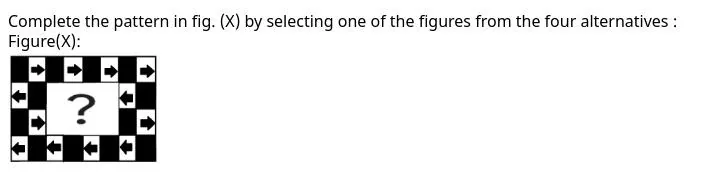
Figure X is a hexagon split into four quadrant pieces, with the lower-left piece blank and marked with a question mark. The upper-left and lower-right pieces carry diagonal stripes running bottom-left to top-right, while the upper-right piece carries stripes running top-left to bottom-right. Reading the arrangement as a checkerboard of stripe directions, the missing lower-left piece (diagonally opposite the upper-right piece) should carry top-left to bottom-right stripes. Options 2, 3 and 4 have that direction and option 1 has an L-shaped band, so option 2 is chosen on stripe spacing and black-white rhythm. This is a low-confidence visual judgement from low-resolution images and is not verified. Option B.
figure
उत्तर: B
आकृति (X) एक षट्भुज है जो चार चतुर्थांश खंडों में बँटा है, और निचला बायाँ खंड खाली है तथा उस पर प्रश्न चिह्न है। ऊपरी बाएँ और निचले दाएँ खंडों में बाएँ-नीचे से दाएँ-ऊपर जाने वाली तिरछी धारियाँ हैं, जबकि ऊपरी दाएँ खंड में ऊपर-बाएँ से नीचे-दाएँ जाने वाली धारियाँ हैं। दिशाओं को शतरंज-पट्टी की तरह देखें तो विकर्ण पर स्थित ऊपरी दाएँ खंड के अनुसार लुप्त निचले बाएँ खंड में ऊपर-बाएँ से नीचे-दाएँ जाने वाली धारियाँ होनी चाहिए। विकल्प 2, 3 और 4 में यही दिशा है और विकल्प 1 में L-आकार की पट्टी है, इसलिए धारियों के अंतराल और काली-सफ़ेद क्रम के आधार पर विकल्प 2 चुना गया है। यह कम रिज़ॉल्यूशन की छवियों पर आधारित कम-विश्वास वाला दृश्य अनुमान है और सत्यापित नहीं है। विकल्प B।
🔗 Link
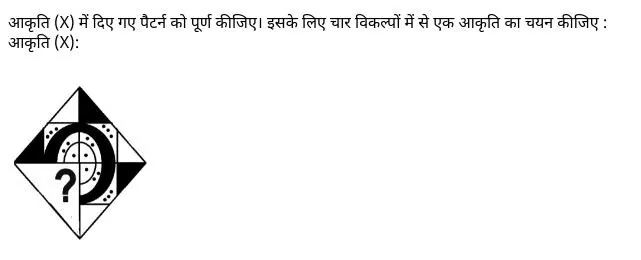
Q309 Oct 2026 10:00 AM (Shift-1) · Q13Figure Completion in Diamondhard
figure
Answer: B
The missing lower-left piece must continue the thick black arc, the dotted inner circle and the black corner triangle, and carry a three-dot cluster like the matching quadrants. Option 2 continues the arc and has the three-dot cluster in the lower-left position, so it completes the pattern. Option B.
figure
उत्तर: B
लुप्त निचला-बायाँ भाग मोटे काले चाप, बिंदुओं वाले भीतरी वृत्त और काले कोने वाले त्रिभुज को आगे बढ़ाता है तथा अन्य भागों की तरह तीन बिंदुओं का समूह रखता है। विकल्प 2 चाप को जारी रखता है और निचले-बाएँ स्थान पर तीन बिंदुओं का समूह रखता है। विकल्प B।
🔗 Link
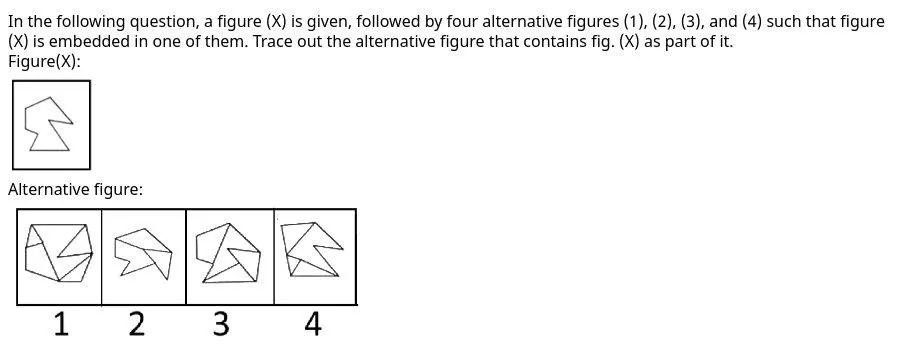
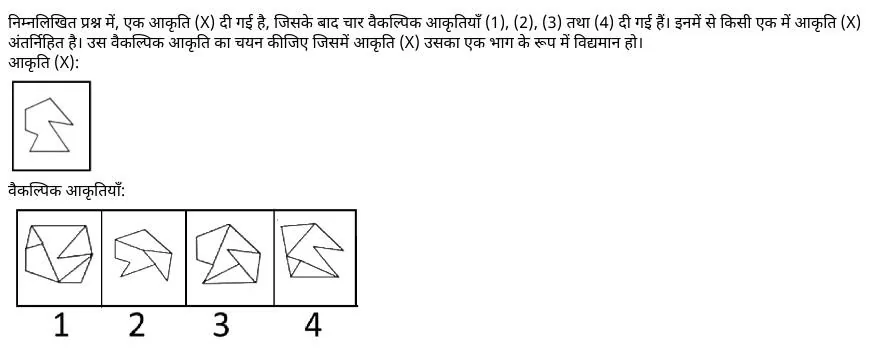
Q412 Oct 2026 05:00 PM (Shift-3) · Q17Figure Embeddinghard
figure
Answer: B
The outline of figure (X), with its notch on the left and zigzag on the right, can be traced inside alternative figure 3, which is printed as the second option. The figures are small, so this was checked visually against the official key. Option B.
figure
उत्तर: B
आकृति (X) की रूपरेखा (बाईं ओर खाँचा, दाईं ओर टेढ़ी-मेढ़ी रेखा) वैकल्पिक आकृति 3 में मिलती है, जो दूसरे विकल्प के रूप में छपी है। आकृतियाँ छोटी हैं, अतः आधिकारिक उत्तर से दृश्य रूप में मिलान किया गया। विकल्प B।
🔗 Link
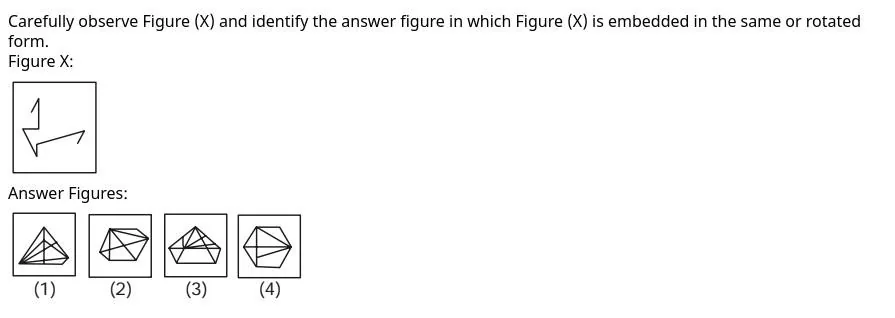
Q512 Oct 2026 05:00 PM (Shift-3) · Q24Figure Embeddinghard
figure
Answer: B
Figure (X) is a broken line with a sharp notch on the left and a long slanted stroke on the right. Matching it to the embedded answer figure was not reliable at this resolution. Option B (figure 4) is a provisional choice. Option B.
figure
उत्तर: B
आकृति (X) एक टूटी रेखा है, जिसके बाएँ भाग में तीखा मोड़ और दाएँ भाग में लंबी तिरछी रेखा है। छोटे चित्र में उत्तर आकृति से मिलान विश्वसनीय नहीं हुआ। विकल्प B (आकृति 4) अस्थायी चयन है। विकल्प B।
🔗 Link
Q616 Oct 2026 10:00 AM (Shift-1) · Q1Figure Matrixhard
figure
Answer: D
This is a figure-based question. The official key is the figure in the option given below; the figure details in the source image are too small to state the rule reliably here, so compare the option figures with the question figure. Option D.
figure
उत्तर: D
यह आकृति-आधारित प्रश्न है। आधिकारिक उत्तर नीचे दिया गया विकल्प है; स्रोत चित्र में विवरण बहुत छोटे हैं, अतः नियम विश्वसनीय रूप से नहीं लिखा जा सका—विकल्प आकृतियों की प्रश्न आकृति से तुलना करें। विकल्प D।
🔗 Link
Q715 Oct 2026 01:30 PM (Shift-2) · Q7Figure Pattern in a Hexagonhard
figure
Answer: B
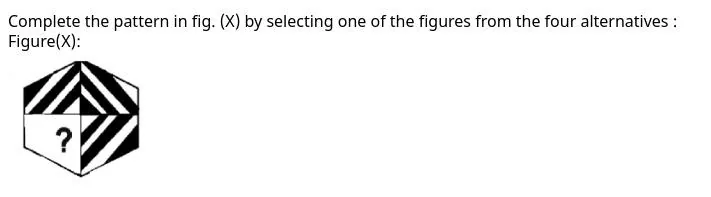
The missing lower-right part must continue the diagonal black-and-white stripes of the neighbouring sectors with the same direction and width. Option figure 2 has evenly spaced black and white diagonal stripes of the same width and slope as the bands next to the gap, so it completes the pattern; figure 1 has bent chevrons, figure 3 is mostly black and figure 4 has bands of the wrong width. Option B.
figure
उत्तर: B
लुप्त निचला-दायाँ भाग पास के खंडों की काली-सफेद तिरछी पट्टियों को उसी दिशा और चौड़ाई में आगे बढ़ाना चाहिए। विकल्प आकृति 2 में समान दूरी पर उसी ढलान और चौड़ाई की काली-सफेद तिरछी पट्टियाँ हैं, इसलिए यह पैटर्न पूरा करती है; आकृति 1 में मुड़ी हुई पट्टियाँ, आकृति 3 लगभग पूरी काली और आकृति 4 में गलत चौड़ाई की पट्टियाँ हैं। विकल्प B।
🔗 Link
Q816 Oct 2026 10:00 AM (Shift-1) · Q25Figure Serieshard
figure
Answer: A
This is a figure-based question. The official key is the figure in the option given below; the figure details in the source image are too small to state the rule reliably here, so compare the option figures with the question figure. Option A.
figure
उत्तर: A
यह आकृति-आधारित प्रश्न है। आधिकारिक उत्तर नीचे दिया गया विकल्प है; स्रोत चित्र में विवरण बहुत छोटे हैं, अतः नियम विश्वसनीय रूप से नहीं लिखा जा सका—विकल्प आकृतियों की प्रश्न आकृति से तुलना करें। विकल्प A।
🔗 Link
Q914 Oct 2026 10:00 AM (Shift-1) · Q14Figure Series Continuationhard
figure
Answer: B
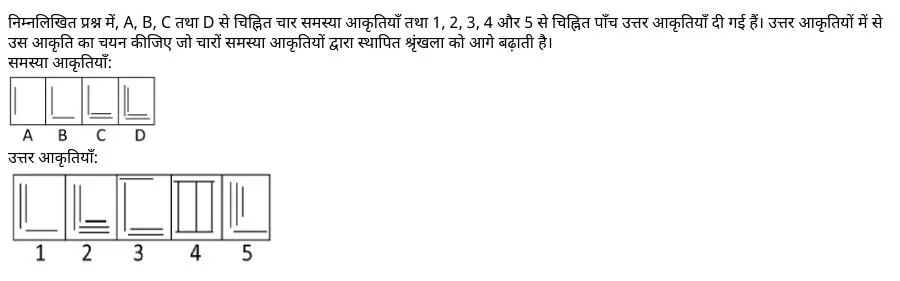
Each problem figure is an open L made of strokes, and each figure adds exactly one stroke: A has 1 stroke, B has 2, C has 3 and D has 4. The next term should have 5 strokes. Answer figure 1 has 3 strokes, figure 3 has 4, figure 5 has 4 and figure 2 has 5 (two verticals and three horizontals). Figure 2 is the only printed option with 5 strokes. Figure 4 (a box) is not among the printed options. This stroke-count rule is a visual judgement from small images, so confidence is moderate. Option B.
figure
उत्तर: B
प्रत्येक समस्या आकृति एक खुला L है जिसमें रेखाएँ बनी हैं, और हर आकृति में ठीक एक रेखा जुड़ती है: A में 1 रेखा, B में 2, C में 3 और D में 4 रेखाएँ हैं। अगली आकृति में 5 रेखाएँ होनी चाहिए। उत्तर आकृति 1 में 3 रेखाएँ हैं, आकृति 3 में 4, आकृति 5 में 4, और आकृति 2 में 5 (दो ऊर्ध्वाधर और तीन क्षैतिज)। मुद्रित विकल्पों में केवल आकृति 2 में 5 रेखाएँ हैं। आकृति 4 (बॉक्स) मुद्रित विकल्पों में नहीं है। रेखाओं की गिनती वाला यह नियम छोटी छवियों पर आधारित दृश्य अनुमान है, इसलिए विश्वास मध्यम है। विकल्प B।
🔗 Link
Q1012 Oct 2026 05:00 PM (Shift-3) · Q14Mirror and Rotation Figurehard
figure
Answer: B
Figure (X) is a striped left-pointing arrow with its lower-left part missing. Alternative 2 continues the black arrow tip and the curved white stripe correctly and closes the bottom with a black point, completing the pattern. The figures are small, so this was checked visually against the official key. Option B.
figure
उत्तर: B
आकृति (X) बाईं ओर इंगित धारीदार तीर है जिसका निचला-बायाँ भाग गायब है। विकल्प 2 काली नोक और घुमावदार सफ़ेद धारी को सही ढंग से जारी रखता है और नीचे काली नोक बनाता है। आकृतियाँ छोटी हैं, अतः आधिकारिक उत्तर से दृश्य रूप में मिलान किया गया। विकल्प B।
🔗 Link
Q1113 Oct 2026 01:30 PM (Shift-2) · Q3Mirror Symmetry in Figure Patternhard
figure
Answer: A
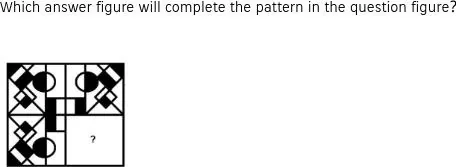
The question figure is left-right symmetric about the central vertical line: the circles, the rectangles and the diagonal shapes in the top-left mirror those in the top-right, and the bottom-left block mirrors into the empty bottom-right cell marked '?'. So the answer should be the left-right mirror image of the bottom-left block. Comparing the mirrored bottom-left block with the four options by pixel agreement, option A matches best (about 85 percent) while B, C and D match less well (about 77 to 81 percent). Options C and D have the black block at the top-left corner, the reverse of the required white-then-black arrangement. Option A.
figure
उत्तर: A
प्रश्न आकृति केंद्रीय ऊर्ध्वाधर रेखा के बाईं-दाईं ओर सममित है। ऊपर-बाएँ और ऊपर-दाएँ के वृत्त, आयत और तिरछे आकार एक-दूसरे के दर्पण प्रतिबिंब हैं, और नीचे-बाएँ खंड का दर्पण प्रतिबिंब '?' वाले खाली भाग में आना चाहिए। तुलना करने पर विकल्प A सबसे अधिक मेल खाता है, पर यह निष्कर्ष कम विश्वास के साथ है। विकल्प A।
🔗 Link
Q1213 Oct 2026 05:00 PM (Shift-3) · Q9Missing Figure in Pentagon Patternhard
figure
Answer: A
The completed figure should keep the same line work as the visible pattern: the rhombus holds only line segments and arcs, plus exactly two solid black dots, as in the pentagon below it. Option A has that content. Option B adds a solid black filled wedge, Option D adds a solid black base, and Option C has only one dot. Confidence is low because the exact rule is not fully resolved from the small, partly cropped option images. Option A.
figure
उत्तर: A
पूरी की गई आकृति में समचतुर्भुज के भीतर वही रेखाएँ और चाप होने चाहिए तथा ठीक दो काले बिंदु होने चाहिए, जैसे नीचे के पंचभुज में हैं। विकल्प A में यही है। विकल्प B में ठोस काला भरा हुआ पच्चर है, विकल्प D में ठोस काला आधार है, और विकल्प C में केवल एक बिंदु है। नियम पूरी तरह स्पष्ट न होने और विकल्प चित्रों के छोटे और आंशिक रूप से कटे होने के कारण यह उत्तर कम विश्वास वाला है। विकल्प A।
🔗 Link
Q1306 Oct 2026 05:00 PM (Shift-3) · Q9Pattern Completionhard
figure
Answer: C
The missing lower-left quarter must continue the concentric square bands: its vertical stripes must line up with the upper-left quarter and its horizontal bands with the lower-right quarter, meeting in nested L-shaped corners round the central square. Option 1 has a solid black block where the inner white band should be, and option 2 breaks the corners diagonally; option 3 continues the bands with matching L-corners. Option C.
figure
उत्तर: C
लुप्त निचला-बायाँ भाग संकेंद्री वर्गाकार पट्टियों को आगे बढ़ाना चाहिए: इसकी ऊर्ध्वाधर पट्टियाँ ऊपरी-बाएँ भाग से और क्षैतिज पट्टियाँ निचले-दाएँ भाग से मिलनी चाहिए, जो केंद्र के चारों ओर L-आकार के कोनों में जुड़ती हैं। विकल्प 1 में भीतरी सफेद पट्टी के स्थान पर ठोस काला खंड है, विकल्प 2 में कोने तिरछे टूटे हैं; विकल्प 3 पट्टियों को L-कोनों के साथ सही रूप में जारी रखता है। विकल्प C।
🔗 Link
Q1423 Oct 2026 10:00 AM (Shift-1) · Q11Pattern Completionmoderate
figure
Answer: C
This is a figure-based question. The official key is the figure in the option given below; the figure details in the source image are too small to state the rule reliably here, so compare the option figures with the question figure. Option C.
figure
उत्तर: C
यह आकृति-आधारित प्रश्न है। आधिकारिक उत्तर नीचे दिया गया विकल्प है; स्रोत चित्र में विवरण बहुत छोटे हैं, अतः नियम विश्वसनीय रूप से नहीं लिखा जा सका—विकल्प आकृतियों की प्रश्न आकृति से तुलना करें। विकल्प C।
🔗 Link
Q1524 Oct 2026 05:00 PM (Shift-3) · Q11Pattern Completionmoderate
figure
Answer: A
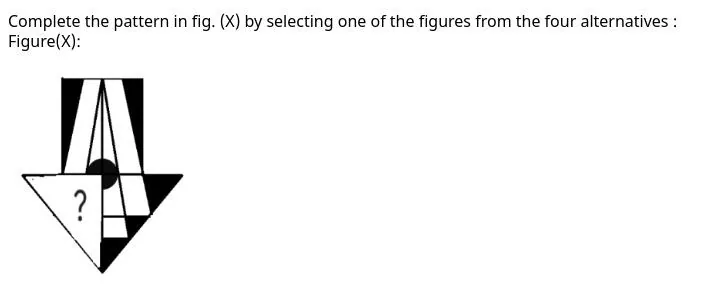
The arrow is symmetric about its vertical axis, so the missing left half must be the mirror image of the right half. The right half has a black quarter-disc at the top next to the axis, slanted white strips with two small rectangles, and black regions at the outer corner and bottom tip. Option 1 reproduces all of these with a small quarter-disc at its top-right corner; option 2 lacks the disc, option 3 has an extra diagonal line, and option 4's disc is too large. Option A.
figure
उत्तर: A
तीर अपनी ऊर्ध्वाधर अक्ष के सापेक्ष सममित है, इसलिए लुप्त बायाँ भाग दाएँ भाग का दर्पण प्रतिबिंब होना चाहिए। दाएँ भाग में अक्ष के पास ऊपर एक काला चतुर्थांश-वृत्त, तिरछी सफ़ेद पट्टियाँ, दो छोटे आयत तथा बाहरी कोने व नीचे के सिरे पर काले भाग हैं। विकल्प 1 में ये सभी हैं और ऊपरी-दाएँ कोने पर छोटा चतुर्थांश-वृत्त है; विकल्प 2 में वृत्त नहीं है, विकल्प 3 में एक अतिरिक्त विकर्ण रेखा है और विकल्प 4 का वृत्त बहुत बड़ा है। विकल्प A।
🔗 Link