CGL 2026 Tier 1EzSSC Practice
Learn › Shift-wise papers

06 Oct 2026 05:00 PM (Shift-3)

SSC CGL Tier 1 2026 · 100 questions · read with answers, or take it as a timed mock.

Tap an option to check your answer, or use “Show answer”. Switch to Hindi with the हिं button at the top.अंग्रेज़ी के लिए ऊपर EN बटन दबाएँ।
Q1Address Matchingeasy
Address A: 5th Cross, 10th Main, Indiranagar, Chennai – 600020
Address B: 10th Cross, 5th Main, Indiranagar, Chennai – 600020
Are these addresses likely to be the same?
Answer: C
Both addresses have the same city (Chennai) and PIN code (600020), but the cross and main road are swapped: A is 5th Cross on 10th Main, while B is 10th Cross on 5th Main, so they are different localities. Option C is correct; A and D are wrong because the streets and PIN codes differ, and B is wrong because the city is the same. Option C.
पता A: 5th Cross, 10th Main, Indiranagar, Chennai – 600020
पता B: 10th Cross, 5th Main, Indiranagar, Chennai – 600020
क्या ये पते समान होने की संभावना रखते हैं?
उत्तर: C
दोनों पतों का शहर (Chennai) और पिन कोड (600020) समान है, लेकिन क्रॉस और मुख्य सड़क आपस में बदली हुई हैं: A में 5th Cross, 10th Main है जबकि B में 10th Cross, 5th Main है। इसलिए ये अलग-अलग स्थान हैं और सही उत्तर विकल्प C है। विकल्प C।
🔗 Link
Q2Letter Shiftingeasy
In a certain code language, "STONE" is written as "RSNMD." How will "CHAIR" be written in the same code language?
Answer: C
Each letter of STONE moves back by one place in the alphabet (S→R, T→S, O→N, N→M, E→D). Applying the same shift to CHAIR gives B, G, Z, H, Q, so the code is BGZHQ, which is option C. Option C.
एक निश्चित कूट भाषा में, “STONE” को “RSNMD” लिखा जाता है। उसी कूट भाषा में “CHAIR” को कैसे लिखा जाएगा?
उत्तर: C
STONE के हर अक्षर को वर्णमाला में एक स्थान पीछे खिसकाया गया है (S→R, T→S, O→N, N→M, E→D)। वही नियम CHAIR पर लगाने से BGZHQ मिलता है, अतः उत्तर विकल्प C है। विकल्प C।
🔗 Link
Q3Alternate Letter Shiftingmoderate
In a certain code language, "COMMUNICATION" is written as "DONMVNJCBTJOO". How will "EDUCATIONALLY" be written?
Answer: A
In COMMUNICATION, letters at odd positions move forward one place (C→D, M→N, U→V, I→J, A→B, I→J, N→O) and letters at even positions stay the same. Applying this to EDUCATIONALLY gives F, D, V, C, B, T, J, O, O, A, M, L, Z, i.e. FDVCBTJOOAMLZ, which is option A. Option A.
एक खास कोड भाषा में, "COMMUNICATION" को "DONMVNJCBTJOO" लिखा जाता है। तो "EDUCATIONALLY" को कैसे लिखा जाएगा?
उत्तर: A
COMMUNICATION में विषम स्थानों के अक्षर एक स्थान आगे और सम स्थानों के अक्षर वही रहते हैं। EDUCATIONALLY पर यही नियम लगाने से FDVCBTJOOAMLZ मिलता है, अतः उत्तर विकल्प A है। विकल्प A।
🔗 Link
Q4Position after Swappingmoderate
In a row of players, Mohan is 6th from the left, and Sohan is 20th from the right. After swapping their places, Mohan becomes 18th from the left. Find the total number of players.
Answer: C
Let the total be N. Sohan is 20th from the right, so his position from the left is N − 19. After the swap Mohan takes that place and is 18th from the left, so N − 19 = 18, giving N = 37. Option C is correct. Option C.
खिलाड़ियों की एक पंक्ति में, मोहन बाएँ से 6वें स्थान पर है और सोहन दाएँ से 20वें स्थान पर है। उनके स्थान आपस में बदलने के बाद, मोहन बाएँ से 18वें स्थान पर हो जाता है। खिलाड़ियों की कुल संख्या ज्ञात कीजिए।
उत्तर: C
माना कुल खिलाड़ी N हैं। सोहन दाएँ से 20वें है, इसलिए बाएँ से उसका स्थान N − 19 है। स्थान बदलने पर मोहन उसी स्थान पर जाता है और बाएँ से 18वाँ हो जाता है, अतः N − 19 = 18 और N = 37; उत्तर विकल्प C है। विकल्प C।
🔗 Link
Q5Empathy and Adaptive Leadershipmoderate
A newly appointed department head reports to a senior director who is highly anxious about an upcoming internal audit and tends to micro-manage minor tasks, affecting team efficiency. How should the department head apply empathy and adaptive leadership to handle this situation effectively?
Answer: D
Empathy means understanding the director's anxiety, and adaptive leadership means changing approach to fit the situation. Option D does both by meeting privately and giving structured audit updates. Options A, B and C either ignore the problem, escalate it, or add stricter monitoring, which would worsen team efficiency. Option D.
एक नए नियुक्त डिपार्टमेंट हेड को एक सीनियर डायरेक्टर को रिपोर्ट करना होता है, जो आने वाले इंटरनल ऑडिट को लेकर बहुत परेशान रहते हैं और छोटे-छोटे कामों में भी बहुत ज़्यादा दख़ल देते हैं, जिससे टीम की कार्यक्षमता पर असर पड़ता है। इस स्थिति को प्रभावी ढंग से संभालने के लिए डिपार्टमेंट हेड को सहानुभूति और अनुकूलनशील नेतृत्व (adaptive leadership) का इस्तेमाल कैसे करना चाहिए?
उत्तर: D
सहानुभूति का अर्थ है डायरेक्टर की चिंता को समझना और अनुकूलनशील नेतृत्व का अर्थ है स्थिति के अनुसार तरीका बदलना। विकल्प D दोनों को पूरा करता है: निजी बैठक में व्यवस्थित ऑडिट जानकारी दी जाती है। अन्य विकल्प समस्या को नज़रअंदाज़ करते हैं, बढ़ाते हैं या निगरानी बढ़ाते हैं, जिससे कार्यक्षमता और घटेगी। विकल्प D।
🔗 Link
Q6Counting Triangleshard
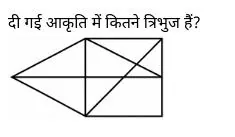
figure
Answer: D
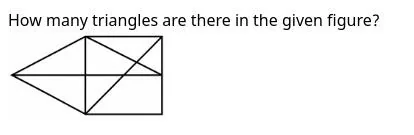
Lines: L-T, L-B, L-RM (horizontal), T-B, T-TR, B-BR, TR-BR, T-RM, B-TR. With M = midpoint of T-B, P = (B-TR)∩(horizontal), Q = (T-RM)∩(B-TR), the triangles are: LTM, LMB, LTB, LT-RM, LBP, T-M-RM, MBP, T-TR-RM, P-Q-RM, P-RM-TR, Q-RM-TR, T-Q-TR, T-B-Q, T-B-TR, B-BR-TR = 15. No option gives 15; the official key is 13. Official key: Option D.
Note: our check disagrees with this official answer; the official key is shown.
figure
उत्तर: D
रेखाएँ: L-T, L-B, L-RM (क्षैतिज), T-B, T-TR, B-BR, TR-BR, T-RM, B-TR। M = T-B का मध्य बिंदु, P = (B-TR) और क्षैतिज रेखा का कटान, Q = (T-RM) और (B-TR) का कटान। त्रिभुज: LTM, LMB, LTB, LT-RM, LBP, T-M-RM, MBP, T-TR-RM, P-Q-RM, P-RM-TR, Q-RM-TR, T-Q-TR, T-B-Q, T-B-TR, B-BR-TR = 15। कोई विकल्प 15 नहीं है; आधिकारिक उत्तर 13 है। आधिकारिक उत्तर: विकल्प D।
नोट: हमारी जाँच इस आधिकारिक उत्तर से असहमत है; यहाँ आधिकारिक कुंजी दी गई है।
🔗 Link
Q7Constructive Response to a Colleague's Ideamoderate
During a meeting, a junior colleague proposes an idea that lacks clear articulation but holds significant potential, only to be quickly dismissed by the manager. Observing the employee’s visible discouragement, what is the most professional and constructive action you should take?
Answer: D
The idea has potential even though it is poorly phrased, so the best response is to restate it in clearer terms in the meeting and suggest revisiting it. Option D does this constructively and supports the discouraged colleague. Options A (silence), B (criticism later) and C (a joke) are less professional or unhelpful. Option D.
बैठक के दौरान, एक कनिष्ठ सहकर्मी ऐसा विचार प्रस्तुत करता/करती है जिसे स्पष्ट रूप से व्यक्त नहीं किया गया है, लेकिन उसमें महत्वपूर्ण संभावनाएँ मौजूद हैं। प्रबंधक द्वारा उस विचार को शीघ्रता से खारिज कर दिया जाता है। कर्मचारी के स्पष्ट रूप से निरुत्साहित होने को देखते हुए, आपके द्वारा उठाया जाने वाला सबसे पेशेवर और रचनात्मक कदम क्या होना चाहिए?
उत्तर: D
विचार में संभावना है भले ही उसे ठीक से नहीं रखा गया, इसलिए बैठक में ही उसे स्पष्ट शब्दों में दोबारा रखना और प्रस्ताव पर पुनर्विचार का सुझाव देना सबसे उचित है; उत्तर विकल्प D है। A चुप्पी, B बाद में आलोचना और C मज़ाक तीनों कम उपयुक्त हैं। विकल्प D।
🔗 Link
Q8Emotional Intelligence in Workplace Dilemmasmoderate
During dinner, your longtime childhood friend and colleague admits that they accidentally erased an important client backup file due to carelessness and intends to attribute the mistake to a recent software glitch the next day. As a peer exercising emotional intelligence, how should you respond to this situation?
Answer: B
Emotional intelligence means respecting the friend while staying honest and fixing the problem. Option B acknowledges their feelings, refuses to cover up the error, and proposes a transparent remediation report reviewed together. Option A asks you to back a false story, C is a sudden betrayal and D is abusive, so they are wrong. Option B.
डिनर के दौरान, आपके बचपन के दोस्त और साथी ने माना कि लापरवाही की वजह से उनसे गलती से एक ज़रूरी क्लाइंट बैकअप फ़ाइल डिलीट हो गई है और वे अगले दिन इस गलती का कारण हाल ही में आई सॉफ़्टवेयर की गड़बड़ी को बताने वाले हैं। एक साथी के तौर पर, इमोशनल इंटेलिजेंस का इस्तेमाल करते हुए, आपको इस स्थिति में क्या करना चाहिए?
उत्तर: B
भावनात्मक बुद्धिमत्ता का अर्थ है दोस्त का सम्मान करते हुए ईमानदार रहना और समस्या सुलझाना। विकल्प B उनकी भावनाओं को समझता है, गलती पर पर्दा नहीं डालता और मिलकर पारदर्शी सुधार रिपोर्ट तैयार करने का सुझाव देता है; उत्तर विकल्प B है। A झूठी कहानी का समर्थन है, C अचानक विश्वासघात है और D अपमानजनक है। विकल्प B।
🔗 Link
Q9Pattern Completionhard
figure
Answer: C
The missing lower-left quarter must continue the concentric square bands: its vertical stripes must line up with the upper-left quarter and its horizontal bands with the lower-right quarter, meeting in nested L-shaped corners round the central square. Option 1 has a solid black block where the inner white band should be, and option 2 breaks the corners diagonally; option 3 continues the bands with matching L-corners. Option C.
figure
उत्तर: C
लुप्त निचला-बायाँ भाग संकेंद्री वर्गाकार पट्टियों को आगे बढ़ाना चाहिए: इसकी ऊर्ध्वाधर पट्टियाँ ऊपरी-बाएँ भाग से और क्षैतिज पट्टियाँ निचले-दाएँ भाग से मिलनी चाहिए, जो केंद्र के चारों ओर L-आकार के कोनों में जुड़ती हैं। विकल्प 1 में भीतरी सफेद पट्टी के स्थान पर ठोस काला खंड है, विकल्प 2 में कोने तिरछे टूटे हैं; विकल्प 3 पट्टियों को L-कोनों के साथ सही रूप में जारी रखता है। विकल्प C।
🔗 Link
Q10Symbol-based Expressionsmoderate
If X % Y means X is added to Y, and X π Y means X is multiplied by Y, find the expression for “the sum of A and B multiplied by the value of C.”
Answer: A
The sum of A and B is written A % B, and multiplying that by C gives (A % B) π C. Option A has exactly this bracketed form, while B groups B with C, C multiplies the wrong pair and D omits the brackets. Option A.
यदि X % Y का अर्थ है X को Y में जोड़ा जाता है, और X π Y का अर्थ है X को Y से गुणा किया जाता है, तो “A और B के योग को C के मान से गुणा किया जाता है” के लिए व्यंजक ज्ञात कीजिए।
उत्तर: A
A और B का योग A % B है, और उसे C से गुणा करने पर (A % B) π C बनता है। विकल्प A यही संरचना दिखाता है; अन्य विकल्पों में गुणा और योग का क्रम गलत है। विकल्प A।
🔗 Link
Q11Interchanged Operation Signsmoderate
If 12 × 3 means 4, 15 − 5 means 75, and 4 ÷ 2 means 6, then what is the value of 20 − 10 × 5 ÷ 2?
Answer: B
The signs are swapped: × means ÷ (12 ÷ 3 = 4), − means × (15 × 5 = 75), and ÷ means + (4 + 2 = 6). So 20 − 10 × 5 ÷ 2 becomes 20 × 10 ÷ 5 + 2 = 200 ÷ 5 + 2 = 42, which is option B. Option B.
यदि 12 × 3 का अर्थ 4 है, 15 − 5 का अर्थ 75 है, और 4 ÷ 2 का अर्थ 6 है, तो 20 − 10 × 5 ÷ 2 का मान क्या है?
उत्तर: B
चिह्न आपस में बदले गए हैं: × का अर्थ ÷ है (12 ÷ 3 = 4), − का अर्थ × है (15 × 5 = 75), और ÷ का अर्थ + है (4 + 2 = 6)। अतः 20 − 10 × 5 ÷ 2 = 20 × 10 ÷ 5 + 2 = 200 ÷ 5 + 2 = 42; उत्तर विकल्प B है। विकल्प B।
🔗 Link
Q12Inference from a Statementeasy
In the following question, one statement is given, followed by certain inferences. Consider the statement to be true even if it seems to contradict commonly known facts. Read the inferences carefully and decide which of them logically follow from the given statement.
Statement:
Pedestrians crossing busy roads without using designated zebra crossings often disrupt traffic movement and increase the chances of accidents during peak hours.
Inferences:
I. Improper road crossing can create safety hazards.
II. Only pedestrians are responsible for road accidents.
Answer: A
Inference I follows because the statement says improper crossing increases the chance of accidents, which is a safety hazard. Inference II is too strong: the statement never says that only pedestrians are responsible. So only Inference I follows, which is option A. Option A.
निम्नलिखित प्रश्न में एक कथन दिया गया है, जिसके बाद कुछ निष्कर्ष दिए गए हैं। कथन को सत्य मानिए, भले ही वह सामान्यतः ज्ञात तथ्यों का विरोध करता हुआ प्रतीत हो। निष्कर्षों को ध्यानपूर्वक पढ़िए और निर्धारित कीजिए कि उनमें से कौन-सा/कौन-से दिए गए कथन से तार्किक रूप से अनुसरण करते हैं।
कथन:
निर्धारित ज़ेब्रा क्रॉसिंग का उपयोग किए बिना व्यस्त सड़कों को पार करना अक्सर यातायात की आवाजाही में बाधा उत्पन्न करता है तथा व्यस्त समय (पीक आवर्स) के दौरान दुर्घटनाओं की संभावना बढ़ा देता है।
निष्कर्ष:
I. सड़क को अनुचित तरीके से पार करना सुरक्षा संबंधी जोखिम उत्पन्न कर सकता है।
II. सड़क दुर्घटनाओं के लिए केवल पैदल यात्री ही जिम्मेदार होते हैं।
उत्तर: A
निष्कर्ष I सही है, क्योंकि कथन के अनुसार बिना ज़ेब्रा क्रॉसिंग सड़क पार करने से दुर्घटना की संभावना बढ़ती है, जो सुरक्षा जोखिम है। निष्कर्ष II कथन से आगे की बात है, क्योंकि कथन में केवल पैदल यात्रियों को ज़िम्मेदार नहीं कहा गया है; उत्तर विकल्प A है। विकल्प A।
🔗 Link
Q13Mirror Image on a Linemoderate
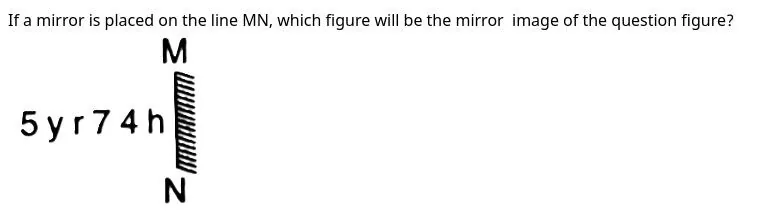
figure
Answer: C
A mirror image reverses the order of the characters and flips each one left to right. The question figure 5 y r 7 4 h therefore becomes h 4 7 r y 5 with every glyph mirrored. Option 3 shows exactly this: the r has its arm on the left, the 7 has its bar pointing left, and the 5 has its bar on the right. Options 1 and 2 have glyphs that are rotated or flipped vertically (the r and the 7 in option 2, the r in option 1), and option 4 has an upside-down h. Option C.
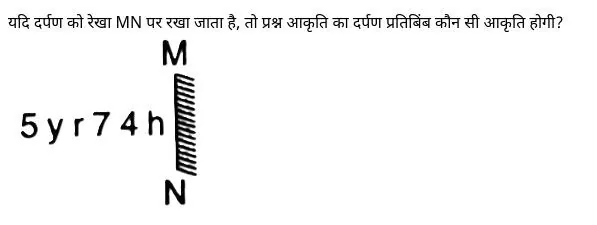
figure
उत्तर: C
दर्पण प्रतिबिंब में अक्षरों का क्रम उलट जाता है और हर अक्षर बाएँ-दाएँ पलट जाता है। प्रश्न आकृति 5 y r 7 4 h का प्रतिबिंब h 4 7 r y 5 होगा, जिसके हर अक्षर पलटे हुए हैं। विकल्प 3 यही दिखाता है: r की भुजा बाईं ओर है, 7 की पट्टी बाईं ओर है और 5 की पट्टी दाईं ओर है। विकल्प 1 और 2 में कुछ अक्षर घूमे या ऊर्ध्वाधर पलटे हुए हैं, और विकल्प 4 में h उलटा है; उत्तर विकल्प C है। विकल्प C।
🔗 Link
Q14Handling Out-of-scope Client Requestseasy
A client requests a specific feature for their software project that is outside the original project scope. Your manager is away, and the client is pressuring you to commit to the deadline today. What should you do?
Answer: C
The request is outside scope and the manager is away, so the right step is to acknowledge it, consult the manager, and give a day-end update, which is option C. Option A commits without authority, B refuses rudely, and D hides work from official records, which is unprofessional. Option C.
एक ग्राहक अपने सॉफ़्टवेयर प्रोजेक्ट के लिए एक विशेष सुविधा (Feature) जोड़ने का अनुरोध करता है, जो मूल परियोजना-परिधि (Project Scope) से बाहर है। आपका प्रबंधक अनुपस्थित है और ग्राहक आप पर आज ही समय-सीमा (Deadline) निर्धारित करने का दबाव डाल रहा है। आपको क्या करना चाहिए?
उत्तर: C
अनुरोध दायरे से बाहर है और प्रबंधक उपलब्ध नहीं हैं, इसलिए सही कदम है अनुरोध स्वीकार करना, प्रबंधक से परामर्श करना और दिन के अंत तक अपडेट देना; उत्तर विकल्प C है। A बिना अधिकार के वचन देता है, B रूखा इनकार है और D कार्य को गुप्त रखता है। विकल्प C।
🔗 Link
Q15Figure Analogyhard
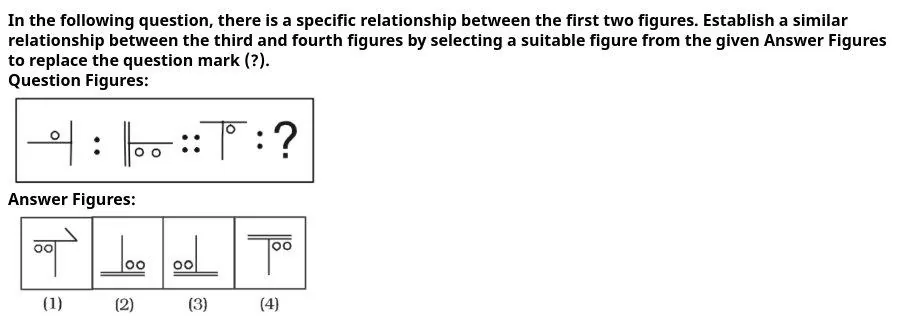
figure
Answer: C
From the first to the second figure the perpendicular line is doubled, the single circle becomes two circles, and the figure is turned over so that the arm and circles move to the opposite side. Applying this to the T: the bar is doubled, the circle becomes two, and the figure turned through 180° gives an inverted T on a double base with the two circles on the left of the stem, which is answer figure 3. The option labelled C reads "3". Option C.
figure
उत्तर: C
पहली से दूसरी आकृति में लंब रेखा दोहरी हो जाती है, एक वृत्त दो वृत्त बन जाता है और आकृति पलट कर भुजा व वृत्त विपरीत ओर आ जाते हैं। यही T पर लागू करने पर: पट्टी दोहरी, दो वृत्त, और 180° घुमाने पर दोहरे आधार पर उल्टा T जिसमें दोनों वृत्त तने के बाईं ओर हों — यह उत्तर आकृति 3 है। विकल्प C का पाठ "3" है। विकल्प C।
🔗 Link
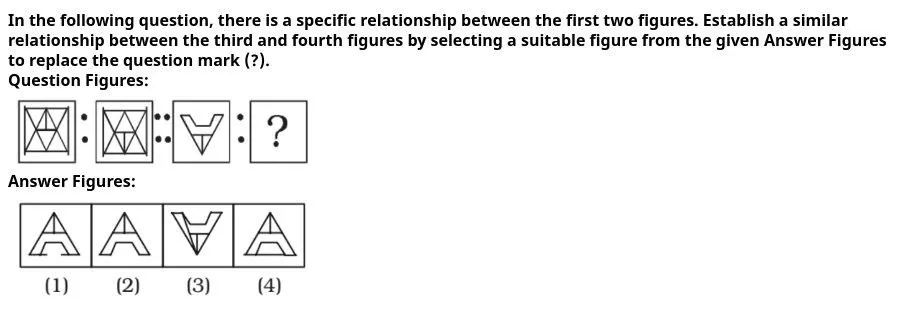
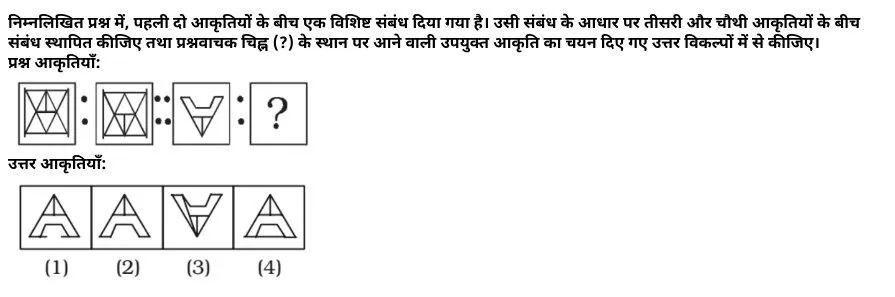
Q16Figure Analogyhard
figure
Answer: B
The second figure is the first flipped top-to-bottom (mirror in a horizontal line). Flipping the V-figure top-to-bottom gives an A-shape with the short vertical at the top, the crossbar below it, and the trapezoidal notch opening at the base with the two short base segments on either side - exactly answer figure 2. Figure 1 has an extra stroke at the lower left, figure 4 closes the notch with a full base line, and figure 3 is not flipped. Option B.
figure
उत्तर: B
दूसरी आकृति पहली आकृति का ऊपर-नीचे पलटा (क्षैतिज दर्पण) रूप है। V-आकृति को ऊपर-नीचे पलटने पर A-आकृति बनती है जिसमें छोटी ऊर्ध्वाधर रेखा ऊपर, उसके नीचे क्षैतिज पट्टी और आधार पर समलंबाकार खाँचा होता है — यह ठीक उत्तर आकृति 2 है। आकृति 1 में नीचे बाईं ओर अतिरिक्त रेखा है, आकृति 4 में खाँचा पूरी आधार रेखा से बंद है, और आकृति 3 पलटी नहीं है। विकल्प B।
🔗 Link
Q17Embedded Figure Identificationmoderate
figure
Answer: D
Figure X is a circle with two radii - one straight up and one to the upper right - bounding a cut-out wedge. Option 4 contains a circle with exactly these two radii (it also has a third radius to the lower left, which is allowed since X only needs to be embedded). Options 1-3 have only diameters/plus or cross lines, with no radius to the upper right. Option D.
figure
उत्तर: D
आकृति X एक वृत्त है जिसमें केंद्र से ऊपर की ओर एक ऊर्ध्वाधर और ऊपर-दाएँ की ओर एक तिरछी रेखा से बनी फाँक है। विकल्प D में वही वृत्त और दोनों रेखाएँ हैं, पर दो अतिरिक्त रेखाएँ भी हैं; यह केवल निकटतम विकल्प है। विकल्प D।
🔗 Link
Q18Venn Diagrameasy
figure
Answer: C
Educated and Employed overlap, and Urban is a third category that can overlap both. Option C shows three circles overlapping pairwise with a common region, the correct representation. A nests two circles inside one, B puts three circles in a row with no common region, and D uses concentric circles, which are wrong. Option C.
figure
उत्तर: C
शिक्षित और नियोजित समूह आपस में मिलते हैं, और शहरी एक तीसरा समूह है जो दोनों से मिल सकता है। विकल्प C तीन वृत्त दिखाता है जो आपस में मिलते हैं और उभयनिष्ठ क्षेत्र बनाते हैं; यही सही उत्तर है। A में एक वृत्त के भीतर दो वृत्त हैं, B में तीन वृत्त एक पंक्ति में हैं, और D में संकेंद्रित वृत्त हैं। विकल्प C।
🔗 Link
Q19Odd Figure (Dot Position)easy
figure
Answer: C
In figures (a), (b), (c) and (e) the dot sits on a corner of the square, but in (d) the dot sits on the middle of the left edge. So (d) is the odd one out, which is option C among the printed options. Option C.
figure
उत्तर: C
आकृति (a), (b), (c) और (e) में बिंदु वर्ग के कोने पर है, पर (d) में बिंदु बाईं भुजा के मध्य में है। इसलिए (d) विषम है, जो दिए गए विकल्पों में विकल्प C है। विकल्प C।
🔗 Link
Q20Implicit Assumptionseasy
Read the given statement carefully and the following assumptions based on it. Decide which of the assumptions are implicit in the statement.
Statement:
The government is considering a complete ban on single-use plastic bags in all retail outlets to protect the local environment.
Assumptions:
I. Retail outlets are the largest source of plastic waste in the region.
II. Eliminating plastic bags will lead to a cleaner and healthier local environment.
Answer: C
The ban is justified by protecting the environment, which assumes that removing bags will make the environment cleaner, so Assumption II is implicit. Assumption I is not needed for the statement to make sense, so it is not implicit. Only Assumption II is implicit, which is option C. Option C.
दिए गए कथन को ध्यानपूर्वक पढ़िए तथा उसके आधार पर दी गई निम्नलिखित मान्यताओं पर विचार कीजिए। निर्धारित कीजिए कि कथन में कौन-सी मान्यता/मान्यताएँ निहित हैं।
कथन:
स्थानीय पर्यावरण की रक्षा के लिए सरकार सभी खुदरा दुकानों में एकल-उपयोग (सिंगल-यूज़) प्लास्टिक बैगों पर पूर्ण प्रतिबंध लगाने पर विचार कर रही है।
मान्यताएँ:
I. क्षेत्र में प्लास्टिक कचरे का सबसे बड़ा स्रोत खुदरा दुकानें हैं।
II. प्लास्टिक बैगों को समाप्त करने से स्थानीय पर्यावरण अधिक स्वच्छ और स्वस्थ बनेगा।
उत्तर: C
प्रतिबंध का औचित्य पर्यावरण की रक्षा है, जो मानता है कि बैग हटाने से पर्यावरण स्वच्छ होगा; इसलिए मान्यता II निहित है। मान्यता I कथन के लिए आवश्यक नहीं है, इसलिए निहित नहीं है। केवल मान्यता II निहित है; उत्तर विकल्प C है। विकल्प C।
🔗 Link
Q21Opposite Faceseasy
figure
Answer: A
Across the four positions, 3 appears beside 1 and 5 (first die), 2 and 5 (second die), 4 and 1 (third die) and 4 and 2 (fourth die). So 3 is adjacent to 1, 2, 4 and 5, and the face opposite 3 must be 6, which is option A. The top face of the first die was read as 1. Option A.
figure
उत्तर: A
चारों स्थितियों में 3 के साथ 1 और 5 (पहला पासा), 2 और 5 (दूसरा), 4 और 1 (तीसरा) तथा 4 और 2 (चौथा) दिखते हैं। अतः 3 के बगल में 1, 2, 4 और 5 हैं, और उसके विपरीत फलक पर 6 होगा; उत्तर विकल्प A है। विकल्प A।
🔗 Link
Q22Odd Figure (Shaded Triangles)hard
figure
Answer: B
Each square has eight sectors around its centre, formed by the two diagonals and the two midlines. In (a), (b), (c) and (e) the two shaded sectors are separated by 90 degrees (two sector steps). In (d) the shaded sectors are separated by 135 degrees (three steps), so (d) is the odd figure, which is option 2. Option B.
figure
उत्तर: B
प्रत्येक वर्ग में केंद्र के चारों ओर आठ खंड हैं। (a), (b), (c) और (e) में छायांकित दो खंड एक-दूसरे से 90° पर हैं, जबकि (d) में वे 135° पर हैं। अतः (d) विषम आकृति है; उत्तर विकल्प 2 है। विकल्प B।
🔗 Link
Q23Column Relationshipsmoderate
Which of the following rows/columns are connected/related with each other in some way?
Table:
Rows / Columns: I | II | III | IV | V
Row I: 4 | 7 | 11 | 9 | 9
Row II: 8 | 11 | 15 | 13 | 13
Row III: 6 | 9 | 13 | 11 | 16
Row IV: 12 | 15 | 20 | 17 | 14
Row V: 10 | 13 | 17 | 15 | 11
Answer: A
Column II minus column I is 3 in every row (7−4, 11−8, 9−6, 15−12, 13−10), and column IV minus column I is 5 in every row. So columns I, II and IV are related. Column III differs from column I by 7 in most rows but by 8 in row IV, so it is not related; the answer is option A. Option A.
निम्नलिखित में से कौन-सी पंक्तियाँ/स्तंभ किसी न किसी प्रकार से आपस में संबंधित हैं?
तालिका:
पंक्तियाँ / स्तंभ: I | II | III | IV | V
पंक्ति I: 4 | 7 | 11 | 9 | 9
पंक्ति II: 8 | 11 | 15 | 13 | 13
पंक्ति III: 6 | 9 | 13 | 11 | 16
पंक्ति IV: 12 | 15 | 20 | 17 | 14
पंक्ति V: 10 | 13 | 17 | 15 | 11
उत्तर: A
स्तंभ II में से स्तंभ I घटाने पर हर पंक्ति में 3 आता है (7−4, 11−8, 9−6, 15−12, 13−10), और स्तंभ IV में से स्तंभ I घटाने पर हर पंक्ति में 5 आता है। अतः स्तंभ I, II और IV संबंधित हैं; स्तंभ III पंक्ति IV में अलग अंतर (8) देता है। उत्तर विकल्प A है। विकल्प A।
🔗 Link
Q24Repeating Cycle Letter Serieseasy
Fill in the blanks (_) using one of the following four options such that the series follows a specific order.
c _ b d c a _ d c a b _ _ a b d
Answer: C
The series repeats the four-letter cycle c, a, b, d. So the blanks at positions 2, 7, 12 and 13 must be a, b, d and c in that order, giving abdc, which is option C. Option C.
रिक्त स्थानों (_) को निम्नलिखित चार विकल्पों में से किसी एक का प्रयोग करके भरिए, ताकि श्रेणी दिए गए क्रम में एक विशिष्ट प्रतिरूप का अनुसरण करे।
c _ b d c a _ d c a b _ _ a b d
उत्तर: C
श्रेणी चार अक्षरों के चक्र c, a, b, d को दोहराती है। अतः स्थान 2, 7, 12 और 13 पर क्रमशः a, b, d और c आएँगे, जिससे abdc बनता है; उत्तर विकल्प C है। विकल्प C।
🔗 Link
Q25Arrow and Circle Movementhard
figure
Answer: D
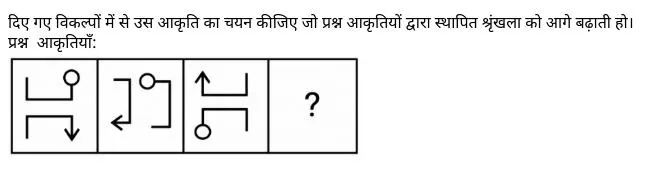
The arrow in the problem figures turns clockwise (down, then left, then up), so the next arrow should point right. Option D has the right-pointing arrow with the circle at the lower left, which continues the series. Option A is a left arrow, B a down arrow, and C has no arrow. Option D.
figure
उत्तर: D
प्रश्न आकृतियों में तीर घड़ी की दिशा में घूमता है (नीचे, फिर बाएँ, फिर ऊपर), इसलिए अगला तीर दाईं ओर होना चाहिए। विकल्प D में दायाँ तीर है और वह श्रृंखला आगे बढ़ाता है; A में बायाँ, B में नीचे का तीर है और C में कोई तीर नहीं है। विकल्प D।
🔗 Link