Tap an option to check your answer, or use “Show answer”. Switch to Hindi with the हिं button at the top.अंग्रेज़ी के लिए ऊपर EN बटन दबाएँ।
Q51Square Root Equationseasy
If $\sqrt{1+\frac{x}{121}}=\frac{12}{11}$, find the value of x.
Answer: C
Square both sides: $1+\frac{x}{121}=\frac{144}{121}$. So $\frac{x}{121}=\frac{23}{121}$, which gives $x=23$. Option C is correct. Quick check: $\sqrt{1+\frac{23}{121}}=\sqrt{\frac{144}{121}}=\frac{12}{11}$. Option C.
यदि $\sqrt{1+\frac{x}{121}}=\frac{12}{11}$, तो x का मान ज्ञात कीजिए।
उत्तर: C
दोनों पक्षों का वर्ग करने पर $1+\frac{x}{121}=\frac{144}{121}$ मिलता है। अतः $\frac{x}{121}=\frac{23}{121}$, इसलिए $x=23$। सही उत्तर विकल्प C है। विकल्प C।
If $x=0.1\bar{2}$ and $y=0.\overline{12}$, find the value of $x+y$.
Answer: B
$x=0.1222\ldots=\frac{12-1}{90}=\frac{11}{90}=\frac{121}{990}$. $y=0.121212\ldots=\frac{12}{99}=\frac{120}{990}$. So $x+y=\frac{241}{990}$. Option B is correct. Option B.
यदि $x=0.1\bar{2}$ और $y=0.\overline{12}$, तो $x+y$ का मान ज्ञात कीजिए।
उत्तर: B
$x=0.1222\ldots=\frac{11}{90}=\frac{121}{990}$ और $y=0.121212\ldots=\frac{12}{99}=\frac{120}{990}$। अतः $x+y=\frac{241}{990}$। सही उत्तर विकल्प B है। विकल्प B।
A tank can be filled in 15 hours under normal conditions. However, due to a leak at the bottom, it takes 20 hours to fill completely. If the tank is already full, how long will the leak alone take to empty it?
Answer: A
Filling rate $=\frac{1}{15}$ per hour. Net filling rate with the leak $=\frac{1}{20}$ per hour. Leak rate $=\frac{1}{15}-\frac{1}{20}=\frac{1}{60}$ per hour. So the leak alone empties the full tank in 60 hours. Option A is correct. Option A.
सामान्य परिस्थितियों में एक टैंक 15 घंटे में भरा जा सकता है। लेकिन, नीचे की ओर एक रिसाव होने के कारण, इसे पूरी तरह भरने में 20 घंटे लगते हैं। यदि टैंक पहले से ही भरा हुआ है, तो अकेले उस रिसाव को इसे खाली करने में कितना समय लगेगा?
उत्तर: A
भरने की दर $=\frac{1}{15}$ प्रति घंटा और रिसाव सहित शुद्ध भरने की दर $=\frac{1}{20}$ प्रति घंटा है। रिसाव की दर $=\frac{1}{15}-\frac{1}{20}=\frac{1}{60}$ प्रति घंटा। अतः अकेला रिसाव पूरा टैंक 60 घंटे में खाली करेगा। सही उत्तर विकल्प A है। विकल्प A।
Find the mean proportional between $9-3\sqrt{2}$ and $6+2\sqrt{2}$.
Answer: C
Mean proportional $=\sqrt{(9-3\sqrt{2})(6+2\sqrt{2})}$. Expanding: $54+18\sqrt{2}-18\sqrt{2}-6\cdot 2=54-12=42$. So the mean proportional is $\sqrt{42}$. Option C is correct. Option C.
$9-3\sqrt{2}$ और $6+2\sqrt{2}$ के बीच माध्य समानुपाती ज्ञात कीजिए।
उत्तर: C
माध्य समानुपाती $=\sqrt{(9-3\sqrt{2})(6+2\sqrt{2})}$ है। गुणा करने पर $54+18\sqrt{2}-18\sqrt{2}-6\cdot 2=54-12=42$ मिलता है। अतः उत्तर $\sqrt{42}$ है, जो विकल्प C है। विकल्प C।
Q55Simple Interest with Change in Principalmoderate
The simple interest on a sum of money for 15 years is equal to $\frac{3}{4}$ of the principal. If the principal is increased by 50% after 10 years, what will be the total interest at the end of the 15-year period?
Answer: A
Let principal be P. Interest for 15 years $=\frac{3P}{4}$, so $R\times 15/100=3/4$ and $R=5\%$. Interest for first 10 years $=\frac{P\times 5\times 10}{100}=\frac{P}{2}$. New principal $=1.5P$. Interest for the last 5 years $=\frac{1.5P\times 5\times 5}{100}=\frac{3P}{8}$. Total interest $=\frac{P}{2}+\frac{3P}{8}=\frac{7P}{8}$. Option A is correct. Option A.
किसी धनराशि पर 15 वर्षों के लिए साधारण ब्याज, मूलधन के $\frac{3}{4}$ के बराबर है। यदि 10 वर्षों के बाद मूलधन में 50% की वृद्धि कर दी जाती है, तो 15-वर्ष की अवधि के अंत में कुल ब्याज कितना होगा?
उत्तर: A
माना मूलधन P है। 15 वर्ष का साधारण ब्याज $\frac{3P}{4}$ है, अतः वार्षिक दर $R=5\%$ है। पहले 10 वर्षों का ब्याज $\frac{P}{2}$ है। नया मूलधन $1.5P$ हो जाता है, और शेष 5 वर्षों का ब्याज $\frac{3P}{8}$ है। कुल ब्याज $=\frac{P}{2}+\frac{3P}{8}=\frac{7P}{8}$। सही उत्तर विकल्प A है। विकल्प A।
Find the equation of the line parallel to $3x - 4y + 8 = 0$ passing through the point $(4, 1)$.
Answer: A
A line parallel to $3x-4y+8=0$ has the form $3x-4y+k=0$. Putting $(4,1)$: $12-4+k=0$, so $k=-8$. The required line is $3x-4y-8=0$. Option A is correct. Option A.
बिंदु $(4, 1)$ से होकर गुजरने वाली और रेखा $3x - 4y + 8 = 0$ के समांतर रेखा का समीकरण ज्ञात कीजिए।
उत्तर: A
समांतर रेखा का रूप $3x-4y+k=0$ होता है। बिंदु $(4,1)$ रखने पर $12-4+k=0$, अतः $k=-8$। इसलिए रेखा $3x-4y-8=0$ है। सही उत्तर विकल्प A है। विकल्प A।
Q57Compound Interest with Partial Withdrawalmoderate
₹1,20,000 is deposited at 10% per annum compound interest. After the first year, 50% of the interest is withdrawn. Find the balance at the end of the second year.
Answer: C
Interest in year 1 $=10\%$ of ₹1,20,000 $=$ ₹12,000. Withdraw half of it, ₹6,000, so the balance at the start of year 2 is ₹1,26,000. Interest in year 2 $=10\%$ of ₹1,26,000 $=$ ₹12,600. Balance at the end of year 2 $=$ ₹1,26,000 $+$ ₹12,600 $=$ ₹1,38,600. Option C is correct. Option C.
₹1,20,000 की राशि 10% सालाना चक्रवृद्धि ब्याज पर जमा की जाती है। पहले साल के बाद, ब्याज का 50% निकाल लिया जाता है। दूसरे साल के आखिर में बची हुई राशि का पता लगाएँ।
उत्तर: C
पहले साल का ब्याज $=10\%$ of ₹1,20,000 $=$ ₹12,000 है। इसका 50%, यानी ₹6,000 निकाला गया, अतः दूसरे साल की शुरुआत में राशि ₹1,26,000 है। दूसरे साल का ब्याज $=10\%$ of ₹1,26,000 $=$ ₹12,600। दूसरे साल के अंत में बची राशि $=$ ₹1,26,000 $+$ ₹12,600 $=$ ₹1,38,600 है। सही उत्तर विकल्प C है। विकल्प C।
A cube with a surface area of $216\ \mathrm{cm}^{2}$ is melted and recast into smaller cubes, each with a surface area of $24\ \mathrm{cm}^{2}$. Find the number of smaller cubes.
Answer: C
For the big cube $6a^{2}=216$, so $a=6$ cm and its volume is $216\ \mathrm{cm}^{3}$. For a small cube $6b^{2}=24$, so $b=2$ cm and its volume is $8\ \mathrm{cm}^{3}$. Number of small cubes $=\frac{216}{8}=27$. Option C is correct. Option C.
एक घन (cube) जिसका पृष्ठीय क्षेत्रफल $216\ \mathrm{cm}^{2}$ है, उसे पिघलाकर छोटे-छोटे घनों में ढाला जाता है, जिनमें से प्रत्येक का पृष्ठीय क्षेत्रफल $24\ \mathrm{cm}^{2}$ है। छोटे घनों की संख्या ज्ञात कीजिए।
उत्तर: C
बड़े घन के लिए $6a^{2}=216$, अतः $a=6$ cm और आयतन $216\ \mathrm{cm}^{3}$ है। छोटे घन के लिए $6b^{2}=24$, अतः $b=2$ cm और आयतन $8\ \mathrm{cm}^{3}$ है। छोटे घनों की संख्या $=\frac{216}{8}=27$ है। सही उत्तर विकल्प C है। विकल्प C।
From the top of a 75 m high lighthouse, the angles of depression of two ships approaching it along the same straight line are $30^{\circ}$ and $45^{\circ}$. Find the approximate distance between the two ships. (Use $\sqrt{3}=1.732$)
Answer: D
Let the nearer ship (angle $45^{\circ}$) be at distance $d_2$ and the farther ship (angle $30^{\circ}$) at distance $d_1$ from the foot of the lighthouse. $\tan 45^{\circ}=\frac{75}{d_2}$ gives $d_2=75$ m. $\tan 30^{\circ}=\frac{75}{d_1}$ gives $d_1=75\sqrt{3}$ m. Distance between ships $=75\sqrt{3}-75=75(1.732-1)=54.9\approx 55$ m. Option D is correct. Option D.
75 m ऊँचे एक प्रकाशस्तंभ के शीर्ष से, एक ही सीधी रेखा में उसकी ओर आते हुए दो जहाजों के अवनमन कोण क्रमशः $30^{\circ}$ और $45^{\circ}$ हैं। जहाजों के बीच की लगभग दूरी ज्ञात कीजिए। ($\sqrt{3}=1.732$ लें)
उत्तर: D
नज़दीक वाले जहाज़ (कोण $45^{\circ}$) की दूरी $d_2$ और दूर वाले जहाज़ (कोण $30^{\circ}$) की दूरी $d_1$ मानें। $\tan 45^{\circ}=\frac{75}{d_2}$ से $d_2=75$ m मिलता है, और $\tan 30^{\circ}=\frac{75}{d_1}$ से $d_1=75\sqrt{3}$ m मिलता है। जहाजों के बीच की दूरी $=75\sqrt{3}-75=75(1.732-1)=54.9\approx 55$ m है। सही उत्तर विकल्प D है। विकल्प D।
The adjacent sides of a parallelogram are 7 cm and 9 cm. If the length of one diagonal is 8 cm, what is the length of the other diagonal?
Answer: C
Parallelogram law: $d_1^{2}+d_2^{2}=2(a^{2}+b^{2})=2(49+81)=260$. So $d_2^{2}=260-64=196$, which gives $d_2=14$ cm. Option C is correct. Option C.
एक समान्तर चतुर्भुज की संलग्न भुजाएँ 7 cm और 9 cm हैं। यदि उसके एक विकर्ण की लंबाई 8 cm है, तो दूसरे विकर्ण की लंबाई ज्ञात कीजिए।
उत्तर: C
समांतर चतुर्भुज नियम से: $d_1^{2}+d_2^{2}=2(a^{2}+b^{2})=2(49+81)=260$। अतः $d_2^{2}=260-64=196$, इसलिए $d_2=14$ cm है। सही उत्तर विकल्प C है। विकल्प C।
In a circle, chord XY subtends an angle of $50^{\circ}$ at point A on the circumference. What angle will it subtend at another point B situated in the same segment?
Answer: B
Angles subtended by the same chord in the same segment of a circle are equal. So the angle at B is also $50^{\circ}$. Option B is correct. Option B.
एक वृत्त में, जीवा XY परिधि पर स्थित बिंदु A पर $50^{\circ}$ का कोण बनाती है। उसी खंड में स्थित किसी अन्य बिंदु B पर यह कौन-सा कोण बनाएगी?
उत्तर: B
एक ही जीवा द्वारा एक ही खंड में बने कोण बराबर होते हैं। अतः बिंदु B पर भी कोण $50^{\circ}$ होगा। सही उत्तर विकल्प B है। विकल्प B।
Q62Trigonometric Identities in a Right Trianglemoderate
In a triangle ABC, right-angled at B, if $\cot A=\frac{1}{2}$, find the value of $\frac{\sin A(\cos C+\cos A)}{\cos C(\sin C-\sin A)}$.
Answer: B
Since B is $90^{\circ}$, $A+C=90^{\circ}$, so $\cos C=\sin A$ and $\sin C=\cos A$. The expression becomes $\frac{\sin A(\sin A+\cos A)}{\sin A(\cos A-\sin A)}=\frac{\sin A+\cos A}{\cos A-\sin A}$. Dividing by $\sin A$: $\frac{\cot A+1}{\cot A-1}=\frac{\frac{1}{2}+1}{\frac{1}{2}-1}=\frac{3/2}{-1/2}=-3$. Option B is correct. Option B.
एक त्रिभुज ABC में, जिसका कोण B समकोण है, यदि $\cot A=\frac{1}{2}$ है, तो $\frac{\sin A(\cos C+\cos A)}{\cos C(\sin C-\sin A)}$ का मान ज्ञात कीजिए।
उत्तर: B
चूँकि कोण B $90^{\circ}$ है, इसलिए $A+C=90^{\circ}$ है, अतः $\cos C=\sin A$ और $\sin C=\cos A$। व्यंजक $\frac{\sin A+\cos A}{\cos A-\sin A}$ हो जाता है। $\sin A$ से भाग देने पर $\frac{\cot A+1}{\cot A-1}=\frac{\frac{1}{2}+1}{\frac{1}{2}-1}=-3$ मिलता है। सही उत्तर विकल्प B है। विकल्प B।
The base of a right prism is a right-angled triangle with legs 6 cm and 8 cm. If the height of the prism is 10 cm, find the lateral surface area.
Answer: A
The hypotenuse of the base is $\sqrt{6^{2}+8^{2}}=10$ cm. Base perimeter $=6+8+10=24$ cm. Lateral surface area $=$ perimeter $\times$ height $=24\times 10=240\ \mathrm{cm}^{2}$. Option A is correct. Option A.
एक समकोणीय प्रिज्म का आधार एक समकोण त्रिभुज है, जिसकी लम्ब भुजाएँ 6 cm तथा 8 cm हैं। यदि प्रिज्म की ऊँचाई 10 cm है, तो उसका पार्श्व पृष्ठीय क्षेत्रफल ज्ञात कीजिए।
उत्तर: A
आधार का कर्ण $\sqrt{6^{2}+8^{2}}=10$ cm है। आधार का परिमाप $=6+8+10=24$ cm है। पार्श्व पृष्ठीय क्षेत्रफल $=$ परिमाप $\times$ ऊँचाई $=24\times 10=240\ \mathrm{cm}^{2}$ है। सही उत्तर विकल्प A है। विकल्प A।
Rationalise each term: $\frac{1}{\sqrt{5}+2}=\sqrt{5}-2$, $\frac{1}{\sqrt{6}+\sqrt{5}}=\sqrt{6}-\sqrt{5}$, $\frac{1}{\sqrt{7}+\sqrt{6}}=\sqrt{7}-\sqrt{6}$. The sum telescopes to $\sqrt{7}-2$. Option A is correct. Option A.
हर पद का परिमेयकरण करने पर: $\frac{1}{\sqrt{5}+2}=\sqrt{5}-2$, $\frac{1}{\sqrt{6}+\sqrt{5}}=\sqrt{6}-\sqrt{5}$, $\frac{1}{\sqrt{7}+\sqrt{6}}=\sqrt{7}-\sqrt{6}$। योग में मध्य पद कट जाते हैं और उत्तर $\sqrt{7}-2$ मिलता है। सही उत्तर विकल्प A है। विकल्प A।
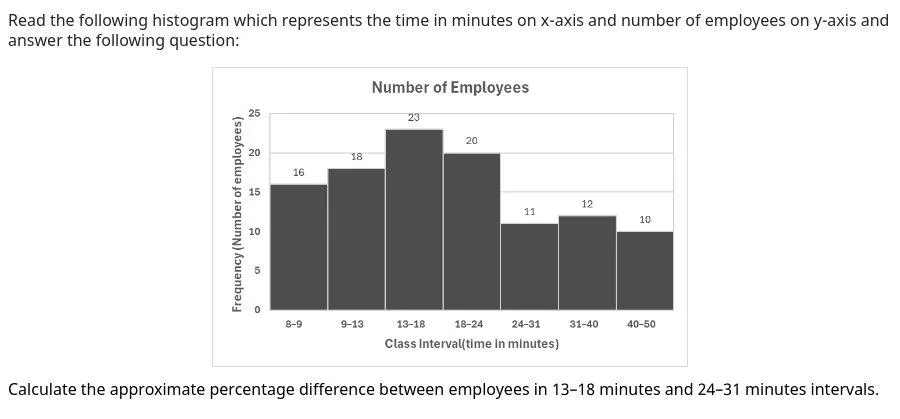
From the histogram, 13–18 has 23 employees and 24–31 has 11 employees. Total employees $=16+18+23+20+11+12+10=110$. Share of 13–18 $=\frac{23}{110}\approx 20.9\%$ and share of 24–31 $=\frac{11}{110}=10\%$. Difference $=\frac{12}{110}\approx 10.9\%\approx 11\%$. Option A is correct. Option A.
उत्तर: A
हिस्टोग्राम से 13–18 अंतराल में 23 और 24–31 अंतराल में 11 कर्मचारी हैं। कुल कर्मचारी $=16+18+23+20+11+12+10=110$ हैं। 13–18 का हिस्सा $=\frac{23}{110}\approx 20.9\%$ और 24–31 का हिस्सा $=\frac{11}{110}=10\%$ है। अंतर $=\frac{12}{110}\approx 10.9\%\approx 11\%$ है। सही उत्तर विकल्प A है। विकल्प A।
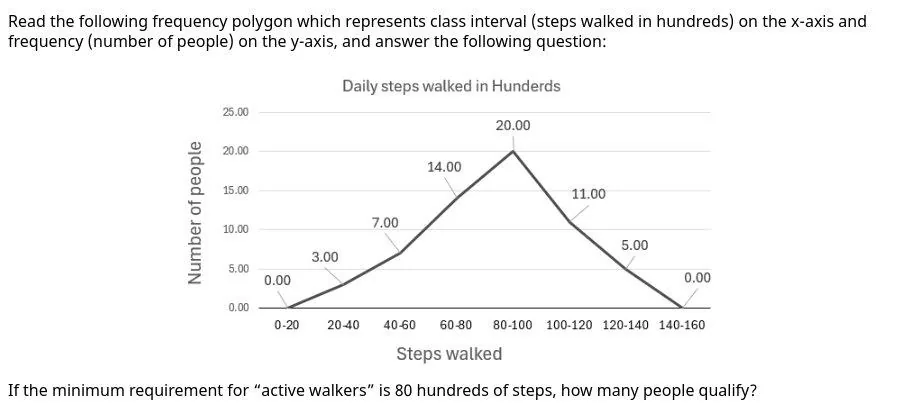
Frequencies from the polygon: 0-20: 0, 20-40: 3, 40-60: 7, 60-80: 14, 80-100: 20, 100-120: 11, 120-140: 5, 140-160: 0. Active walkers need at least 80 hundreds of steps, so the classes 80-100, 100-120, 120-140 and 140-160 qualify. Count $=20+11+5+0=36$. Option B is correct. Option B.
उत्तर: B
बहुभुज से आवृत्तियाँ: 80-100 में 20, 100-120 में 11, 120-140 में 5 और 140-160 में 0 लोग हैं। अतः योग $=20+11+5+0=36$ है। सही उत्तर विकल्प B है। विकल्प B।
Two congruent circles, each of radius 4 cm, intersect in such a way that the centre of each circle lies on the circumference of the other. Find the length of their common chord.
Answer: D
Let the centres be $O_1$ and $O_2$. Since each centre lies on the other circle, $O_1O_2=4$ cm. The common chord is perpendicular to $O_1O_2$ and is bisected by it. Half chord $=\sqrt{4^{2}-2^{2}}=\sqrt{12}=2\sqrt{3}$ cm. So the full common chord is $4\sqrt{3}$ cm. Option D is correct. Option D.
4 cm त्रिज्या वाले दो सर्वांगसम वृत्त एक-दूसरे को इस प्रकार प्रतिच्छेद करते हैं कि प्रत्येक वृत्त का केंद्र दूसरे वृत्त की परिधि पर स्थित है। उनकी उभयनिष्ठ जीवा की लंबाई ज्ञात कीजिए।
उत्तर: D
माना केंद्र $O_1$ और $O_2$ हैं। चूँकि प्रत्येक केंद्र दूसरे वृत्त की परिधि पर है, $O_1O_2=4$ cm है। उभयनिष्ठ जीवा $O_1O_2$ पर लंबवत है और उसे समद्विभाजित करती है। अर्ध-जीवा $=\sqrt{4^{2}-2^{2}}=2\sqrt{3}$ cm है। अतः पूरी उभयनिष्ठ जीवा $4\sqrt{3}$ cm है। सही उत्तर विकल्प D है। विकल्प D।
A mango juice is made by mixing water and mango concentrate in the ratio 9:7. If x liters of water and 3x liters of mango concentrate is mixed in 160 liters of mango juice, then the new ratio becomes 13:14. What is the quantity of the new mango juice (in liters)?
Answer: D
In 160 litres of juice with water : concentrate $=9:7$, water $=90$ L and concentrate $=70$ L. After adding $x$ L water and $3x$ L concentrate, $\frac{90+x}{70+3x}=\frac{13}{14}$, so $1260+14x=910+39x$, giving $x=14$. New juice $=160+x+3x=160+56=216$ litres. Check: water $104$, concentrate $112$, ratio $13:14$. Option D is correct. Option D.
एक आम का जूस पानी और आम के सांद्र को 9:7 के अनुपात में मिलाकर बनाया जाता है। यदि 160 लीटर आम के जूस में x लीटर पानी और 3x लीटर आम का सांद्र मिलाया जाता है, तो नया अनुपात 13:14 हो जाता है। नए आम के जूस की मात्रा (लीटर में) क्या है?
उत्तर: D
160 लीटर जूस में पानी : सांद्र $=9:7$ है, अतः पानी $=90$ लीटर और सांद्र $=70$ लीटर है। $x$ लीटर पानी और $3x$ लीटर सांद्र मिलाने पर $\frac{90+x}{70+3x}=\frac{13}{14}$ होता है, अतः $x=14$ मिलता है। नए जूस की मात्रा $=160+x+3x=160+56=216$ लीटर है। सही उत्तर विकल्प D है। विकल्प D।
Two right circular cylinders have equal volumes, and the ratio of their heights is 16: 25. What is the ratio of their radii?
Answer: B
Equal volumes: $\pi r_1^{2}h_1=\pi r_2^{2}h_2$, so $\frac{r_1^{2}}{r_2^{2}}=\frac{h_2}{h_1}=\frac{25}{16}$. Hence $\frac{r_1}{r_2}=\frac{5}{4}$. Option B is correct. Option B.
दो लंब वृत्तीय बेलनों के आयतन समान हैं, और उनकी ऊँचाइयों का अनुपात 16: 25 है। उनकी त्रिज्याओं का अनुपात क्या है?
उत्तर: B
समान आयतन के लिए $\pi r_1^{2}h_1=\pi r_2^{2}h_2$, अतः $\frac{r_1^{2}}{r_2^{2}}=\frac{h_2}{h_1}=\frac{25}{16}$। इसलिए $\frac{r_1}{r_2}=\frac{5}{4}$ है। सही उत्तर विकल्प B है। विकल्प B।
In triangle ABC, points D and E lie on AB and AC, respectively, such that $AD\times AC=AB\times AE$. If $\angle ADE=\angle ACB+20^{\circ}$ and $\angle ABC=70^{\circ}$, find $\angle A$.
Answer: D
From $AD\times AC=AB\times AE$, we get $\frac{AD}{AB}=\frac{AE}{AC}$. With the common angle A, triangle ADE is similar to triangle ABC (SAS), with D corresponding to B and E to C. So $\angle ADE=\angle ABC=70^{\circ}$. Then $\angle ACB+20^{\circ}=70^{\circ}$, so $\angle ACB=50^{\circ}$. Thus $\angle A=180^{\circ}-70^{\circ}-50^{\circ}=60^{\circ}$. Option D is correct. Option D.
त्रिभुज ABC में, बिंदु D और E क्रमश: AB तथा AC पर स्थित हैं, इस प्रकार कि $AD\times AC=AB\times AE$ है। यदि $\angle ADE=\angle ACB+20^{\circ}$ तथा $\angle ABC=70^{\circ}$ है, तो $\angle A$ का मान ज्ञात कीजिए।
उत्तर: D
$AD\times AC=AB\times AE$ से $\frac{AD}{AB}=\frac{AE}{AC}$ मिलता है। उभयनिष्ठ कोण A के कारण त्रिभुज ADE, त्रिभुज ABC के समरूप है (D का संगत B, और E का संगत C है)। अतः $\angle ADE=\angle ABC=70^{\circ}$। तब $\angle ACB+20^{\circ}=70^{\circ}$, यानी $\angle ACB=50^{\circ}$। इसलिए $\angle A=180^{\circ}-70^{\circ}-50^{\circ}=60^{\circ}$ है। सही उत्तर विकल्प D है। विकल्प D।
During a festive sale, a shop advertises a scheme: "Buy 11 items while paying only for 8." Calculate the percentage discount offered in this deal.
Answer: B
The customer pays for 8 items and gets 11, so the free items are $11-8=3$. Discount $=\frac{3}{11}\times 100\approx 27.27\%$. Option B is correct. Option B.
एक उत्सव बिक्री के दौरान, एक दुकान एक योजना का विज्ञापन करती है: “8 वस्तुओं का भुगतान करें और 11 वस्तुएँ प्राप्त करें।” इस योजना में दी गई छूट का प्रतिशत ज्ञात कीजिए।
उत्तर: B
ग्राहक 8 वस्तुओं का भुगतान करता है और 11 वस्तुएँ पाता है, अतः मुफ़्त वस्तुएँ $11-8=3$ हैं। छूट $=\frac{3}{11}\times 100\approx 27.27\%$ है। सही उत्तर विकल्प B है। विकल्प B।
From the pie chart, Equity is 40% and Gold is 15%, so together they are 55% of the portfolio. If the total is $T$, then $0.55\,T\ge 2{,}20{,}000$, so $T\ge \frac{2{,}20{,}000\times 100}{55}=₹4{,}00{,}000$. Option A is correct. Option A.
उत्तर: A
पाई चार्ट से इक्विटी 40% और गोल्ड 15% है, अतः दोनों मिलकर पोर्टफोलियो का 55% हैं। यदि कुल मान $T$ है, तो $0.55\,T\ge 2{,}20{,}000$ है, इसलिए $T\ge \frac{2{,}20{,}000\times 100}{55}=₹4{,}00{,}000$। सही उत्तर विकल्प A है। विकल्प A।
If $x+\frac{1}{x}=23$, then find the value of $x^{2}+\frac{1}{x^{2}}+x+\frac{1}{x}$.
Answer: C
$\left(x+\frac{1}{x}\right)^{2}=x^{2}+\frac{1}{x^{2}}+2$, so $x^{2}+\frac{1}{x^{2}}=23^{2}-2=527$. Adding $x+\frac{1}{x}=23$ gives $527+23=550$. Option C is correct. Option C.
यदि $x+\frac{1}{x}=23$ है, तो $x^{2}+\frac{1}{x^{2}}+x+\frac{1}{x}$ का मान ज्ञात कीजिए।
उत्तर: C
$\left(x+\frac{1}{x}\right)^{2}=x^{2}+\frac{1}{x^{2}}+2$ है, अतः $x^{2}+\frac{1}{x^{2}}=23^{2}-2=527$। $x+\frac{1}{x}=23$ जोड़ने पर $527+23=550$ मिलता है। सही उत्तर विकल्प C है। विकल्प C।
An airplane flies along the four sides of a square field at speeds of 200 km/h, 400 km/h, 600 km/h, and 800 km/h respectively. What is the average speed of the plane around the entire perimeter?
Answer: A
Let each side be $d$, so the total distance is $4d$. Total time $=\frac{d}{200}+\frac{d}{400}+\frac{d}{600}+\frac{d}{800}=\frac{d(12+6+4+3)}{2400}=\frac{25d}{2400}$. Average speed $=\frac{4d}{25d/2400}=384$ km/h. This is the harmonic mean of the four speeds. Option A is correct. Option A.
एक हवाई जहाज एक चौकोर (वर्गाकार) मैदान की चारों भुजाओं पर क्रमश: 200 किमी/घंटा, 400 किमी/घंटा, 600 किमी/घंटा और 800 किमी/घंटा की गति से उड़ता है। पूरे परिमाप के चारों ओर हवाई जहाज़ की औसत गति क्या है?
उत्तर: A
प्रत्येक भुजा $d$ मानें, अतः कुल दूरी $4d$ है। कुल समय $=\frac{d}{200}+\frac{d}{400}+\frac{d}{600}+\frac{d}{800}=\frac{25d}{2400}$ है। औसत गति $=\frac{4d}{25d/2400}=384$ किमी/घंटा। सही उत्तर विकल्प A है। विकल्प A।
Node A: 40, 55, 30, 65. Node B: 35, 60, 45, 50. A node-instance fails if its speed is not strictly greater than 45. Failures: Node A 40 and 30; Node B 35 and 45 (45 is not strictly greater than 45). Total $=4$. Option C is correct. Option C.
उत्तर: C
नोड ए: 40, 55, 30, 65। नोड बी: 35, 60, 45, 50। जिस नोड-इंस्टेंस की गति 45 से निरंतर अधिक नहीं है, वह विफल है। विफल: नोड ए में 40 और 30; नोड बी में 35 और 45 (45, 45 से अधिक नहीं है)। कुल $=4$। सही उत्तर विकल्प C है। विकल्प C।