CGL 2026 Tier 1EzSSC Practice
Learn › Shift-wise papers

23 Oct 2026 10:00 AM (Shift-1)

SSC CGL Tier 1 2026 · 100 questions · read with answers, or take it as a timed mock.

Tap an option to check your answer, or use “Show answer”. Switch to Hindi with the हिं button at the top.अंग्रेज़ी के लिए ऊपर EN बटन दबाएँ।
Q1Figure Seriesmoderate
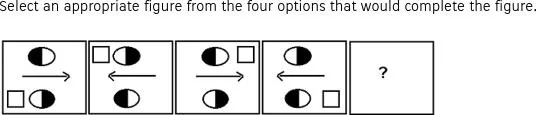
figure
Answer: C
Three things change in each step. The arrow alternates →, ←, →, ← so the fifth arrow is →. The shading of the two circles alternates (top left-black/bottom right-black, then the reverse), so the fifth figure has the top circle left-black and the bottom circle right-black. The small square moves one corner clockwise (bottom-left, top-left, top-right, bottom-right), so it returns to bottom-left. Only option C has all three. Option C.
figure
उत्तर: C
हर चरण में तीन परिवर्तन होते हैं। तीर क्रमशः →, ←, →, ← है, अतः पाँचवीं आकृति में तीर → होगा। दोनों वृत्तों की छायांकन बारी-बारी से बदलती है, अतः पाँचवीं आकृति में ऊपर का वृत्त बायाँ काला और नीचे का वृत्त दायाँ काला होगा। छोटा वर्ग दक्षिणावर्त एक कोने से आगे बढ़ता है (नीचे-बाएँ, ऊपर-बाएँ, ऊपर-दाएँ, नीचे-दाएँ), अतः वह पुनः नीचे-बाएँ आएगा। केवल विकल्प C में तीनों बातें हैं। विकल्प C।
🔗 Link
Q2Angle between Handseasy
What will be the angle formed between the hour hand and minute hand of a clock at 1:24 pm, when taken in a clockwise direction from the hour hand?
Answer: C
At 1:24 the hour hand is at $30\times1+0.5\times24=42^{\circ}$ and the minute hand at $6\times24=144^{\circ}$ from 12. Going clockwise from the hour hand to the minute hand: $144-42=102^{\circ}$. Option C.
दोपहर 1:24 बजे एक घड़ी में घंटे की सुई से दक्षिणावर्त दिशा में घुमाने पर घंटे की सुई और मिनट की सुई के बीच कितना कोण बनेगा?
उत्तर: C
1:24 पर घंटे की सुई 12 से $30\times1+0.5\times24=42^{\circ}$ पर और मिनट की सुई $6\times24=144^{\circ}$ पर है। घंटे की सुई से दक्षिणावर्त मिनट की सुई तक: $144-42=102^{\circ}$। विकल्प C।
🔗 Link
Q3Mirror Imageeasy
figure
Answer: C
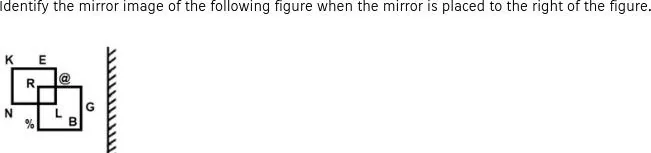
With the mirror on the right, every character must be laterally reversed and the layout flipped left-right. Option A shows K unreversed, option B shows @ unreversed and option D has lost the letter L. Only option C shows all characters (K, E, @, R, L, B, G, N, %) correctly reversed in the flipped layout. Option C.
figure
उत्तर: C
दर्पण दाईं ओर होने पर प्रत्येक अक्षर/चिह्न बाएँ-दाएँ उलट जाता है और पूरी आकृति भी बाएँ-दाएँ पलट जाती है। विकल्प A में K उलटा नहीं है, विकल्प B में @ उलटा नहीं है और विकल्प D में L अक्षर नहीं है। केवल विकल्प C में सभी अक्षर (K, E, @, R, L, B, G, N, %) सही रूप से उलटे हैं। विकल्प C।
🔗 Link
Q4Two Setseasy
In a group of 90 students, 40 take French, 30 take German, and 10 take both. How many students take only one language?
Answer: A
Only French $=40-10=30$; only German $=30-10=20$. Only one language $=30+20=50$. Option A.
90 छात्रों के एक समूह में, 40 छात्र फ्रेंच, 30 छात्र जर्मन और 10 छात्र दोनों भाषाएँ लेते हैं। कितने छात्र केवल एक भाषा लेते हैं?
उत्तर: A
केवल फ्रेंच $=40-10=30$; केवल जर्मन $=30-10=20$। केवल एक भाषा $=30+20=50$। विकल्प A।
🔗 Link
Q5Three Setseasy
In a group of students, 18 play Cricket, 24 play Basketball, and 15 play Volleyball. 9 play both Cricket and Basketball, 7 play both Cricket and Volleyball, and 6 play both Basketball and Volleyball. 3 students play all three. How many play both Cricket and Basketball but not Volleyball?
Answer: A
Cricket and Basketball $=9$, of whom 3 also play Volleyball. So $9-3=6$ play Cricket and Basketball but not Volleyball. Option A.
छात्रों के एक समूह में, 18 क्रिकेट खेलते हैं, 24 बास्केटबॉल खेलते हैं, और 15 वॉलीबॉल खेलते हैं। 9 क्रिकेट और बास्केटबॉल दोनों खेलते हैं, 7 क्रिकेट और वॉलीबॉल दोनों खेलते हैं, और 6 बास्केटबॉल और वॉलीबॉल दोनों खेलते हैं। 3 छात्र तीनों खेलते हैं। कितने छात्र क्रिकेट और बास्केटबॉल दोनों खेलते हैं लेकिन वॉलीबॉल नहीं खेलते?
उत्तर: A
क्रिकेट और बास्केटबॉल $=9$, जिनमें से 3 वॉलीबॉल भी खेलते हैं। अतः $9-3=6$। विकल्प A।
🔗 Link
Q6Embedded Figureseasy
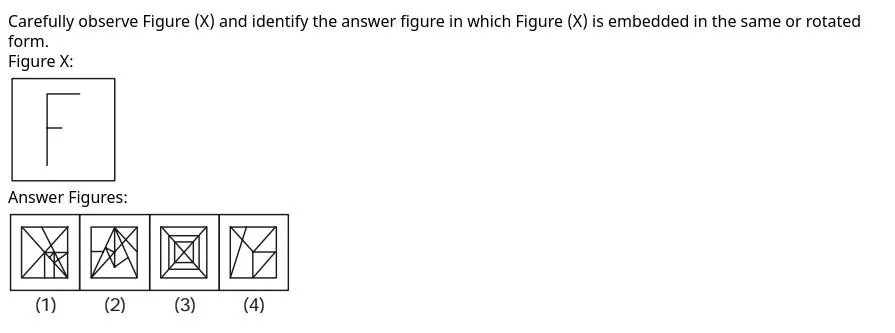
figure
Answer: D
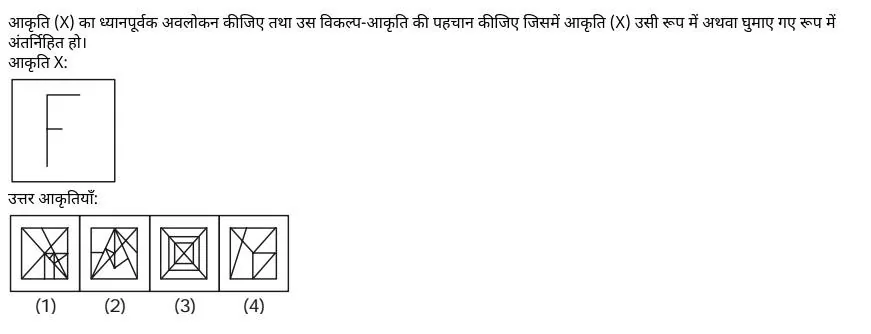
The given figure is a zigzag made of slanting lines (/\/). Option D, a square with both diagonals and lines joining the midpoints of the sides, contains these slanting segments in the same orientation, so the figure is embedded in it. Option D.
figure
उत्तर: D
दी गई आकृति तिरछी रेखाओं से बनी टेढ़ी-मेढ़ी (/\/) आकृति है। विकल्प D, जिसमें दोनों विकर्ण और भुजाओं के मध्य-बिंदुओं को जोड़ने वाली रेखाएँ हैं, इन तिरछे खंडों को उसी दिशा में रखता है, अतः आकृति उसमें अंतर्निहित है। विकल्प D।
🔗 Link
Q7Algebraic Identitieseasy
What will be the value of m³ + n³+ p³, if m + n + p = 0?
Answer: B
$m^{3}+n^{3}+p^{3}-3mnp=(m+n+p)(m^{2}+n^{2}+p^{2}-mn-np-pm)$. With $m+n+p=0$ the right side is 0, so $m^{3}+n^{3}+p^{3}=3mnp$. Option B.
m³ + n³+ p³ का मान क्या होगा, अगर m + n + p = 0 हो?
उत्तर: B
$m^{3}+n^{3}+p^{3}-3mnp=(m+n+p)(m^{2}+n^{2}+p^{2}-mn-np-pm)$। $m+n+p=0$ होने पर दायाँ पक्ष 0 है, अतः $m^{3}+n^{3}+p^{3}=3mnp$। विकल्प B।
🔗 Link
Q8Weakening an Argumentmoderate
A university noticed that students participating in international exchange programs achieved higher research output than other students. The university concluded that exchange programs directly improve academic productivity.

Which of the following, if true, would most weaken the university’s conclusion?
Answer: B
If the participants were already top-ranked students, their higher research output may come from their own ability rather than from the exchange programme. This offers an alternative cause and most weakens the conclusion. Options A and C, if anything, support it, and D is irrelevant. Option B.
एक विश्वविद्यालय ने देखा कि अंतरराष्ट्रीय विनिमय कार्यक्रमों में भाग लेने वाले विद्यार्थियों का शोध-उत्पादन अन्य विद्यार्थियों की तुलना में अधिक था। विश्वविद्यालय ने निष्कर्ष निकाला कि विनिमय कार्यक्रम सीधे तौर पर शैक्षणिक उत्पादकता में सुधार करते हैं।

निम्नलिखित में से कौन-सा कथन, यदि सत्य हो, तो विश्वविद्यालय के निष्कर्ष को सबसे अधिक कमजोर करेगा?
उत्तर: B
यदि प्रतिभागी पहले से ही उच्च रैंक वाले विद्यार्थी थे, तो उनका अधिक शोध-उत्पादन कार्यक्रम के बजाय उनकी अपनी क्षमता के कारण हो सकता है। यह एक वैकल्पिक कारण देता है और निष्कर्ष को सबसे अधिक कमज़ोर करता है। A और C बल्कि निष्कर्ष का समर्थन करते हैं, और D अप्रासंगिक है। विकल्प B।
🔗 Link
Q9Position Interchangeeasy
In a row of boys, Arjun is 9th from the left, and Ravi is 15th from the right. If they interchange their positions, Arjun becomes 20th from the left. How many boys are there in the row?
Answer: D
After the swap Arjun takes Ravi's place, so Ravi's position is 20th from the left and 15th from the right. Total $=20+15-1=34$. Option D.
लड़कों की एक पंक्ति में, अर्जुन बाएँ से 9वें स्थान पर है और रवि दाएँ से 15वें स्थान पर है। यदि वे अपने स्थान आपस में बदल लेते हैं, तो अर्जुन बाएँ से 20वें स्थान पर हो जाता है। पंक्ति में कुल कितने लड़के हैं?
उत्तर: D
अदला-बदली के बाद अर्जुन रवि के स्थान पर है, अतः वह स्थान बाएँ से 20वाँ और दाएँ से 15वाँ है। कुल $=20+15-1=34$। विकल्प D।
🔗 Link
Q10Mixed Serieseasy
Complete the following series.

5, 1, 35, 4, 315, 9, 3465, 16, ?
Answer: C
Two series alternate. Odd places: 5, 35, 315, 3465 (×7, ×9, ×11), so the next is $3465\times13=45045$. Even places: 1, 4, 9, 16 (squares). Option C.
निम्नलिखित श्रृंखला को पूर्ण कीजिए।

5, 1, 35, 4, 315, 9, 3465, 16, ?
उत्तर: C
दो श्रृंखलाएँ बारी-बारी से हैं। विषम स्थान: 5, 35, 315, 3465 (×7, ×9, ×11), अतः अगला $3465\times13=45045$। सम स्थान: 1, 4, 9, 16 (वर्ग)। विकल्प C।
🔗 Link
Q11Pattern Completionmoderate
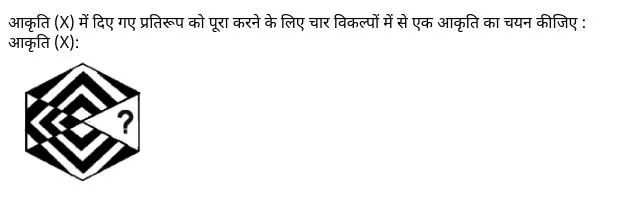
figure
Answer: C
This is a figure-based question. The official key is the figure in the option given below; the figure details in the source image are too small to state the rule reliably here, so compare the option figures with the question figure. Option C.
figure
उत्तर: C
यह आकृति-आधारित प्रश्न है। आधिकारिक उत्तर नीचे दिया गया विकल्प है; स्रोत चित्र में विवरण बहुत छोटे हैं, अतः नियम विश्वसनीय रूप से नहीं लिखा जा सका—विकल्प आकृतियों की प्रश्न आकृति से तुलना करें। विकल्प C।
🔗 Link
Q12Interchanging Numberseasy
Which two numbers should be interchanged to make the given equation correct?
12 ÷ 2 × 4 + 8 − 6 = 14
Answer: D
Swap 2 and 6: $12\div6\times4+8-2=2\times4+8-2=8+8-2=14$. Checks of the others: 4↔6 gives 40, 2↔4 gives 8, 6↔8 gives 22. Option D.
निम्नलिखित समीकरण को सही बनाने के लिए किन दो संख्याओं को आपस में बदलना चाहिए?
12 ÷ 2 × 4 + 8 − 6 = 14
उत्तर: D
2 और 6 बदलें: $12\div6\times4+8-2=8+8-2=14$। अन्य: 4↔6 से 40, 2↔4 से 8, 6↔8 से 22। विकल्प D।
🔗 Link
Q13Mirror Image of Characterseasy
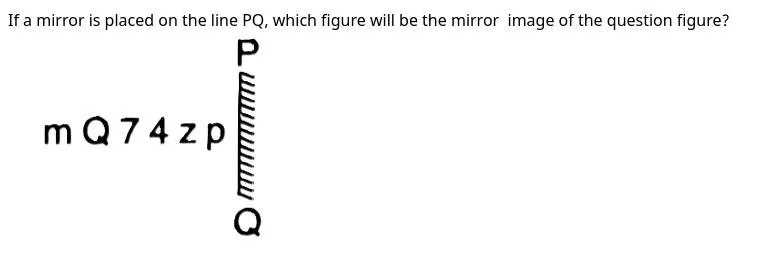
figure
Answer: D
The mirror PQ is on the right, so the order of characters reverses (p z 4 7 Q m) and each character is flipped left-to-right: p becomes q, z is reversed, 4, 7 and Q are reversed, and m stays an m facing the other way. Only option D shows every character correctly flipped. Option D.
figure
उत्तर: D
दर्पण PQ दाईं ओर है, अतः अक्षरों का क्रम उलट जाता है (p z 4 7 Q m) और प्रत्येक अक्षर बाएँ-दाएँ पलटता है: p, q बन जाता है, z, 4, 7 और Q उलटे होते हैं, और m उलटी दिशा में रहता है। केवल विकल्प D में सभी अक्षर सही पलटे हैं। विकल्प D।
🔗 Link
Q14Related Rows/Columns in a Tableeasy
figure
Answer: C
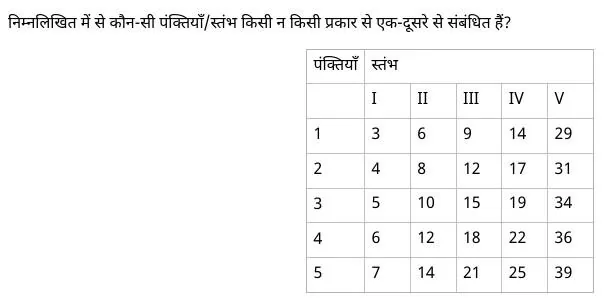
In every row Column II is twice Column I (6, 8, 10, 12, 14) and Column III is three times Column I (9, 12, 15, 18, 21). Columns IV and V do not follow this link. Columns I, II and III are related,. Option C.
figure
उत्तर: C
हर पंक्ति में स्तंभ II, स्तंभ I का दोगुना (6, 8, 10, 12, 14) और स्तंभ III, स्तंभ I का तिगुना (9, 12, 15, 18, 21) है। स्तंभ IV और V इस संबंध में नहीं हैं। स्तंभ I, II और III संबंधित हैं,। विकल्प C।
🔗 Link
Q15Interpreting Body Languageeasy
In behavioral psychology, which practice represents the most significant methodological error when interpreting an individual's non-verbal communication and body language?
Answer: A
A single gesture (crossed arms, say) can mean different things in different situations, so reading isolated gestures without context is the main error. Options B, C and D describe good practice. Option A.
व्यवहारिक मनोविज्ञान में, किसी व्यक्ति के गैर-मौखिक संचार एवं शारीरिक भाषा की व्याख्या करते समय सबसे बड़ी पद्धतिगत त्रुटि कौन-सी है?
उत्तर: A
एक ही संकेत (जैसे बाँहें मोड़ना) अलग-अलग परिस्थितियों में अलग अर्थ रख सकता है, अतः संदर्भ के बिना अलग-थलग संकेतों की व्याख्या मुख्य त्रुटि है। B, C और D अच्छी पद्धति बताते हैं। विकल्प A।
🔗 Link
Q16Odd Figure Outeasy
figure
Answer: C
Figures A, B and D are each made of four equal squares, while figure C is made of five squares. So C is the odd one out. Option C.
figure
उत्तर: C
आकृतियाँ A, B और D प्रत्येक चार समान वर्गों से बनी हैं, जबकि आकृति C पाँच वर्गों से बनी है। अतः C असंगत है। विकल्प C।
🔗 Link
Q17Odd Figure Outeasy
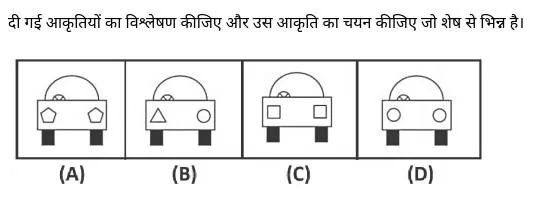
figure
Answer: B
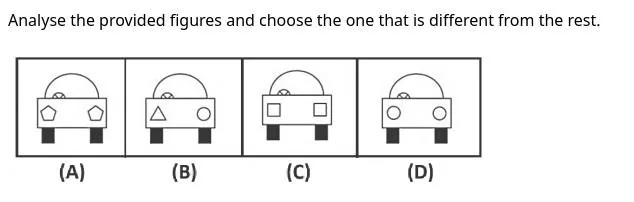
In figures A, C and D both 'headlights' of the car are the same shape (two pentagons, two squares, two circles). In figure B they are different (a triangle and a circle). So B is the odd one out. Option B.
figure
उत्तर: B
आकृतियों A, C और D में कार की दोनों 'हेडलाइट' एक ही आकार की हैं (दो पंचभुज, दो वर्ग, दो वृत्त)। आकृति B में वे अलग हैं (त्रिभुज और वृत्त)। अतः B असंगत है। विकल्प B।
🔗 Link
Q18Figure Analogymoderate
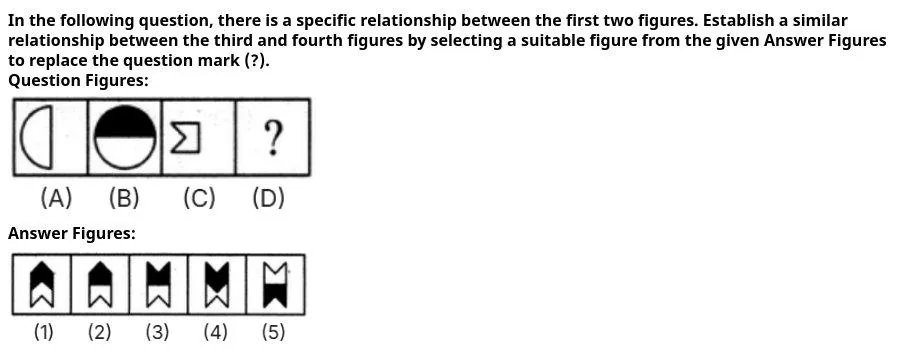
figure
Answer: B
From (A) to (B) the half figure is joined with its mirror image to make a whole figure, turned through 90°, and the top half is shaded black. Doing the same to the Σ-shape gives a closed zigzag (M over W) figure with its top half black, which is answer figure 3. Option B.
figure
उत्तर: B
(A) से (B) में आधी आकृति को उसकी दर्पण छवि से जोड़कर पूर्ण आकृति बनाई जाती है, उसे 90° घुमाया जाता है और ऊपरी आधा भाग काला कर दिया जाता है। Σ-आकृति पर यही करने से ऊपर काले आधे भाग वाली बंद ज़िगज़ैग (M के ऊपर W) आकृति मिलती है, जो उत्तर आकृति 3 है। विकल्प B।
🔗 Link
Q19Figure Analogymoderate
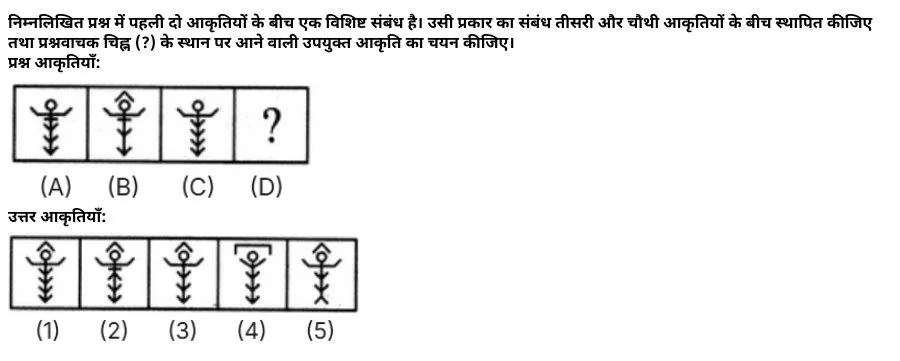
figure
Answer: A
This is a figure-based question. The official key is the figure in the option given below; the figure details in the source image are too small to state the rule reliably here, so compare the option figures with the question figure. Option A.
figure
उत्तर: A
यह आकृति-आधारित प्रश्न है। आधिकारिक उत्तर नीचे दिया गया विकल्प है; स्रोत चित्र में विवरण बहुत छोटे हैं, अतः नियम विश्वसनीय रूप से नहीं लिखा जा सका—विकल्प आकृतियों की प्रश्न आकृति से तुलना करें। विकल्प A।
🔗 Link
Q20Embedded Figureseasy
figure
Answer: A
This is a figure-based question. The official key is the figure in the option given below; the figure details in the source image are too small to state the rule reliably here, so compare the option figures with the question figure. Option A.
figure
उत्तर: A
यह आकृति-आधारित प्रश्न है। आधिकारिक उत्तर नीचे दिया गया विकल्प है; स्रोत चित्र में विवरण बहुत छोटे हैं, अतः नियम विश्वसनीय रूप से नहीं लिखा जा सका—विकल्प आकृतियों की प्रश्न आकृति से तुलना करें। विकल्प A।
🔗 Link
Q21Symbol Rotationeasy
figure
Answer: C
Each step moves the first symbol to the end: Δ X = → X = Δ → = Δ X. Moving '=' to the end gives Δ X =, so the series returns to the first figure. Option C.
figure
उत्तर: C
हर चरण में पहला चिह्न अंत में चला जाता है: Δ X = → X = Δ → = Δ X। '=' को अंत में ले जाने पर Δ X = मिलता है, अर्थात श्रृंखला पहली आकृति पर लौट आती है। विकल्प C।
🔗 Link
Q22Rule-Based Decisioneasy
Read the given situation carefully and consider all the relevant facts, conditions and constraints. Choose the option that represents the most appropriate, practical and logical decision based solely on the information provided.

A logistics firm promotes delivery supervisors if they have completed 2 years of service, have zero active customer complaints and have an attendance rate above 95%. Nitin has worked with the firm for 3 years, has an attendance rate of 97%, but has 1 active customer complaint registered against him last month.

What decision should be taken?
Answer: A
Nitin meets the service (3 years) and attendance (97%) conditions but fails the 'zero active complaints' condition because one complaint is active. There is no exception, so he should not be promoted. Option A.
दिए गए परिस्थिति को ध्यानपूर्वक पढ़ें और सभी महत्वपूर्ण तथ्यों, शर्तों और सीमाओं पर विचार करें। केवल दी गई जानकारी के आधार पर सबसे उचित, व्यावहारिक और तार्किक निर्णय को दर्शाने वाले विकल्प का चयन करें।

एक रसद फर्म डिलीवरी पर्यवेक्षकों को पदोन्नत करती है यदि उन्होंने 2 साल की सेवा पूरी कर ली है, शून्य सक्रिय ग्राहक शिकायतें हैं और उपस्थिति दर 95% से अधिक है। नितिन ने फर्म के साथ 3 साल तक काम किया है, उनकी उपस्थिति दर 97% है, लेकिन पिछले महीने उनके खिलाफ 1 सक्रिय ग्राहक शिकायत दर्ज की गई है।

क्या निर्णय लिया जाना चाहिए?
उत्तर: A
नितिन सेवा (3 वर्ष) और उपस्थिति (97%) की शर्तें पूरी करते हैं, पर एक सक्रिय शिकायत होने से 'शून्य सक्रिय शिकायत' की शर्त पूरी नहीं होती। कोई अपवाद नहीं है, अतः पदोन्नति नहीं होगी। विकल्प A।
🔗 Link
Q23Degree Serieseasy
Find the missing term (?) in the following series.

Warm → Hot → Scorching → ?
Answer: A
The words show increasing heat: warm, hot, scorching. The next step up is 'burning'. Mild, tepid and cool go in the opposite direction. Option A.
श्रृंखला में लुप्त पद (?) ज्ञात कीजिए।

गर्म → बहुत गर्म → झुलसा देने वाला / अत्यधिक गर्म → ?
उत्तर: A
शब्द बढ़ती गर्मी दर्शाते हैं: गर्म, बहुत गर्म, झुलसा देने वाला। अगला चरण 'जलता हुआ' है। हल्का, गुनगुना और ठंडा उलटी दिशा में हैं। विकल्प A।
🔗 Link
Q24Word Analogyeasy
Which pair shares the SAME type of relationship as COMPOSER : SYMPHONY?
Answer: A
A composer creates a symphony; likewise an author creates a novel (creator : work created). A microphone and canvas are tools or materials, and a kitchen is a workplace. Option A.
कौन-सा युग्म 'संगीतकार : संगीत रचना' के समान संबंध साझा करता है?
उत्तर: A
संगीतकार संगीत रचना बनाता है; इसी प्रकार लेखक उपन्यास बनाता है (रचयिता : रचना)। माइक्रोफ़ोन और कैनवास उपकरण/सामग्री हैं, और रसोईघर कार्यस्थल है। विकल्प A।
🔗 Link
Q25Cube from a Netmoderate
figure
Answer: B
In the net the middle row is 1 dot, 4 dots, 5 dots, 2 dots, with 3 dots above the 4-dot face and 6 dots below the 5-dot face. Opposite pairs are 1–5, 4–2 and 3–6. Option A shows 3 and 6 together, C shows 1 and 5 together, and D shows 4 and 2 together, so all three are impossible. Only option B (3, 4 and 1 together) can be correct. Option B.
figure
उत्तर: B
जाल की मध्य पंक्ति में 1, 4, 5, 2 बिंदु हैं; 4 बिंदु वाले फलक के ऊपर 3 और 5 बिंदु वाले फलक के नीचे 6 बिंदु हैं। विपरीत युग्म 1–5, 4–2 और 3–6 हैं। विकल्प A में 3 और 6, C में 1 और 5, तथा D में 4 और 2 साथ दिखते हैं, अतः ये असंभव हैं। केवल विकल्प B (3, 4 और 1 साथ) सही हो सकता है। विकल्प B।
🔗 Link