Which number should replace the question mark? : 1, 2, 6, 24, ?, 720
Answer: C
The terms are factorials: $1!=1$, $2!=2$, $3!=6$, $4!=24$, $5!=120$, $6!=720$. So the missing term is $120$, which is option C. Check: $24 \times 5 = 120$ and $120 \times 6 = 720$. Option C.
प्रश्नवाचक चिन्ह के स्थान पर कौन सी संख्या आएगी? : 1, 2, 6, 24, ?, 720
उत्तर: C
पद क्रमशः फैक्टोरियल हैं: $1!=1$, $2!=2$, $3!=6$, $4!=24$, $5!=120$, $6!=720$। अतः लुप्त पद $120$ है, जो विकल्प C है। जाँच: $24 \times 5 = 120$ और $120 \times 6 = 720$। विकल्प C।
In a certain code If CLEAR is coded as DMFBS, how is DMFBS coded?
Answer: A
In CLEAR → DMFBS each letter moves one place forward: C→D, L→M, E→F, A→B, R→S. Applying the same shift to DMFBS: D→E, M→N, F→G, B→C, S→T, giving ENGCT. The answer is option A. Option B, C and D do not follow the +1 shift. Option A.
एक निश्चित कोड में यदि CLEAR को DMFBS के रूप में कोडित किया जाता है, तो DMFBS को कैसे कोडित किया जाएगा?
उत्तर: A
CLEAR → DMFBS में हर अक्षर वर्णमाला में एक स्थान आगे है: C→D, L→M, E→F, A→B, R→S। यही शिफ्ट DMFBS पर लगाने पर: D→E, M→N, F→G, B→C, S→T, यानी ENGCT। अतः विकल्प A सही है। विकल्प B, C और D +1 शिफ्ट का पालन नहीं करते। विकल्प A।
In the sequence, what follows next: 2P, 5M, 10J, 17G, ?
Answer: C
Numbers 2, 5, 10, 17 have differences 3, 5, 7, so the next difference is 9 and the next number is 26. Letters P, M, J, G are at positions 16, 13, 10, 7, each going back 3 places, so the next letter is D (position 4). The answer is 26D, which is. Option C.
अनुक्रम में, आगे क्या आता है: 2P, 5M, 10J, 17G, ?
उत्तर: C
संख्याएँ 2, 5, 10, 17 हैं, जिनके अंतर 3, 5, 7 हैं; अगला अंतर 9 होगा, अतः अगली संख्या 26 है। अक्षर P, M, J, G की वर्णमाला-स्थिति 16, 13, 10, 7 है, यानी हर बार 3 स्थान पीछे; अतः अगला अक्षर D है। उत्तर 26D है, जो विकल्प C है। विकल्प C।
In a certain code language, "PLANNER" is written as "SFOOBMQ." How will "DRAWING" be written?
Answer: D
PLANNER reversed is RENNALP. Moving each letter one place forward gives S, F, O, O, B, M, Q, which is SFOOBMQ. Apply the same rule to DRAWING: reversed it is GNIWARD, and moving each letter one place forward gives HOJXBSE. Option D.
एक निश्चित कूट भाषा में, "PLANNER" को "SFOOBMQ" लिखा जाता है। उसी कूट भाषा में "DRAWING" को कैसे लिखा जाएगा?
उत्तर: D
PLANNER को उल्टा करने पर RENNALP बनता है, और हर अक्षर को एक स्थान आगे बढ़ाने पर SFOOBMQ मिलता है। यही नियम DRAWING पर लगाने पर: उल्टा GNIWARD, और एक स्थान आगे बढ़ाने पर HOJXBSE। अतः उत्तर विकल्प D है। विकल्प D।
Four options are given below, out of which three are similar in a certain way while one is different. Identify the option that is different from the others.
Answer: D
Fleet, Convoy and Armada are all collective nouns for groups of ships or vehicles (Armada is a large fleet of warships). Caravan is a collective noun for a group of travellers, usually people or animals such as camels travelling together over land. So option D, Caravan, is the different one. Option D.
चार शब्द दिए गए हैं, जिनमें से तीन किसी तरह से एक जैसे हैं और चौथा अलग है। अलग शब्द को चुनें।
उत्तर: D
Fleet, Convoy और Armada तीनों जहाजों या वाहनों के समूह के लिए प्रयुक्त समूहवाचक संज्ञाएँ हैं (Armada युद्धपोतों का बड़ा बेड़ा है)। Caravan यात्रियों, आमतौर पर लोगों या ऊँटों, के एक साथ भूमि पर यात्रा करते समूह को कहते हैं। अतः विकल्प D, Caravan, अलग है। विकल्प D।
A + B means A is the father of B. A = B means A is the wife of B. A × B means A is the brother of B. A ÷ B means A is the daughter of B. If P ÷ R + S + Q, which of the following is true?
Answer: C
P ÷ R: P is the daughter of R. R + S: R is the father of S. S + Q: S is the father of Q. So R is the grandfather of Q, and P (daughter of R) is the sister of S, which makes P the aunt of Q. Option C is true. Option A is false (P is not Q's daughter), option B is false (Q is the nephew of P), and option D is false (P is not Q's mother). Option C.
A + B का अर्थ है कि A, B का पिता है। A = B का अर्थ है कि A, B की पत्नी है। A × B का अर्थ है कि A, B का भाई है। A ÷ B का अर्थ है कि A, B की पुत्री है। यदि P ÷ R + S + Q है, तो निम्नलिखित में से कौन-सा कथन सत्य है?
उत्तर: C
P ÷ R: P, R की पुत्री है। R + S: R, S का पिता है। S + Q: S, Q का पिता है। अतः R, Q का दादा है और P (R की पुत्री) S की बहन है, इसलिए P, Q की फूफी है। विकल्प C सत्य है। विकल्प A गलत है (P, Q की पुत्री नहीं है), विकल्प B गलत है (Q, P का भतीजा है), और विकल्प D गलत है (P, Q की माँ नहीं है)। विकल्प C।
Study the pattern in the given series and find the next set of letters in the series. FIE, IHH, LGK, OFN, ?
Answer: A
Take each position separately. First letters: F, I, L, O move +3 each, so the next is R. Second letters: I, H, G, F move -1 each, so the next is E. Third letters: E, H, K, N move +3 each, so the next is Q. The answer is REQ, which is. Option A.
दी गई श्रेणी में प्रतिरूप का अध्ययन कीजिए और श्रेणी में अक्षरों का अगला समूह ज्ञात कीजिए। FIE, IHH, LGK, OFN, ?
उत्तर: A
हर स्थान को अलग-अलग देखें। पहले अक्षर: F, I, L, O में हर बार +3, अतः अगला R है। दूसरे अक्षर: I, H, G, F में हर बार -1, अतः अगला E है। तीसरे अक्षर: E, H, K, N में हर बार +3, अतः अगला Q है। उत्तर REQ है, जो विकल्प A है। विकल्प A।
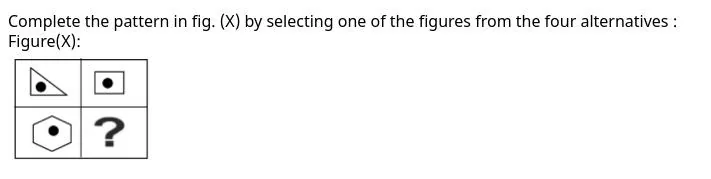
Read the 2x2 grid clockwise from the top-left cell. The polygon gains one side each step: triangle (3 sides, top-left), rectangle (4 sides, top-right), pentagon (5 sides, bottom-right), hexagon (6 sides, bottom-left). Every figure has a dot inside, so the missing bottom-right figure is a pentagon with a dot inside a rectangle. The answer is option A, which is figure 1. Option A.
उत्तर: A
2x2 ग्रिड में ऊपर-बाईं कोठरी से घड़ी की दिशा में पढ़ें। हर चरण में बहुभुज की भुजा एक बढ़ती है: त्रिभुज (3 भुजा, ऊपर-बायाँ), आयत (4 भुजा, ऊपर-दायाँ), पंचभुज (5 भुजा, नीचे-दायाँ), षट्भुज (6 भुजा, नीचे-बायाँ)। हर आकृति के अंदर बिंदु है, अतः लुप्त नीचे-दायीं आकृति बिंदु वाले पंचभुज के आयत के अंदर है। उत्तर विकल्प A है, जो आकृति 1 है। विकल्प A।
Arrange the following according to the stages of construction.
1. Painting
2. Designing
3. Foundation
4. Roofing
Answer: A
The stages of construction in order are: Designing (2) first, then Foundation (3), then Roofing (4), and finally Painting (1). So the order is 2, 3, 4, 1, which is. Option A.
निम्नलिखित को निर्माण के चरणों के अनुसार सही क्रम में व्यवस्थित कीजिए।
1. Painting (पेंटिंग / रंगाई)
2. Designing (डिज़ाइन तैयार करना)
3. Foundation (नींव डालना)
4. Roofing (छत बनाना)
उत्तर: A
निर्माण के चरणों का क्रम है: पहले Designing (2), फिर Foundation (3), फिर Roofing (4), और अंत में Painting (1)। अतः क्रम 2, 3, 4, 1 है, जो विकल्प A है। विकल्प A।
Which of the following centre code does not maintain the pattern of "one letter followed by three digits"?
Answer: C
The required pattern is one letter first, then three digits. A123, B456 and D012 all follow it. In 789C the letter comes at the end after three digits, so it breaks the pattern. Option C.
इनमें से कौन-सा सेंटर कोड "एक अक्षर और उसके बाद तीन अंक" वाले पैटर्न का पालन नहीं करता है?
उत्तर: C
आवश्यक पैटर्न है: पहले एक अक्षर, फिर तीन अंक। A123, B456 और D012 इसका पालन करते हैं। 789C में अक्षर तीन अंकों के बाद अंत में है, इसलिए यह पैटर्न तोड़ता है। अतः उत्तर विकल्प C है। विकल्प C।
In the following question, a matrix of numbers is given. These numbers follow a certain pattern either row-wise or column-wise. Identify this pattern and choose the missing number accordingly.
7 9 21 27
4 2 36 18
9 4 54 ?
Answer: B
In each row, the third entry is the first entry times a factor, and the fourth entry is the second entry times the same factor. Row 1: 7 x 3 = 21 and 9 x 3 = 27. Row 2: 4 x 9 = 36 and 2 x 9 = 18. Row 3: 9 x 6 = 54, so the factor is 6 and the missing entry is 4 x 6 = 24. Option B.
नीचे दिए गए प्रश्न में संख्याओं का एक मैट्रिक्स दिया गया है। ये संख्याएँ पंक्ति या स्तंभ के अनुसार किसी विशेष पैटर्न का पालन करती हैं। इस पैटर्न की पहचान कीजिए और उसके अनुसार लुप्त संख्या का चयन कीजिए।
7 9 21 27
4 2 36 18
9 4 54 ?
उत्तर: B
हर पंक्ति में तीसरी संख्या पहली संख्या का एक गुणक है, और चौथी संख्या दूसरी संख्या का उसी गुणक से गुणा है। पंक्ति 1: 7 x 3 = 21 और 9 x 3 = 27। पंक्ति 2: 4 x 9 = 36 और 2 x 9 = 18। पंक्ति 3: 9 x 6 = 54, अतः गुणक 6 है और लुप्त संख्या 4 x 6 = 24 है। उत्तर विकल्प B है। विकल्प B।
Read the statement carefully and assume it to be true. Then examine the two conclusions given below it and decide which conclusion(s), if any, logically follow from the statement.
Statement:
A public library has introduced a new service that allows members to check out tablets and e-readers in addition to traditional books.
Conclusions:
I. The library considers digital learning resources to be useful for its members.
II. The library has decided to discontinue lending printed books.
Answer: A
The statement says the library added tablets and e-readers in addition to traditional books, so conclusion I (the library values digital resources) follows. Conclusion II is wrong because the statement says the new service sits alongside printed books; it does not say lending of printed books has stopped. Option A.
कथन को ध्यानपूर्वक पढ़िए और उसे सत्य मानिए। फिर उसके नीचे दिए गए दो निष्कर्षों की जाँच कीजिए तथा निर्धारित कीजिए कि कौन-सा/कौन-से निष्कर्ष, यदि कोई हो, कथन से तार्किक रूप से अनुसरण करते हैं।
कथन:
एक सार्वजनिक पुस्तकालय ने एक नई सेवा प्रारम्भ की है, जिसके अंतर्गत सदस्य पारंपरिक पुस्तकों के अतिरिक्त टैबलेट और ई-रीडर भी उधार ले सकते हैं।
निष्कर्ष:
I. पुस्तकालय का मानना है कि डिजिटल शिक्षण संसाधन उसके सदस्यों के लिए उपयोगी हैं।
II. पुस्तकालय ने मुद्रित पुस्तकों को उधार देने की सेवा बंद करने का निर्णय लिया है।
उत्तर: A
कथन के अनुसार पुस्तकालय ने पारंपरिक पुस्तकों के अतिरिक्त टैबलेट और ई-रीडर उधार देने की सेवा शुरू की है, इसलिए निष्कर्ष I (डिजिटल संसाधन उपयोगी मानना) अनुसरण करता है। निष्कर्ष II गलत है, क्योंकि कथन के अनुसार नई सेवा मुद्रित पुस्तकों के साथ है, उनका उधार बंद होना नहीं कहा गया है। अतः उत्तर विकल्प A है। विकल्प A।
Read the statement carefully and assume it to be true. Then examine the two conclusions given below it and decide which conclusion(s), if any, logically follow from the statement.
Statement:
England have received a boost with Jofra Archer back in the squad after serving his suspension for the final Test. He was unavailable for the second Test due to a breach of COVID-19 protocols, but his absence did not harm England’s performance as much as had been anticipated.
Conclusions:
I. Archer was suspended for applying saliva to the ball in violation of new playing rules introduced by the COVID-19 pandemic.
II. England was able to secure a favourable result in the second test match.
Answer: B
The statement says Archer missed the second Test for a breach of COVID-19 protocols, without saying what the breach was, so I (applying saliva) does not follow. It says his absence did not harm England's performance as much as feared, which supports that England got a favourable result in that Test (II follows). Only II follows. Option B.
कथन को ध्यानपूर्वक पढ़िए और उसे सत्य मानिए। फिर उसके नीचे दिए गए दो निष्कर्षों की जाँच कीजिए तथा निर्धारित कीजिए कि कौन-सा/कौन-से निष्कर्ष, यदि कोई हो, कथन से तार्किक रूप से अनुसरण करते हैं।
कथन:
जोफ्रा आर्चर को अंतिम टेस्ट के लिए निलंबन अवधि पूरी करने के बाद पुनः टीम में शामिल किए जाने से इंग्लैंड को मजबूती मिली है। वह कोविड-19 प्रोटोकॉल के उल्लंघन के कारण दूसरे टेस्ट में उपलब्ध नहीं थे, लेकिन उनकी अनुपस्थिति से इंग्लैंड के प्रदर्शन को उतना नुकसान नहीं हुआ, जितनी आशंका व्यक्त की गई थी।
निष्कर्ष:
I. आर्चर को कोविड-19 महामारी के दौरान लागू किए गए नए खेल नियमों का उल्लंघन करते हुए गेंद पर लार लगाने के कारण निलंबित किया गया था।
II. इंग्लैंड दूसरे टेस्ट मैच में अनुकूल परिणाम प्राप्त करने में सफल रहा।
उत्तर: B
कथन बताता है कि आर्चर कोविड-19 प्रोटोकॉल उल्लंघन के कारण दूसरा टेस्ट नहीं खेले, पर उल्लंघन क्या था यह नहीं बताता, अतः I (गेंद पर लार) अनुसरण नहीं करता। उनकी अनुपस्थिति से इंग्लैंड के प्रदर्शन को अपेक्षा जितनी हानि नहीं हुई, अतः II अनुसरण करता है। विकल्प B।
In the following question, one statement is given, followed by certain inferences. Consider the statement to be true even if it seems to contradict commonly known facts. Read the inferences carefully and decide which of them logically follow from the given statement.
Statement:
The municipal corporation has warned that citizens caught wasting water by washing cars or driveways with hosepipes during the peak summer months will face a heavy penalty of ₹5,000.
Inferences:
I. The city is likely facing a water scarcity or supply crunch during the summer.
II. Imposing a fine of ₹5,000 will completely stop the wastage of water in the city.
Answer: D
A heavy penalty for wasting water in peak summer suggests the city faces a water shortage, so inference I follows. Inference II claims the fine will completely stop wastage, which the statement does not say; a warning and fine may reduce wastage but not guarantee it stops completely. Option D.
निम्नलिखित प्रश्न में एक कथन दिया गया है, जिसके बाद कुछ निष्कर्ष दिए गए हैं। कथन को सत्य मानिए, भले ही वह सामान्यतः ज्ञात तथ्यों के विपरीत प्रतीत होता हो। निष्कर्षों को ध्यानपूर्वक पढ़िए और निर्णय कीजिए कि उनमें से कौन-सा/कौन-से निष्कर्ष दिए गए कथन से तार्किक रूप से अनुसरण करते हैं।
कथन:
नगर निगम ने चेतावनी दी है कि ग्रीष्म ऋतु के चरम महीनों के दौरान कारों या ड्राइववे को पाइप (होसपाइप) से धोकर पानी की बर्बादी करते हुए पकड़े गए नागरिकों पर ₹5,000 का भारी जुर्माना लगाया जाएगा।
निष्कर्ष:
I. ग्रीष्म ऋतु के दौरान नगर में जल-संकट या जलापूर्ति की कमी होने की संभावना है।
II. ₹5,000 का जुर्माना लगाने से नगर में पानी की बर्बादी पूर्णतः रुक जाएगी।
उत्तर: D
ग्रीष्म के चरम महीनों में पानी की बर्बादी पर भारी जुर्माने से संकेत मिलता है कि नगर में जल-संकट है, अतः निष्कर्ष I अनुसरण करता है। निष्कर्ष II कहता है कि जुर्माने से बर्बादी पूर्णतः रुक जाएगी, जो कथन में नहीं है; जुर्माना बर्बादी कम कर सकता है, पर पूर्ण रोक की गारंटी नहीं। अतः उत्तर विकल्प D है। विकल्प D।
A multinational corporation has identified excessive paper usage as a significant contributor to operational cost and environmental waste. The management has decided to implement a long-term sustainability strategy aimed at minimizing dependence on physical documents while maintaining efficiency and accessibility of records.
Which of the following policies would most effectively help the organization achieve this objective?
Answer: C
The goal is to reduce dependence on paper while keeping records efficient and accessible. Option C, a digital documentation system for storing, sharing and managing records, does exactly this. Options A and D increase printing, and option B increases paper purchases, so they work against the goal. Option C.
एक बहुराष्ट्रीय कंपनी ने पाया है कि कार्यालय में कागज़ का अत्यधिक उपयोग परिचालन लागत बढ़ाने के साथ-साथ पर्यावरणीय अपशिष्ट का प्रमुख कारण है। इसलिए प्रबंधन ने एक दीर्घकालिक सतत् रणनीति अपनाने का निर्णय लिया है, जिसका उद्देश्य कार्यकुशलता एवं अभिलेखों की सुगमता बनाए रखते हुए भौतिक दस्तावेज़ों पर निर्भरता कम करना है।
निम्नलिखित में से कौन-सी नीति इस उद्देश्य की प्राप्ति में सर्वाधिक प्रभावी होगी?
उत्तर: C
लक्ष्य है कागज़ पर निर्भरता घटाना और अभिलेखों की कार्यकुशलता व सुगमता बनाए रखना। विकल्प C, यानी अभिलेखों के संग्रहण, साझा करने और प्रबंधन की डिजिटल प्रणाली, ठीक यही करता है। विकल्प A और D छपाई बढ़ाते हैं, और विकल्प B कागज़ की खरीद बढ़ाता है, अतः ये लक्ष्य के विरुद्ध हैं। उत्तर विकल्प C है। विकल्प C।
In the following question, three statements are given, followed by two conclusions. Consider the statements to be true even if they differ from commonly known facts. Read the conclusions carefully and decide which of the conclusions logically follow from the given statements.
Statements:
Only a few files are folders.
Some folders are documents.
No document is a book.
Conclusions:
I. All files can be folders is a possibility.
II. All folders can be files is a possibility.
Answer: B
Statement 1 says only a few files are folders, so not all files can be folders; conclusion I, a possibility of all files being folders, contradicts it and does not follow. Conclusion II is possible: since folders are the set of things that can be files in this reading, all folders can be files without contradicting the statements. Option B.
निम्नलिखित प्रश्न में तीन कथन दिए गए हैं, जिनके बाद दो निष्कर्ष दिए गए हैं। कथनों को सत्य मानिए, भले ही वे सामान्यतः ज्ञात तथ्यों से भिन्न हों। निष्कर्षों को ध्यानपूर्वक पढ़िए और यह निर्णय कीजिए कि दिए गए कथनों से कौन-सा/कौन-से निष्कर्ष तार्किक रूप से अनुसरण करता/करते हैं।
कथन:
केवल कुछ फ़ाइलें फ़ोल्डर हैं।
कुछ फ़ोल्डर दस्तावेज़ हैं।
कोई भी दस्तावेज़ पुस्तक नहीं है।
निष्कर्ष:
I. सभी फ़ाइलें फ़ोल्डर हो सकती हैं यह एक संभावना है।
II. सभी फ़ोल्डर फ़ाइलें हो सकते हैं यह एक संभावना है।
उत्तर: B
पहला कथन कहता है कि केवल कुछ फ़ाइलें फ़ोल्डर हैं, अतः सभी फ़ाइलों का फ़ोल्डर होना कथन के विरुद्ध है; निष्कर्ष I अनुसरण नहीं करता। निष्कर्ष II संभव है, क्योंकि सभी फ़ोल्डरों का फ़ाइल होना कथनों का खंडन नहीं करता। अतः उत्तर विकल्प B है। विकल्प B।
A table is a piece of furniture, so the Table circle lies inside the Furniture circle. A transistor is an electronic component, not furniture, so the Transistor circle is separate. The diagram with one circle nested inside a larger circle and a separate circle beside it is figure 2, which is. Option B.
उत्तर: B
मेज़ एक प्रकार का फर्नीचर है, अतः Table का वृत्त Furniture के वृत्त के अंदर होगा। ट्रांज़िस्टर फर्नीचर नहीं है, इसलिए उसका वृत्त अलग होगा। एक वृत्त के दूसरे बड़े वृत्त के अंदर और एक अलग वृत्त वाला आरेख आकृति 2 है, जो विकल्प B है। विकल्प B।
To address the significant decline in foot traffic at the downtown shopping district, the local chamber of commerce has proposed pedestrianizing the area to encourage leisure walking. Which assumption underlies this proposal?
Answer: A
The proposal is meant to bring back shoppers by encouraging walking. For that to work, pedestrian-only zones must lead visitors to spend more, which is option A. Option B is a claim about the single biggest cause, option C is about business capability, and option D is a predicted result. None of these has to be true for the proposal to make sense. Option A.
डाउनटाउन के शॉपिंग क्षेत्र में पैदल आने वाले लोगों की संख्या में आई उल्लेखनीय कमी को दूर करने के लिए, स्थानीय वाणिज्य मंडल (चैंबर ऑफ़ कॉमर्स) ने लोगों को अवकाश के समय पैदल घूमने के लिए प्रोत्साहित करने हेतु उस क्षेत्र को केवल पैदल चलने वालों के लिए आरक्षित (पैदल क्षेत्र) बनाने का प्रस्ताव रखा है। इस प्रस्ताव के आधार पर कौन-सी मान्यता निहित है?
उत्तर: A
प्रस्ताव का उद्देश्य पैदल चलने को बढ़ावा देकर खरीदारों को वापस लाना है। इसके काम करने के लिए ज़रूरी है कि पैदल क्षेत्र आगंतुकों को अधिक खरीदारी के लिए प्रेरित करें, जो विकल्प A है। विकल्प B एक कारण के बारे में दावा है, C व्यवसायों की क्षमता के बारे में है, और D एक अनुमानित परिणाम है; प्रस्ताव के लिए ये आवश्यक नहीं हैं। विकल्प A।
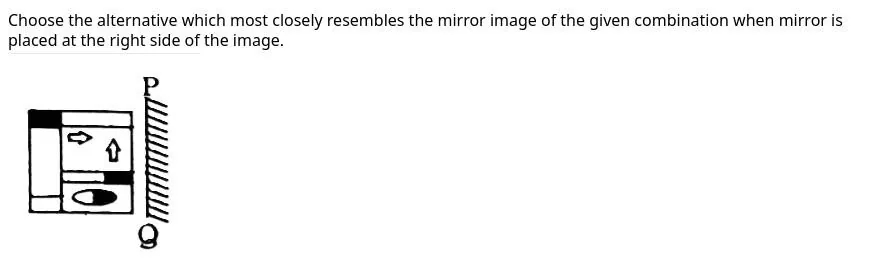
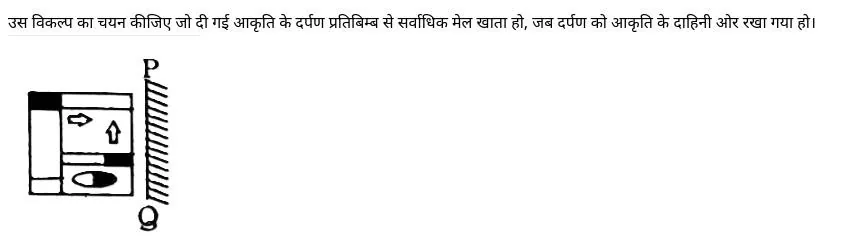
A mirror on the right reverses the figure left to right. The up arrow stays up, the right-pointing arrow becomes a left-pointing one, and the black block at the top-left moves to the top-right. Option 1 still shows a right-pointing arrow, so it is out. Options 2 and 3 both match the arrows and top-right block; option 2 is chosen for the oval shading. This choice is low confidence because the shading of the oval is hard to read at this resolution. Option B.
उत्तर: B
दाहिनी ओर के दर्पण से आकृति बाएँ-दाएँ उलट जाती है: ऊपर वाला तीर ऊपर रहता है, दाएँ तीर का बायाँ तीर हो जाता है, और ऊपर-बाएँ का काला भाग ऊपर-दाएँ आ जाता है। विकल्प 1 में अब भी दायाँ तीर है, इसलिए वह गलत है। विकल्प 2 और 3 तीर व ऊपर-दाएँ काले भाग से मेल खाते हैं; अंडाकार की छाया के आधार पर विकल्प 2 चुना गया है। यह उत्तर कम विश्वसनीय है। विकल्प B।
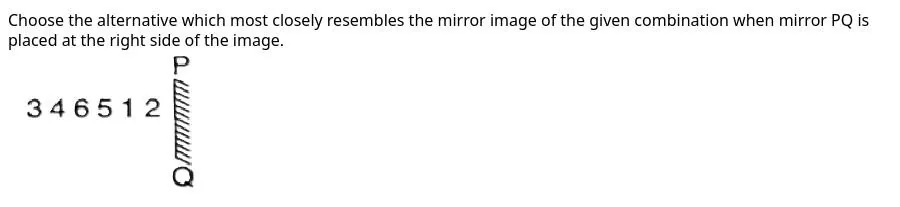
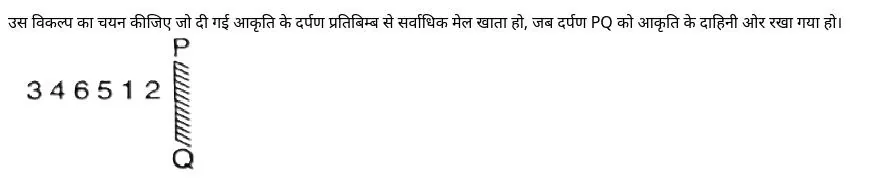
With the mirror on the right, the string 3 4 6 5 1 2 is read in reverse order (2 1 5 6 4 3) and each digit is reflected left to right, not turned upside down. Option 1 shows a 9-like glyph where a mirrored 6 is needed, so it is out. Options 2, 3 and 4 look alike at this resolution; option 2 is chosen as the one that matches the reflected glyphs. Low confidence. Option B.
उत्तर: B
दाहिनी ओर के दर्पण पर 3 4 6 5 1 2 को उल्टे क्रम (2 1 5 6 4 3) में पढ़ा जाता है और हर अंक को बाएँ-दाएँ परावर्तित किया जाता है, उल्टा नहीं। विकल्प 1 में 6 की जगह 9 जैसा आकार है, इसलिए वह गलत है। विकल्प 2, 3 और 4 इस रिज़ॉल्यूशन पर लगभग एक जैसे दिखते हैं; परावर्तित आकारों से मेल के आधार पर विकल्प 2 चुना गया है। विश्वसनीयता कम है। विकल्प B।
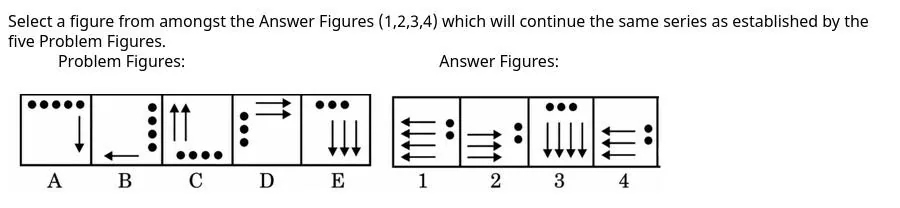
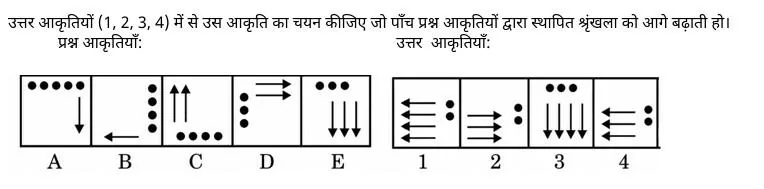
Count the dots and arrows in each problem figure. A has 5 dots and 1 arrow, B has 4 dots and 1 arrow, C has 4 dots and 2 arrows, D has 3 dots and 2 arrows, and E has 3 dots and 3 arrows. The dots fall 5, 4, 4, 3, 3 and the arrows rise 1, 1, 2, 2, 3, so the next figure should have 2 dots and 3 arrows. Option 4 (3 left arrows and 2 dots) fits. Low confidence because the count-based rule is inferred from five figures. Option D.
उत्तर: D
हर प्रश्न आकृति में बिंदु और तीर गिनें। A में 5 बिंदु और 1 तीर, B में 4 बिंदु और 1 तीर, C में 4 बिंदु और 2 तीर, D में 3 बिंदु और 2 तीर, तथा E में 3 बिंदु और 3 तीर हैं। बिंदु 5, 4, 4, 3, 3 और तीर 1, 1, 2, 2, 3 क्रम में हैं, अतः अगली आकृति में 2 बिंदु और 3 तीर होने चाहिए। विकल्प 4 (3 बाएँ तीर और 2 बिंदु) इससे मेल खाता है। नियम पाँच आकृतियों से अनुमानित है, इसलिए विश्वसनीयता कम है। विकल्प D।