Tap an option to check your answer, or use “Show answer”. Switch to Hindi with the हिं button at the top.अंग्रेज़ी के लिए ऊपर EN बटन दबाएँ।
Q1Figure Matrixhard
Answer: D
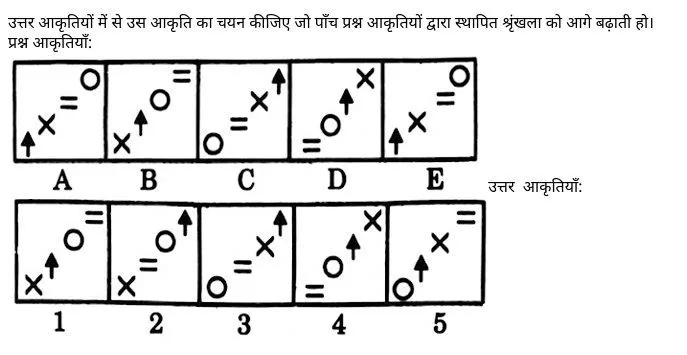
This is a figure-based question. The official key is the figure in the option given below; the figure details in the source image are too small to state the rule reliably here, so compare the option figures with the question figure. Option D.
उत्तर: D
यह आकृति-आधारित प्रश्न है। आधिकारिक उत्तर नीचे दिया गया विकल्प है; स्रोत चित्र में विवरण बहुत छोटे हैं, अतः नियम विश्वसनीय रूप से नहीं लिखा जा सका—विकल्प आकृतियों की प्रश्न आकृति से तुलना करें। विकल्प D।
Two numbers are in the ratio 3:4. If their LCM is 240, find the numbers.
Answer: C
Let the numbers be $3k$ and $4k$. Since 3 and 4 are co-prime, their LCM is $12k$. So $12k=240$, which gives $k=20$ and the numbers are $60$ and $80$. Check: LCM(60, 80) = 240. Option A (90, 120) has LCM 360, option B (45, 60) has LCM 180 and option D (30, 40) has LCM 120, so all three are wrong. Option C.
दो संख्याएँ 3:4 के अनुपात में हैं। अगर उनका लघुत्तम समापवर्त्य 240 है, तो संख्याएँ ज्ञात कीजिए।
उत्तर: C
मान लीजिए संख्याएँ $3k$ और $4k$ हैं। चूँकि 3 और 4 सह-अभाज्य हैं, इनका लघुत्तम समापवर्त्य $12k$ होता है। $12k=240$ से $k=20$ मिलता है, अतः संख्याएँ 60 और 80 हैं। जाँच: LCM(60, 80) = 240। विकल्प A (90, 120) का LCM 360, B (45, 60) का 180 और D (30, 40) का 120 है, इसलिए सही विकल्प C है। विकल्प C।
The rule is $n^{3}-8$. Check: $6^{3}=216$ and $216-8=208$. Applying the same rule to 5: $5^{3}-8=125-8=117$. So the missing number is 117, which is option C. Options A (120), B (125) and D (110) do not follow the rule; B is just $5^{3}$ without subtracting 8. Option C.
लुप्त संख्या ज्ञात कीजिए: 6 : 208 :: 5 : ?
उत्तर: C
इस संबंध का नियम $n^{3}-8$ है। जाँच: $6^{3}=216$ और $216-8=208$। इसी नियम को 5 पर लगाने पर $5^{3}-8=125-8=117$ मिलता है। अतः लुप्त संख्या 117 है, जो विकल्प C है। विकल्प C।
This is a figure-based question. The official key is the figure in the option given below; the figure details in the source image are too small to state the rule reliably here, so compare the option figures with the question figure. Option D.
उत्तर: D
यह आकृति-आधारित प्रश्न है। आधिकारिक उत्तर नीचे दिया गया विकल्प है; स्रोत चित्र में विवरण बहुत छोटे हैं, अतः नियम विश्वसनीय रूप से नहीं लिखा जा सका—विकल्प आकृतियों की प्रश्न आकृति से तुलना करें। विकल्प D।
If 'A' means '+', 'B' means '−', and 'C' means ‘×’
what is the value of the following expression?
5 A 3 C 2=?
Answer: A
Replace the symbols: $5+3\times2$. By BODMAS, multiplication comes before addition, so $3\times2=6$ and then $5+6=11$. Option B (16) comes from evaluating left to right, $(5+3)\times2$, which is not the standard convention. Option A is the answer. Option A.
यदि 'A' का अर्थ '+', 'B' का अर्थ '−' और 'C' का अर्थ '×' है, तो निम्नलिखित व्यंजक का मान क्या है?
5 A 3 C 2=?
उत्तर: A
संकेतों को बदलने पर व्यंजक $5+3\times2$ बनता है। BODMAS नियम के अनुसार पहले गुणा होता है: $3\times2=6$, फिर $5+6=11$। अतः सही उत्तर विकल्प A (11) है। विकल्प B (16) बाएँ से दाएँ $(5+3)\times2$ हल करने से आता है, जो मानक नियम नहीं है। विकल्प A।
In a survey, 25 people like Tea, 20 like Coffee, and 10 like both. How many like only Tea?
Answer: A
Total who like Tea = 25, of whom 10 also like Coffee. Those who like only Tea = $25-10=15$. Option A (15) is correct. Option B (10) is the number who like both, and options C (13) and D (12) do not follow from the data. Option A.
एक सर्वेक्षण में, 25 लोगों को चाय पसंद है, 20 को कॉफ़ी पसंद है, और 10 को दोनों पसंद हैं। कितने लोगों को केवल चाय पसंद है?
उत्तर: A
चाय पसंद करने वालों की कुल संख्या 25 है, जिनमें से 10 लोग चाय और कॉफ़ी दोनों पसंद करते हैं। केवल चाय पसंद करने वाले = $25-10=15$। अतः सही विकल्प A (15) है। विकल्प B (10) दोनों पसंद करने वालों की संख्या है। विकल्प A।
If JOURNAL is coded as KPVSOBM, how is KPVSOBM coded?
Answer: A
Each letter of JOURNAL moves one step forward: J to K, O to P, U to V, R to S, N to O, A to B, L to M, giving KPVSOBM. The same one-step forward shift applied to KPVSOBM gives LQWTPCN, which is option A. Option B has U in place of T, option C ends in O instead of N, and option D ends in M instead of N. Option A.
यदि JOURNAL को KPVSOBM के रूप में कोडित किया जाता है, तो KPVSOBM को किस प्रकार कोडित किया जाएगा?
उत्तर: A
JOURNAL के हर अक्षर को एक स्थान आगे बढ़ाने पर KPVSOBM बनता है। उसी नियम से KPVSOBM का कूट LQWTPCN होगा, जो विकल्प A है। विकल्प B में चौथा अक्षर U है, C का अंतिम अक्षर O है और D का अंतिम अक्षर M है, इसलिए वे गलत हैं। विकल्प A।
The terms are consecutive perfect squares: $11^{2}=121$, $12^{2}=144$, $13^{2}=169$, $14^{2}=196$, $15^{2}=225$. The next term is $16^{2}=256$, which is option B. Option D (289) is $17^{2}$, the square after 256, so it is a distractor. Option B.
श्रृंखला में अगली संख्या क्या है?
121, 144, 169, 196, 225, ?
उत्तर: B
ये संख्याएँ क्रमिक वर्ग संख्याएँ हैं: $11^{2}=121$, $12^{2}=144$, $13^{2}=169$, $14^{2}=196$, $15^{2}=225$। अगली संख्या $16^{2}=256$ है, जो विकल्प B है। विकल्प D (289) $17^{2}$ है, जो 256 के बाद आती है। विकल्प B।
In a certain code language, "WRITING" is written as "HOJUJSX." How will "READERS" be written?
Answer: C
Reverse WRITING to get GNITIRW, then move each letter one step forward to get HOJUJSX. For READERS, reverse to SREDAER and move each letter one step forward: TSFEBFS. This is option C. Options A, B and D each differ from TSFEBFS in one or two letters. Option C.
एक निश्चित कूट भाषा में, “WRITING” को “HOJUJSX” लिखा जाता है। उसी कूट भाषा में “READERS” को कैसे लिखा जाएगा?
उत्तर: C
WRITING को उलटने पर GNITIRW बनता है, और हर अक्षर को एक आगे बढ़ाने पर HOJUJSX मिलता है। उसी नियम से READERS को उलटकर SREDAER लिखें और हर अक्षर एक आगे बढ़ाएँ: TSFEBFS। अतः सही उत्तर विकल्प C है। विकल्प C।
In this following question, four words have been given, out of which three are alike in some manner and the fourth one is different. Choose odd one out.
Answer: D
Lok Sabha, Rajya Sabha and Legislative Assembly are all legislative bodies that make laws. Supreme Court is a judicial body that interprets law and is not a legislature. So the odd one out is Supreme Court,. Option D.
इस सवाल में चार शब्द दिए गए हैं, जिनमें से तीन किसी न किसी तरह से एक जैसे हैं और चौथा अलग है। अलग शब्द को चुनें।
उत्तर: D
Lok Sabha, Rajya Sabha और Legislative Assembly सभी विधायी संस्थाएँ हैं, जो कानून बनाती हैं। Supreme Court न्यायपालिका की संस्था है, विधायिका की नहीं। अतः अलग शब्द Supreme Court है, जो विकल्प D है। विकल्प D।
If $A + B$ means A is the brother of B, $A \div B$ means A is the father of B, and $A \times B$ means A is the sister of B — which of the following means M is the uncle of P?
Answer: C
$M+N$ means M is the brother of N, and $N \div P$ means N is the father of P. So M is the brother of P's father, which makes M the uncle of P. Option A makes P the brother of M, so there is no uncle link. Option B makes S the grandfather of P, so M is only a great-uncle. Option D links M to K and T to P, with no father relation. Option C.
यदि $A + B$ का अर्थ है कि A, B का भाई है, $A \div B$ का अर्थ है कि A, B का पिता है, और $A \times B$ का अर्थ है कि A, B की बहन है — तो निम्नलिखित में से कौन-सा यह दर्शाता है कि M, P का अंकल/चाचा/मामा/मौसा/फूफा है?
उत्तर: C
$M+N$ का अर्थ है कि M, N का भाई है, और $N\div P$ का अर्थ है कि N, P का पिता है। अतः M, P के पिता का भाई है, यानी M, P का चाचा/ताऊ/मामा जैसा अंकल है। विकल्प A में P, M का भाई बनता है। विकल्प B में M, P के दादा का भाई बनता है, यानी ग्रेट-अंकल। विकल्प D में पिता वाला संबंध नहीं बनता। अतः सही उत्तर विकल्प C है। विकल्प C।
Study the pattern in the given series and find the next set of letters in the series.
HNA, FOY, DPW, ?
Answer: A
Look at each position in the three groups. First letters: H, F, D, so B (each step back by 2). Second letters: N, O, P, so Q (each step forward by 1). Third letters: A, Y, W, so U (each step back by 2, wrapping from A to Y). The next group is BQU, option A. Option B breaks the second-letter pattern (P instead of Q), and options C and D break the third-letter pattern. Option A.
दी गई श्रेणी में प्रतिरूप का अध्ययन कीजिए और श्रेणी में अक्षरों का अगला समूह ज्ञात कीजिए।
HNA, FOY, DPW, ?
उत्तर: A
हर स्थान पर अक्षरों का पैटर्न देखिए। पहले अक्षर H, F, D हैं, इसलिए अगला B (हर बार 2 पीछे)। दूसरे अक्षर N, O, P हैं, इसलिए अगला Q (हर बार 1 आगे)। तीसरे अक्षर A, Y, W हैं, इसलिए अगला U (हर बार 2 पीछे, A से Y की ओर चक्रीय)। अतः अगला समूह BQU है, जो विकल्प A है। विकल्प A।
From the letters of the word ‘BLACKBOARD’, identify which of the given options cannot be formed, using each letter only as many times as it appears in the original word.
Answer: D
BLACKBOARD has one C, one L, one K, one O, two A, two B, one R and one D. CLOCK needs two C's (C-L-O-C-K), but the word has only one C, so it cannot be formed. BACKLOAD (two A's, one each of B, C, K, L, O, D), ABROAD and BLOCK all fit the available letters. Option D.
शब्द ‘BLACKBOARD’ के अक्षरों से, प्रत्येक अक्षर का उतनी ही बार उपयोग करते हुए जितनी बार वह मूल शब्द में दिया गया है, निम्नलिखित विकल्पों में से कौन-सा शब्द नहीं बनाया जा सकता, वह पहचानिए।
उत्तर: D
BLACKBOARD में C केवल एक बार है, जबकि CLOCK में C दो बार आता है (C-L-O-C-K)। इसलिए CLOCK नहीं बनाया जा सकता, अतः सही उत्तर विकल्प D है। BACKLOAD, ABROAD और BLOCK शब्द मूल शब्द के अक्षरों से बन सकते हैं। विकल्प D।
Which centre code does not follow the pattern of "three digits in ascending order"?
Answer: C
The rule is that the three digits in the code increase from left to right. 123, 456 and 234 each satisfy this, but in 785 the digits go 7, 8 (rising) and then 5 (falling), so the code breaks the rule. The answer is option C (785C). Option C.
कौन-सा सेंटर कोड "बढ़ते क्रम में तीन अंक" वाले पैटर्न का पालन नहीं करता है?
उत्तर: C
नियम यह है कि कोड के तीनों अंक बाएँ से दाएँ बढ़ते क्रम में हों। 123, 456 और 234 यह नियम पूरा करते हैं, लेकिन 785 में 7, 8 के बाद 5 आता है, जो बढ़ते क्रम में नहीं है। अतः सही उत्तर विकल्प C (785C) है। विकल्प C।
In the following question, a matrix of numbers is given. These numbers follow a certain pattern either row-wise or column-wise. Identify this pattern and choose the missing number accordingly.
5 8 20 32
3 6 21 42
7 2 35 ?
Answer: D
In each row the third and fourth entries are the first and second entries multiplied by the same factor. Row 1: $5\times4=20$ and $8\times4=32$. Row 2: $3\times7=21$ and $6\times7=42$. Row 3: $7\times5=35$, so the factor is 5 and the missing number is $2\times5=10$. Option D (10) is the answer. Options A, B and C do not fit this pattern. Option D.
नीचे दिए गए प्रश्न में संख्याओं का एक मैट्रिक्स दिया गया है। ये संख्याएँ पंक्ति या स्तंभ के अनुसार किसी विशेष पैटर्न का पालन करती हैं। इस पैटर्न की पहचान कीजिए और उसके अनुसार लुप्त संख्या का चयन कीजिए।
5 8 20 32
3 6 21 42
7 2 35 ?
उत्तर: D
हर पंक्ति में तीसरा और चौथा पद, पहले और दूसरे पद को एक ही गुणक से गुणा करके बनता है। पंक्ति 1: $5\times4=20$ और $8\times4=32$। पंक्ति 2: $3\times7=21$ और $6\times7=42$। पंक्ति 3: $7\times5=35$, अतः गुणक 5 है और लुप्त संख्या $2\times5=10$ है। सही उत्तर विकल्प D (10) है। विकल्प D।
If $14\#3 = 45$ and $18\#4 = 58$, find the value of $22\#5$.
Answer: A
Find the rule for $a\#b$ from the examples. $3\times14+3=45$ and $3\times18+4=58$, so $a\#b=3a+b$. Then $22\#5=3\times22+5=66+5=71$, which is option A. Option B (68), C (76) and D (82) do not follow from the rule. Option A.
यदि $14\#3 = 45$ और $18\#4 = 58$ है, तो $22\#5$ का मान ज्ञात कीजिए।
उत्तर: A
उदाहरणों से नियम मिलता है: $a\#b=3a+b$। जाँच: $3\times14+3=45$ और $3\times18+4=58$। अतः $22\#5=3\times22+5=66+5=71$, जो विकल्प A है। विकल्प A।
Read the statement carefully and assume it to be true. Then examine the two conclusions given below it and decide which conclusion(s), if any, logically follow from the statement. Statement:
A boy says to his friend, “Look at the sign on the road; it indicates that this is a one-way road.” Conclusions:
I. Vehicles are permitted to move only in the direction indicated by the arrow on the signboard.
II. The boy is familiar with traffic signs.
Answer: C
A one-way sign means traffic may move only in the direction shown (I follows). The boy recognises and explains the sign correctly, which shows he is familiar with traffic signs (II follows). Both follow. Option C.
कथन को ध्यानपूर्वक पढ़िए और उसे सत्य मानिए। फिर उसके नीचे दिए गए दो निष्कर्षों की जाँच कीजिए तथा निर्धारित कीजिए कि कौन-सा/कौन-से निष्कर्ष, यदि कोई हो, कथन से तार्किक रूप से अनुसरण करते हैं। कथन:
एक लड़का अपने मित्र से कहता है, “सड़क पर लगे संकेत को देखो; यह दर्शाता है कि यह एक-तरफ़ा (वन-वे) सड़क है।” निष्कर्ष:
I. वाहनों को केवल संकेत-पट्ट पर दर्शाए गए तीर की दिशा में ही चलने की अनुमति है।
II. लड़का यातायात संकेतों से परिचित है।
उत्तर: C
वन-वे संकेत का अर्थ है वाहन केवल दर्शाई दिशा में चल सकते हैं (I)। लड़का संकेत को पहचानकर सही समझाता है, जो दर्शाता है कि वह यातायात संकेतों से परिचित है (II)। दोनों अनुसरण करते हैं। विकल्प C।
Read the statement carefully and assume it to be true. Then examine the two conclusions given below it and decide which conclusion(s), if any, logically follow from the statement. Statement:
The school has decided to increase the number of library books and extend library hours to encourage reading habits among students. Conclusions:
I. The school wishes to promote reading among students.
II. The school believes greater access to books may encourage reading habits.
Answer: A
The school's decision to add books and extend hours is aimed at encouraging reading, so Conclusion I follows. The same decision shows the school believes more access to books can encourage reading habits, so Conclusion II also follows. The answer is option A (both conclusions follow). Option A.
कथन को ध्यानपूर्वक पढ़िए और उसे सत्य मानिए। फिर उसके नीचे दिए गए दो निष्कर्षों की जाँच कीजिए तथा निर्धारित कीजिए कि कौन-सा/कौन-से निष्कर्ष, यदि कोई हो, कथन से तार्किक रूप से अनुसरण करते हैं। कथन:
विद्यालय ने विद्यार्थियों में पठन-पाठन की आदतों को प्रोत्साहित करने के लिए पुस्तकालय में पुस्तकों की संख्या बढ़ाने तथा पुस्तकालय के समय में विस्तार करने का निर्णय लिया है। निष्कर्ष:
I. विद्यालय विद्यार्थियों में पढ़ने की आदत को बढ़ावा देना चाहता है।
II. विद्यालय का मानना है कि पुस्तकों तक अधिक पहुँच पढ़ने की आदतों को प्रोत्साहित कर सकती है।
उत्तर: A
विद्यालय का निर्णय पढ़ने की आदत को बढ़ावा देने के लिए है, इसलिए निष्कर्ष I अनुसरण करता है। इसी निर्णय से यह भी स्पष्ट है कि विद्यालय मानता है कि पुस्तकों तक अधिक पहुँच से पढ़ने की आदत बढ़ सकती है, अतः निष्कर्ष II भी अनुसरण करता है। सही उत्तर विकल्प A है। विकल्प A।
Pahi is exploring extracurricular opportunities offered by her school. She is particularly drawn to activities that encourage artistic expression, imagination, and hands-on creativity. At the same time, she has little interest in physically demanding or highly competitive sports.
Considering her interests and preferences, which of the following clubs would be the most suitable for her to join?
Answer: A
Pahi likes artistic expression, imagination and hands-on creativity, and dislikes physically demanding or competitive sports. Option A, the Art and Craft Club, matches these interests. Options B, C and D are all physical or competitive sports clubs, which she has little interest in. Option A.
पाही अपने विद्यालय द्वारा प्रदान किए जाने वाले सह-पाठ्यक्रम/पाठ्येतर/करिकुलर संबंधी अवसरों के बारे में जान रही है। उसकी विशेष रुचि ऐसी गतिविधियों में है, जो कलात्मक अभिव्यक्ति, कल्पनाशीलता और व्यावहारिक रचनात्मकता को प्रोत्साहित करती हैं। साथ ही, उसकी शारीरिक रूप से अधिक मेहनत वाले या अत्यधिक प्रतिस्पर्धात्मक खेलों में बहुत कम रुचि है।
उसकी रुचियों और प्राथमिकताओं को ध्यान में रखते हुए, निम्नलिखित में से उसके लिए कौन-सा क्लब सबसे उपयुक्त होगा?
उत्तर: A
पाही को कलात्मक अभिव्यक्ति, कल्पनाशीलता और रचनात्मकता पसंद है, जबकि शारीरिक या प्रतिस्पर्धात्मक खेल उसे पसंद नहीं। विकल्प A, चित्रकला एवं हस्तशिल्प क्लब, उसकी रुचि से मेल खाता है। B, C और D शारीरिक या प्रतिस्पर्धात्मक खेलों के क्लब हैं। विकल्प A।
In the following question, three statements are given, followed by two conclusions. Consider the statements to be true even if they differ from commonly known facts. Read the conclusions carefully and decide which of the conclusions logically follow from the given statements. Statements:
Only a few mirrors are combs.
Some combs are brushes.
No brush is a dryer. Conclusions:
I. All mirrors can be combs is a possibility.
II. All combs can be mirrors is a possibility.
Answer: C
'Only a few mirrors are combs' means some mirrors are combs and some mirrors are definitely not combs. So 'all mirrors can be combs' is impossible (I does not follow). Nothing stops every comb from being a mirror, so 'all combs can be mirrors' is possible (II follows). Option C.
निम्नलिखित प्रश्न में तीन कथन दिए गए हैं, जिनके बाद दो निष्कर्ष दिए गए हैं। कथनों को सत्य मानिए, भले ही वे सामान्यतः ज्ञात तथ्यों से भिन्न हों। निष्कर्षों को ध्यानपूर्वक पढ़िए और यह निर्णय कीजिए कि दिए गए कथनों से कौन-सा/से निष्कर्ष तर्कसंगत रूप से अनुसरण करता/करते हैं। कथन:
केवल कुछ दर्पण कंघियाँ हैं।
कुछ कंघियाँ ब्रश हैं।
कोई भी ब्रश ड्रायर नहीं है। निष्कर्ष:
I. सभी दर्पण कंघियाँ हो सकते हैं यह एक संभावना है।
II. सभी कंघियाँ दर्पण हो सकती हैं यह एक संभावना है।
उत्तर: C
'Only a few mirrors are combs' का अर्थ है कुछ दर्पण कंघे हैं और कुछ दर्पण निश्चित रूप से कंघे नहीं हैं। अतः 'सभी दर्पण कंघे हो सकते हैं' असंभव है (I नहीं)। सभी कंघों का दर्पण होना संभव है (II अनुसरण करता है)। विकल्प C।
Snakes and lizards are both reptiles, but a snake is not a lizard. So Reptiles must be the large set containing two separate, non-overlapping subsets, Snake and Lizard. Option D shows exactly this. Option A has three overlapping circles, option B has nested concentric circles, and option C has one overlapping and one nested pair. Option D.
उत्तर: D
साँप और छिपकली दोनों सरीसृप हैं, लेकिन साँप छिपकली नहीं है। इसलिए सरीसृप बड़ा समुच्चय है, जिसके भीतर साँप और छिपकली दो अलग-अलग, न-काटते उपसमुच्चय हैं। यह संबंध विकल्प D में दिखता है। अतः सही उत्तर विकल्प D है। विकल्प D।
Read the given statement carefully and the following assumptions based on it. Decide which of the assumptions are implicit in the statement. Statement:
The government has decided to offer tax incentives to companies that set up manufacturing plants in rural areas to stimulate local employment. Assumptions:
I. Companies are likely to be motivated by financial incentives to expand their operations into rural regions.
II. There is a lack of adequate manufacturing infrastructure currently available in urban regions.
Answer: A
Assumption I is implicit: the tax incentive is offered only because companies are expected to respond to financial incentives by setting up in rural areas. Assumption II is not implicit, because the statement says nothing about infrastructure in urban regions and the decision does not depend on it. So. Option A.
दिए गए कथन को ध्यानपूर्वक पढ़ें तथा उसके आधार पर दी गई निम्नलिखित मान्यताओं पर विचार कीजिए। निर्धारित कीजिए कि कथन में कौन-सी मान्यता/मान्यताएँ निहित हैं। कथन:
स्थानीय रोजगार को प्रोत्साहित करने के लिए सरकार ने उन कंपनियों को कर प्रोत्साहन (टैक्स इंसेंटिव) देने का निर्णय लिया है, जो ग्रामीण क्षेत्रों में विनिर्माण (मैन्युफैक्चरिंग) इकाइयाँ स्थापित करेंगी। मान्यताएँ:
I. कंपनियाँ वित्तीय प्रोत्साहनों से प्रेरित होकर अपने परिचालन का विस्तार ग्रामीण क्षेत्रों में करने की संभावना रखती हैं।
II. वर्तमान में शहरी क्षेत्रों में पर्याप्त विनिर्माण अवसंरचना का अभाव है।
उत्तर: A
मान्यता I निहित है: कर प्रोत्साहन इसलिए दिया जा रहा है क्योंकि सरकार मानती है कि कंपनियाँ वित्तीय प्रोत्साहन से ग्रामीण क्षेत्रों में इकाइयाँ लगाने को प्रेरित होंगी। मान्यता II निहित नहीं है, क्योंकि कथन में शहरी क्षेत्रों के अवसंरचना के बारे में कुछ नहीं कहा गया है। अतः सही उत्तर विकल्प A है। विकल्प A।
This is a figure-based question. The official key is the figure in the option given below; the figure details in the source image are too small to state the rule reliably here, so compare the option figures with the question figure. Option D.
उत्तर: D
यह आकृति-आधारित प्रश्न है। आधिकारिक उत्तर नीचे दिया गया विकल्प है; स्रोत चित्र में विवरण बहुत छोटे हैं, अतः नियम विश्वसनीय रूप से नहीं लिखा जा सका—विकल्प आकृतियों की प्रश्न आकृति से तुलना करें। विकल्प D।
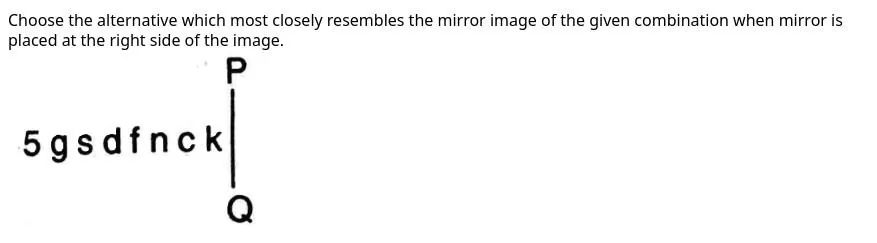
The mirror image reverses the order of the characters, so 7DISCHARGE5 becomes 5EGRAHCSID7 and each character is flipped sideways. Options B and C keep the original order (DISCHARGE) with flipped letters, which is wrong. Option A appears to swap C and R in the middle of the word. Option D matches the reversed order E-G-R-A-H-C-S-I-D. This reading of the small glyphs is tentative. Option D.
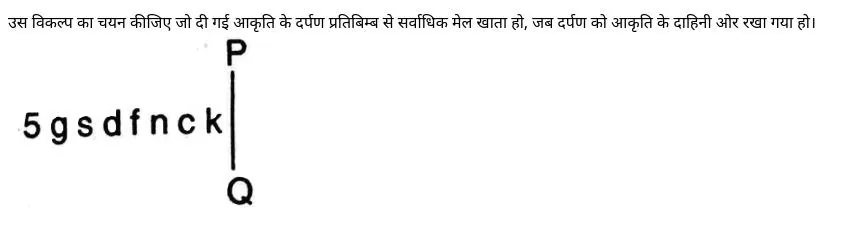
उत्तर: D
दर्पण प्रतिबिंब में अक्षरों का क्रम उलट जाता है, इसलिए 7DISCHARGE5 का प्रतिबिंब 5EGRAHCSID7 के क्रम में होगा और हर अक्षर पार्श्व में पलटा होगा। विकल्प B और C में मूल क्रम DISCHARGE ही बना रहता है, जो गलत है। विकल्प D उलटे क्रम E-G-R-A-H-C-S-I-D से मेल खाता है। विकल्प D।
This is a figure-based question. The official key is the figure in the option given below; the figure details in the source image are too small to state the rule reliably here, so compare the option figures with the question figure. Option A.
उत्तर: A
यह आकृति-आधारित प्रश्न है। आधिकारिक उत्तर नीचे दिया गया विकल्प है; स्रोत चित्र में विवरण बहुत छोटे हैं, अतः नियम विश्वसनीय रूप से नहीं लिखा जा सका—विकल्प आकृतियों की प्रश्न आकृति से तुलना करें। विकल्प A।