Tap an option to check your answer, or use “Show answer”. Switch to Hindi with the हिं button at the top.अंग्रेज़ी के लिए ऊपर EN बटन दबाएँ।
Q1Address Comparisoneasy
Address 1: Street No. 22, Vasant Vihar, New Delhi – 110057 Address 2: Street No. 22, Vasant Vihar, New Delhi – 110022
Are these addresses likely to be the same?
Answer: C
Both addresses have the same street number (22), the same locality (Vasant Vihar) and the same city (New Delhi). Only the pin codes differ: 110057 and 110022. Since the pin code is a key part of an address, the two addresses are not the same. Option A is wrong because the pin codes differ. Option B is wrong because the city is the same. Option D is wrong because the street is the same. Option C.
पता 1: Street No. 22, Vasant Vihar, New Delhi – 110057 पता 2: Street No. 22, Vasant Vihar, New Delhi – 110022
क्या ये दोनों पते संभवतः एक ही हैं?
उत्तर: C
दोनों पतों में सड़क संख्या 22, वसंत विहार और शहर नई दिल्ली समान हैं। केवल पिन कोड अलग हैं: 110057 और 110022। पिन कोड पते का एक अहम हिस्सा है, इसलिए ये दोनों पते एक नहीं हैं। विकल्प A गलत है क्योंकि पिन कोड अलग है। विकल्प B गलत है क्योंकि शहर समान है। विकल्प D गलत है क्योंकि सड़क समान है। विकल्प C।
In a certain code language, "GHOST" is written as "JMRXW." How will "SHOUT" be written in the same code language?
Answer: A
Compare GHOST with JMRXW letter by letter: G to J is +3, H to M is +5, O to R is +3, S to X is +5 and T to W is +3. So the shift alternates +3, +5, +3, +5, +3. Apply the same pattern to SHOUT: S+3 = V, H+5 = M, O+3 = R, U+5 = Z, T+3 = W. The code is VMRZW, which is option A. Options B, C and D change one or more letters from this pattern. Option A.
एक निश्चित कूट भाषा में, “GHOST” को “JMRXW” लिखा जाता है। उसी कूट भाषा में “SHOUT” को कैसे लिखा जाएगा?
उत्तर: A
GHOST और JMRXW की तुलना करें: G से J (+3), H से M (+5), O से R (+3), S से X (+5) और T से W (+3)। इस प्रकार शिफ्ट +3, +5, +3, +5, +3 के क्रम में बदलती है। यही नियम SHOUT पर लगाने पर S+3 = V, H+5 = M, O+3 = R, U+5 = Z, T+3 = W मिलता है। अतः कूट VMRZW है, जो विकल्प A है। विकल्प B, C और D इस नियम से मेल नहीं खाते। विकल्प A।
In a certain code language, "TRANSFORMATION" is written as "URBNTFPRNAUIPN". How will "ORGANIZATION" be written?
Answer: D
Compare TRANSFORMATION (14 letters) with URBNTFPRNAUIPN. At odd positions (1, 3, 5 ...) each letter moves one step forward: T to U, A to B, S to T, O to P, M to N, T to U, O to P. At even positions (2, 4, 6 ...) the letter stays the same: R, N, F, R, A, I, N. Apply this rule to ORGANIZATION: O to P, R stays R, G to H, A stays A, N to O, I stays I, Z to A (wrapping around), A stays A, T to U, I stays I, O to P, N stays N. The code is PRHAOIAAUIPN, which is. Option D.
एक निश्चित कूट भाषा में, “TRANSFORMATION” को “URBNTFPRNAUIPN” लिखा जाता है। उसी कूट भाषा में “ORGANIZATION” को कैसे लिखा जाएगा?
उत्तर: D
TRANSFORMATION (14 अक्षर) और URBNTFPRNAUIPN की तुलना करें। विषम स्थानों (1, 3, 5 ...) के अक्षर एक स्थान आगे खिसकते हैं: T से U, A से B, S से T, O से P, M से N, T से U, O से P। सम स्थानों (2, 4, 6 ...) के अक्षर वही रहते हैं। यही नियम ORGANIZATION पर लगाने पर: O से P, R वही, G से H, A वही, N से O, I वही, Z से A (चक्र पूरा होकर), A वही, T से U, I वही, O से P, N वही। अतः कूट PRHAOIAAUIPN है, जो विकल्प D है। विकल्प D।
In a row, Aditi is 15th from the left, and Neha is 5th from the left. How many people are there between them?
Answer: B
Neha is at position 5 and Aditi is at position 15, both counted from the left. The people between them occupy positions 6 to 14. That is 15 - 5 - 1 = 9 people. Option B (9) is correct. Option B.
एक पंक्ति में, अदिति बाएँ से 15वें स्थान पर है और नेहा बाएँ से 5वें स्थान पर है। उनके बीच कितने व्यक्ति हैं?
उत्तर: B
नेहा बाएँ से 5वें और अदिति बाएँ से 15वें स्थान पर है। इनके बीच के व्यक्ति 6 से 14 तक के स्थानों पर हैं। अतः संख्या 15 - 5 - 1 = 9 है। उत्तर विकल्प B (9) है। विकल्प B।
Q5Emotional Intelligence in Team Managementmoderate
A sudden, unexpected policy change from upper management triggers widespread anxiety and rumours about job security within your team. As a leader utilising high Emotional Intelligence, which approach most effectively manages this collective emotional contagion?
Answer: B
High emotional intelligence means recognising the team's feelings and responding to them constructively. Option B does this: it acknowledges concerns, clears up misinformation, gives concrete next steps and builds trust and psychological safety, which reduces the spread of anxiety. Option A (silence) lets rumours grow. Option C (suppressing discussion and enforcing detachment) ignores the emotions. Option D (criticising the leadership) damages professional credibility and feeds the anxiety. Option B.
ऊपरी मैनेजमेंट की ओर से अचानक और अप्रत्याशित पॉलिसी में बदलाव से आपकी टीम में नौकरी की सुरक्षा को लेकर चिंता और अफ़वाहें फैल जाती हैं। एक ऐसे लीडर के तौर पर जिसमें हाई इमोशनल इंटेलिजेंस है, कौन-सा तरीका इस सामूहिक भावनात्मक असर को सबसे बेहतर ढंग से संभाल सकता है?
उत्तर: B
उच्च भावनात्मक बुद्धिमत्ता का अर्थ है टीम की भावनाओं को पहचानना और उनका रचनात्मक उत्तर देना। विकल्प B यही करता है: यह चिंताओं को स्वीकार करता है, गलत जानकारी दूर करता है, ठोस अगले कदम बताता है और भरोसा व मानसिक सुरक्षा बनाता है, जिससे चिंता और अफ़वाहें कम होती हैं। विकल्प A (चुप्पी) से अफ़वाहें बढ़ती हैं। विकल्प C बातचीत दबाता है और भावनाओं को अनदेखा करता है। विकल्प D नेतृत्व की आलोचना करके पेशेवर विश्वसनीयता को नुकसान पहुँचाता है और चिंता को और बढ़ाता है। विकल्प B।
You are facilitating a training session where a participant uses a term that is unintentionally offensive to the identity of another person. The offended individual appears noticeably uncomfortable but chooses to remain silent. What is the most effective and professional response?
Answer: D
The best response addresses the offence openly and respectfully without shaming anyone. Option D calmly explains why the term is sensitive and offers inclusive alternatives, which educates the speaker and respects every participant. Option A ignores the harm. Option B is a private follow-up that leaves the group uninformed. Option C publicly shames the speaker, which is unprofessional. Option D.
आप एक प्रशिक्षण सत्र का संचालन कर रहे हैं, जहाँ एक प्रतिभागी अनजाने में ऐसा शब्द प्रयोग करता है जो किसी अन्य व्यक्ति की पहचान के संदर्भ में अपमानजनक माना जा सकता है। संबंधित व्यक्ति स्पष्ट रूप से असहज दिखाई देता है, लेकिन चुप रहना चुनता है। सबसे प्रभावी और पेशेवर प्रतिक्रिया क्या होगी?
उत्तर: D
सबसे अच्छी प्रतिक्रिया वह है जो अपमान को खुलकर और सम्मानपूर्वक संबोधित करे, बिना किसी को शर्मिंदा किए। विकल्प D शांतिपूर्वक बताता है कि शब्द संवेदनशील क्यों है और समावेशी विकल्प सुझाता है, जिससे वक्ता को समझ मिलती है और सभी प्रतिभागियों का सम्मान होता है। विकल्प A हानि को अनदेखा करता है। विकल्प B केवल निजी बातचीत है और समूह को जानकारी नहीं देता। विकल्प C सार्वजनिक रूप से शर्मिंदा करता है, जो अव्यावसायिक है। विकल्प D।
Q7Emotional Competence at a Public Countermoderate
You are a public relations officer managing a counter. An elderly citizen whose pension documentation has been delayed due to an administrative error begins shouting at you, banging on the counter, and weeping out of sheer desperation. Which action showcases the highest emotional competence?
Answer: C
Emotional competence means staying calm, recognising the person's distress and responding to the real problem. Option C does this: it moves the citizen aside, offers water, listens, acknowledges the delay and works towards a solution. Option A treats a distressed elderly person as a threat. Option B escalates the conflict. Option D ignores the emotion and is dismissive. Option C.
आप एक पब्लिक रिलेशंस ऑफ़िसर हैं और एक काउंटर संभाल रहे हैं। एक बुजुर्ग नागरिक, जिनकी पेंशन के कागज़ात में प्रशासनिक गलती की वजह से देरी हो गई है, आप पर चिल्लाने लगते हैं, काउंटर पर हाथ पटकते हैं और बेबसी में रोने लगते हैं। कौन-सा काम सबसे ज़्यादा इमोशनल कॉम्पिटेंसी (भावनात्मक समझदारी) दिखाता है?
उत्तर: C
भावनात्मक समझदारी का अर्थ है शांत रहना, व्यक्ति की परेशानी को पहचानना और असली समस्या का समाधान करना। विकल्प C यही करता है: व्यक्ति को शांति से एक तरफ़ ले जाता है, पानी देता है, सुनता है, देरी स्वीकार करता है और समाधान की ओर बढ़ता है। विकल्प A एक परेशान बुजुर्ग को खतरे की तरह देखता है। विकल्प B टकराव बढ़ाता है। विकल्प D भावना को अनदेखा करता है और उदासीन है। विकल्प C।
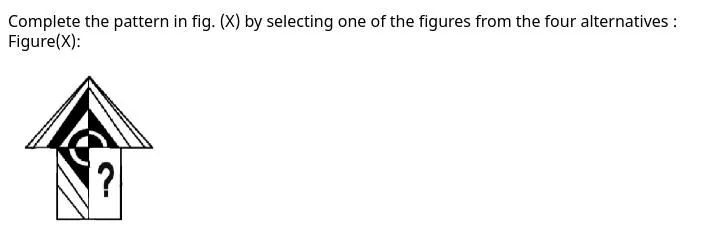
The missing lower-right part of the arrow's shaft must continue the design of the arrow head above it: the concentric arc around the centre continues into the top-left corner of the missing part, and the broad black diagonal band and thin parallel lines continue downward in the same direction. Option figure 1 shows the arc at the top-left and the black band with thin parallel lines below in the correct direction; figure 2 lacks the arc, figure 3 has crossing lines and figure 4 has extra hatching. Option A.
उत्तर: A
तीर के दंड का लुप्त निचला-दायाँ भाग ऊपर के तीर-शीर्ष की रचना को आगे बढ़ाना चाहिए: केंद्र के चारों ओर का संकेंद्री चाप लुप्त भाग के ऊपरी-बाएँ कोने में जारी रहता है, और चौड़ी काली तिरछी पट्टी तथा पतली समांतर रेखाएँ उसी दिशा में नीचे जाती हैं। विकल्प आकृति 1 में ऊपर-बाएँ चाप और नीचे सही दिशा में काली पट्टी व पतली रेखाएँ हैं; आकृति 2 में चाप नहीं है, आकृति 3 में काटती रेखाएँ हैं और आकृति 4 में अतिरिक्त छायांकन है। विकल्प A।
If [+]means 'square of the number' and [×] means 'cube root of the number', evaluate the value of the following expression.
$[+]4 \times [\times]27 - 10$
Answer: D
[+]4 means the square of 4, which is 16. [×]27 means the cube root of 27, which is 3. The expression becomes 16 × 3 − 10 = 48 − 10 = 38. Option D (38) is correct. Option D.
यदि [+] का अर्थ 'संख्या का वर्ग' तथा [×] का अर्थ 'संख्या का घनमूल' है, तो निम्नलिखित व्यंजक का मान ज्ञात कीजिए।
$[+]4 \times [\times]27 - 10$
उत्तर: D
[+]4 का अर्थ 4 का वर्ग है, जो 16 है। [×]27 का अर्थ 27 का घनमूल है, जो 3 है। व्यंजक बनता है 16 × 3 − 10 = 48 − 10 = 38। उत्तर विकल्प D (38) है। विकल्प D।
Study the pattern followed in the given equations and identify the value of the missing term accordingly.
$3 \times 4 = 19$
$4 \times 5 = 29$
$5 \times 6 = 41$
$6 \times 7 = ?$
Answer: C
The added amounts follow a pattern: 19 - 12 = 7, 29 - 20 = 9, 41 - 30 = 11. The added amount rises by 2 each time, so the next is 13. Then 6 × 7 = 42 and 42 + 13 = 55. Option C (55) is correct. Option C.
दिए गए समीकरणों में अपनाए गए पैटर्न का अध्ययन कीजिए और उसके अनुसार लुप्त पद का मान ज्ञात कीजिए।
$3 \times 4 = 19$
$4 \times 5 = 29$
$5 \times 6 = 41$
$6 \times 7 = ?$
उत्तर: C
जोड़ी गई संख्याओं में पैटर्न है: 19 - 12 = 7, 29 - 20 = 9, 41 - 30 = 11। यह हर बार 2 बढ़ रही है, इसलिए अगली संख्या 13 है। फिर 6 × 7 = 42 और 42 + 13 = 55। उत्तर विकल्प C (55) है। विकल्प C।
In the following question, one statement is given, followed by certain inferences. Consider the statement to be true even if it seems to contradict commonly known facts. Read the inferences carefully and decide which of them logically follow from the given statement. Statement:
A city hospital has introduced online appointment booking and video consultations to reduce overcrowding and make healthcare services more accessible. Inferences:
I. The hospital believes technology can improve access to healthcare services.
II. All patients will stop visiting the hospital in person.
III. The hospital was unable to provide any medical services earlier.
Answer: C
Take the statement as true: the hospital adopted online booking and video consultation to make services more accessible. Inference I follows, because the hospital's move assumes technology can improve access. Inference II is too strong, since the statement says services become more accessible, not that in-person visits stop. Inference III is not supported, because the statement says nothing about earlier services being unavailable. Only Inference I follows, which is. Option C.
निम्नलिखित प्रश्न में एक कथन दिया गया है, जिसके बाद कुछ निष्कर्ष दिए गए हैं। कथन को सत्य मानिए, भले ही वह सामान्यतः ज्ञात तथ्यों का विरोध करता हुआ प्रतीत हो। निष्कर्षों को ध्यानपूर्वक पढ़िए और निर्धारित कीजिए कि उनमें से कौन-सा/कौन-से दिए गए कथन से तार्किक रूप से अनुसरण करते हैं। कथन:
एक नगर के अस्पताल ने भीड़भाड़ कम करने तथा स्वास्थ्य सेवाओं को अधिक सुलभ बनाने के लिए ऑनलाइन अपॉइंटमेंट बुकिंग और वीडियो परामर्श (Video Consultation) की सुविधा शुरू की है। निष्कर्ष:
I. अस्पताल का मानना है कि प्रौद्योगिकी (Technology) स्वास्थ्य सेवाओं तक पहुँच में सुधार कर सकती है।
II. सभी रोगी अस्पताल में व्यक्तिगत रूप से आना बंद कर देंगे।
III. पहले अस्पताल कोई भी चिकित्सा सेवा प्रदान करने में सक्षम नहीं था।
उत्तर: C
कथन को सत्य मानें: अस्पताल ने सेवाओं को अधिक सुलभ बनाने के लिए ऑनलाइन बुकिंग और वीडियो परामर्श शुरू किए। निष्कर्ष I अनुसरण करता है, क्योंकि अस्पताल का कदम मानता है कि प्रौद्योगिकी पहुँच सुधार सकती है। निष्कर्ष II बहुत अधिक है, क्योंकि कथन केवल सुलभता बढ़ने की बात करता है, व्यक्तिगत रूप से आना बंद होने की नहीं। निष्कर्ष III का समर्थन कथन नहीं करता। अतः केवल निष्कर्ष I अनुसरण करता है, जो विकल्प C है। विकल्प C।
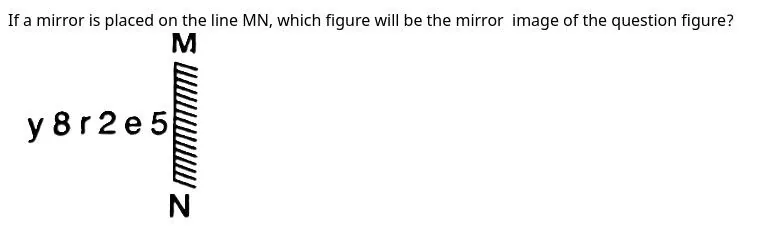
This is a figure-based question. The official key is the figure in the option given below; the figure details in the source image are too small to state the rule reliably here, so compare the option figures with the question figure. Option C.
उत्तर: C
यह आकृति-आधारित प्रश्न है। आधिकारिक उत्तर नीचे दिया गया विकल्प है; स्रोत चित्र में विवरण बहुत छोटे हैं, अतः नियम विश्वसनीय रूप से नहीं लिखा जा सका—विकल्प आकृतियों की प्रश्न आकृति से तुलना करें। विकल्प C।
Your assignment is to buy some equipment for your office. One of the sellers presents you with a "personal gift" if you choose his equipment, which is costlier and inferior compared to the competitor’s equipment. What should you do in such a situation?
Answer: B
Accepting a personal gift from a vendor creates a conflict of interest, and choosing inferior, costlier equipment harms the office. The right step is to decline the offer and report the incident to the manager, which is option B. Option A accepts the gift. Option C chooses poor quality. Option D tries to justify a bad choice rather than acting on the offer. Option B.
आपका कार्य अपने कार्यालय के लिए कुछ उपकरण खरीदना है। विक्रेताओं में से एक आपको एक "व्यक्तिगत उपहार" (Personal Gift) देने की पेशकश करता है, यदि आप उसके उपकरण चुनते हैं, जबकि उसके उपकरण प्रतिस्पर्धी विक्रेता के उपकरणों की तुलना में अधिक महंगे और निम्न गुणवत्ता वाले हैं। ऐसी स्थिति में आपको क्या करना चाहिए?
उत्तर: B
विक्रेता से व्यक्तिगत उपहार लेना हितों के टकराव का मामला है, और महंगे व घटिया उपकरण चुनना कार्यालय को नुकसान पहुँचाता है। सही कदम है प्रस्ताव अस्वीकार करना और घटना की सूचना प्रबंधक को देना, जो विकल्प B है। विकल्प A उपहार स्वीकार करता है। विकल्प C घटिया गुणवत्ता चुनता है। विकल्प D गलत चयन को सही ठहराने की कोशिश करता है। विकल्प B।
This is a figure-based question. The official key is the figure in the option given below; the figure details in the source image are too small to state the rule reliably here, so compare the option figures with the question figure. Option D.
उत्तर: D
यह आकृति-आधारित प्रश्न है। आधिकारिक उत्तर नीचे दिया गया विकल्प है; स्रोत चित्र में विवरण बहुत छोटे हैं, अतः नियम विश्वसनीय रूप से नहीं लिखा जा सका—विकल्प आकृतियों की प्रश्न आकृति से तुलना करें। विकल्प D।
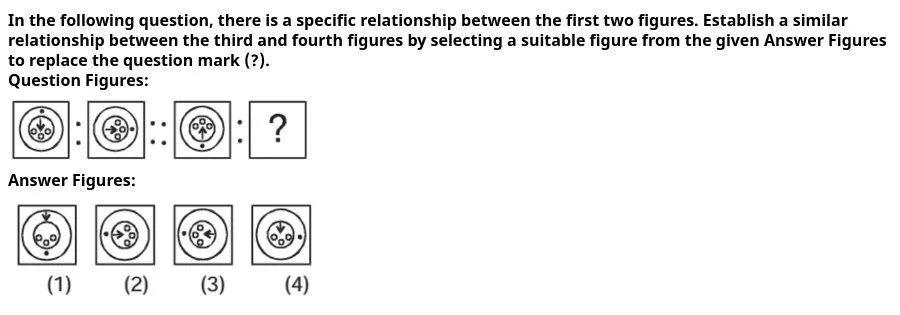
In the first pair, the arrow at the top of the circle points down in figure 1 and to the right in figure 2, which is a quarter turn anticlockwise. The same quarter turn anticlockwise applied to figure 3 (arrow pointing up) gives an arrow pointing left, which is option C. Dot counts were not used to decide. This is a provisional reading of the rule. Option C.
उत्तर: C
पहले जोड़े में, वृत्त के ऊपर का तीर आकृति 1 में नीचे की ओर और आकृति 2 में दाईं ओर है, यानी एक चौथाई घूर्णन वामावर्त। यही घूर्णन आकृति 3 (तीर ऊपर की ओर) पर लगाने पर तीर बाईं ओर होता है, जो विकल्प C है। बिंदुओं की संख्या का उपयोग नहीं किया गया। यह नियम का अनुमानित पाठ है। विकल्प C।
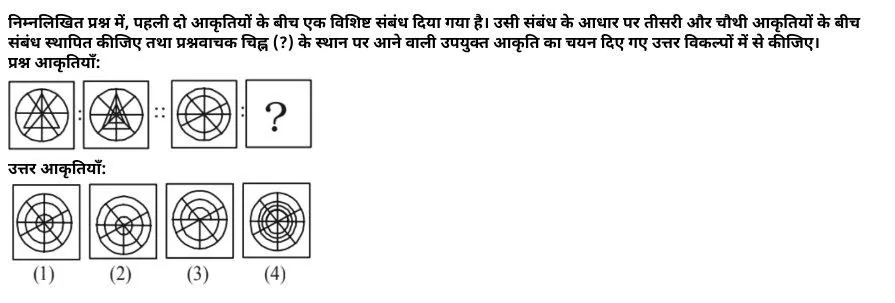
From the first figure to the second, the outer design stays the same and one more, smaller copy of the inner shape is added inside (a smaller triangle within the triangle). Applying the same change to the third figure (a circle with the same spokes and one inner ring), the answer must keep the spokes in the same positions and add one smaller ring at the centre. Answer figure 1 does exactly this; figure 2 changes the spoke positions, figure 3 has a broken ring and figure 4 adds several rings. Answer figure 1 is printed as the first option. Option A.
उत्तर: A
पहली से दूसरी आकृति में बाहरी रचना वही रहती है और भीतर आंतरिक आकृति की एक और छोटी प्रति (त्रिभुज के भीतर छोटा त्रिभुज) जुड़ जाती है। यही परिवर्तन तीसरी आकृति (समान तीलियों और एक भीतरी वलय वाला वृत्त) पर लगाने से तीलियाँ उसी स्थिति में रहेंगी और केंद्र में एक छोटा वलय जुड़ेगा। उत्तर आकृति 1 ठीक ऐसी है; आकृति 2 में तीलियों की स्थिति बदली है, आकृति 3 में वलय टूटा है और आकृति 4 में कई वलय जुड़े हैं। उत्तर आकृति 1 पहला विकल्प है। विकल्प A।
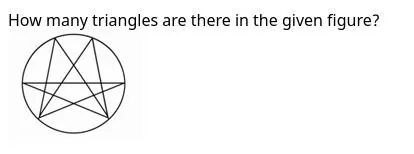
Seven straight chords join six points on the circle: top-left (TL), top-right (TR), left (L), right (R), bottom-left (BL) and bottom-right (BR). Three chords form a triangle when each pair meets and the three meeting points are different. Only the chords TL-BL and TR-BR do not meet, so 35 - 5 = 30 triples of chords meet pairwise. Two of these triples meet at one point and form no triangle: TL-BR, TR-BR and L-BR all pass through BR, and TL-BL, TR-BL and R-BL all pass through BL. So 30 - 2 = 28 triangles. Option D (28) is correct. Option D.
उत्तर: D
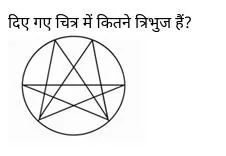
चित्र में वृत्त के भीतर सात सीधी रेखाएँ वृत्त पर के छह बिंदुओं (ऊपर-बाएँ TL, ऊपर-दाएँ TR, बाएँ L, दाएँ R, नीचे-बाएँ BL, नीचे-दाएँ BR) को जोड़ती हैं। तीन रेखाएँ एक त्रिभुज बनाती हैं यदि उनके हर जोड़े मिलें और तीनों मिलन-बिंदु अलग-अलग हों। केवल TL-BL और TR-BR नहीं मिलतीं, इसलिए 35 - 5 = 30 रेखा-त्रिक जोड़ों में मिलते हैं। इनमें दो त्रिक एक ही बिंदु पर मिलते हैं और त्रिभुज नहीं बनाते: TL-BR, TR-BR और L-BR सभी BR से होकर जाते हैं, तथा TL-BL, TR-BL और R-BL सभी BL से होकर जाते हैं। अतः 30 - 2 = 28 त्रिभुज हैं। उत्तर विकल्प D (28) है। विकल्प D।
In a survey of 100 college students regarding three programming languages: 45 know Python, 55 know Java, and 40 know C++. It is found that 15 students know all three languages. Furthermore, 25 know both Python and Java, 20 know both Java and C++, and 20 know both Python and C++. How many students in this group do NOT know any of these three programming languages?
Answer: B
Number who know at least one language = 45 + 55 + 40 - (25 + 20 + 20) + 15 = 140 - 65 + 15 = 90. Students who know none = 100 - 90 = 10. Option B (10) is correct. Option B.
100 महाविद्यालयी छात्रों पर तीन प्रोग्रामिंग भाषाओं के संबंध में किए गए एक सर्वेक्षण में, 45 छात्र Python जानते हैं, 55 छात्र Java जानते हैं, तथा 40 छात्र C++ जानते हैं। यह पाया गया कि 15 छात्र तीनों भाषाएँ जानते हैं। इसके अतिरिक्त, 25 छात्र Python और Java दोनों जानते हैं, 20 छात्र Java और C++ दोनों जानते हैं, तथा 20 छात्र Python और C++ दोनों जानते हैं। इस समूह में कितने छात्र इन तीनों प्रोग्रामिंग भाषाओं में से कोई भी भाषा नहीं जानते हैं?
उत्तर: B
कम से कम एक भाषा जानने वाले छात्र = 45 + 55 + 40 - (25 + 20 + 20) + 15 = 140 - 65 + 15 = 90। कोई भी भाषा न जानने वाले छात्र = 100 - 90 = 10। उत्तर विकल्प B (10) है। विकल्प B।
Read the given statement carefully and the following assumptions based on it. Decide which of the assumptions are implicit in the statement. Statement:
The national government should implement a total ban on the manufacturing and sale of plastic packaging to curb the rising levels of environmental pollution effectively. Assumptions:
I. Plastic packaging is one of the primary sources contributing to the current state of pollution.
II. Manufacturers are capable of transitioning to sustainable alternatives if plastic is prohibited.
Answer: D
A total ban to 'effectively' curb pollution assumes plastic packaging is a major source of pollution (Assumption I), which is the basis of the policy. It also assumes manufacturers can switch to sustainable alternatives, since a ban is only workable if substitutes exist (Assumption II). Both are implicit, so option D is correct. Option D.
दिए गए कथन को ध्यानपूर्वक पढ़िए तथा उसके आधार पर दी गई निम्नलिखित मान्यताओं पर विचार कीजिए। निर्धारित कीजिए कि कथन में कौन-सी मान्यता/मान्यताएँ निहित हैं। कथन:
पर्यावरण प्रदूषण के बढ़ते स्तर को प्रभावी रूप से नियंत्रित करने के लिए राष्ट्रीय सरकार को प्लास्टिक पैकेजिंग के निर्माण और बिक्री पर पूर्ण प्रतिबंध लागू करना चाहिए। मान्यताएँ:
I. प्लास्टिक पैकेजिंग वर्तमान प्रदूषण की स्थिति में योगदान देने वाले प्रमुख स्रोतों में से एक है।
II. यदि प्लास्टिक पर प्रतिबंध लगाया जाता है, तो निर्माता टिकाऊ (सस्टेनेबल) विकल्पों को अपनाने में सक्षम होंगे।
उत्तर: D
प्रदूषण को प्रभावी ढंग से रोकने के लिए पूर्ण प्रतिबंध मानता है कि प्लास्टिक पैकेजिंग प्रदूषण का बड़ा स्रोत है (मान्यता I), जो नीति का आधार है। साथ ही यह मानता है कि प्रतिबंध तभी व्यावहारिक है जब निर्माता टिकाऊ विकल्प अपना सकें (मान्यता II)। दोनों निहित हैं, इसलिए उत्तर विकल्प D है। विकल्प D।
Figures (a), (b), (c) and (e) each contain a straight arrow inside a closed outline. Figure (d) has a curved arrow, which is the only one of its kind, so it is different. Option C (d) is correct. Option C.
उत्तर: C
आकृतियाँ (a), (b), (c) और (e) में से हर एक में एक सीधा तीर एक बंद आकार के भीतर है। आकृति (d) में घुमावदार तीर है, जो अकेली ऐसी आकृति है, इसलिए वही भिन्न है। उत्तर विकल्प C (d) है। विकल्प C।
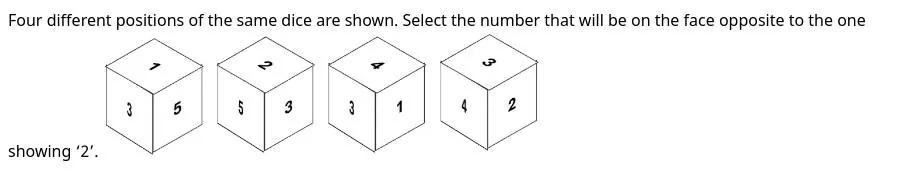
The second, third and fourth dice show 2 next to 3, 4 and 5, so the face opposite 2 is 1 or 6. On the third die, faces 4, 3 and 1 meet at one corner, so 3 is next to 1, 4 and (from the second die) 2 and 5. Since 3 touches four faces (1, 2, 4, 5), its only possible opposite face is 6. So 6 is not opposite 2, and 1 is. Option A (1) is correct. The argument does not use the top face of the first die. Option A.
उत्तर: A
दूसरे, तीसरे और चौथे पासे में 2 के साथ 3, 4 और 5 लगे हैं, इसलिए 2 के विपरीत फलक 1 या 6 हो सकता है। तीसरे पासे में फलक 4, 3 और 1 एक ही कोने पर मिलते हैं, इसलिए 3 के पड़ोसी 1 और 4 हैं; दूसरे पासे से 3 के पड़ोसी 2 और 5 भी हैं। चूँकि 3 के चार फलक (1, 2, 4, 5) पड़ोसी हैं, उसका विपरीत फलक केवल 6 हो सकता है। अतः 6 का 2 से विपरीत होना संभव नहीं, और 2 का विपरीत फलक 1 है। उत्तर विकल्प A (1) है। यह तर्क पहले पासे के ऊपरी फलक पर निर्भर नहीं करता। विकल्प A।
This is a figure-based question. The official key is the figure in the option given below; the figure details in the source image are too small to state the rule reliably here, so compare the option figures with the question figure. Option D.
उत्तर: D
यह आकृति-आधारित प्रश्न है। आधिकारिक उत्तर नीचे दिया गया विकल्प है; स्रोत चित्र में विवरण बहुत छोटे हैं, अतः नियम विश्वसनीय रूप से नहीं लिखा जा सका—विकल्प आकृतियों की प्रश्न आकृति से तुलना करें। विकल्प D।
Which of the following rows/columns are connected/related with each other in some way?
Rows | Columns
| I | II | III | IV | V
I | 2 | 5 | 3 | 7 | 6
II | 4 | 25 | 9 | 49 | 14
III | 8 | 125 | 27 | 343 | 132
IV | 16 | 625 | 81 | 2401 | 180
V | 32 | 3125 | 249 | 16807 | 508
Answer: C
Column I is powers of 2 (2, 4, 8, 16, 32). Column II is powers of 5 (5, 25, 125, 625, 3125). Column IV is powers of 7 (7, 49, 343, 2401, 16807). Column III is powers of 3 (3, 9, 27, 81) but its last entry 249 should be 243, so it breaks the pattern. Column V has no pattern. Columns I, II and IV are related, which is. Option C.
निम्नलिखित में से कौन-सी पंक्तियाँ/स्तंभ किसी न किसी प्रकार से आपस में संबंधित हैं?
पंक्तियाँ | स्तंभ
| I | II | III | IV | V
I | 2 | 5 | 3 | 7 | 6
II | 4 | 25 | 9 | 49 | 14
III | 8 | 125 | 27 | 343 | 132
IV | 16 | 625 | 81 | 2401 | 180
V | 32 | 3125 | 249 | 16807 | 508
उत्तर: C
स्तंभ I में 2 की घातें हैं (2, 4, 8, 16, 32)। स्तंभ II में 5 की घातें हैं (5, 25, 125, 625, 3125)। स्तंभ IV में 7 की घातें हैं (7, 49, 343, 2401, 16807)। स्तंभ III में 3 की घातें हैं (3, 9, 27, 81), पर अंतिम मान 243 होना चाहिए था, 249 नहीं, इसलिए वह संबंध तोड़ता है। स्तंभ V में कोई पैटर्न नहीं है। अतः स्तंभ I, II और IV संबंधित हैं, जो विकल्प C है। विकल्प C।
Fill in the blanks (_) using one of the following four options such that the series follows a specific pattern in the given order.
_ bb _ c _ bg _ b _ g
Answer: B
Fill the five blanks in order with the option letters. Option B (cgbcb) gives c bb g c b bg c b b g, which is c b b g c b b g c b b g. The block 'cbbg' repeats three times, so the series is consistent. The other options break the repetition. Option B.
रिक्त स्थानों (_) को निम्नलिखित चार विकल्पों में से किसी एक का प्रयोग करके भरिए, ताकि श्रेणी दिए गए क्रम में एक विशिष्ट प्रतिरूप का अनुसरण करे।
_ bb _ c _ bg _ b _ g
उत्तर: B
पाँच रिक्त स्थानों को विकल्प के अक्षरों से क्रम में भरें। विकल्प B (cgbcb) से श्रेणी बनती है c bb g c b bg c b b g, यानी c b b g c b b g c b b g। खंड 'cbbg' तीन बार दोहराया जाता है, इसलिए श्रेणी सुसंगत है। अन्य विकल्प यह दोहराव नहीं बनाते। उत्तर विकल्प B है। विकल्प B।
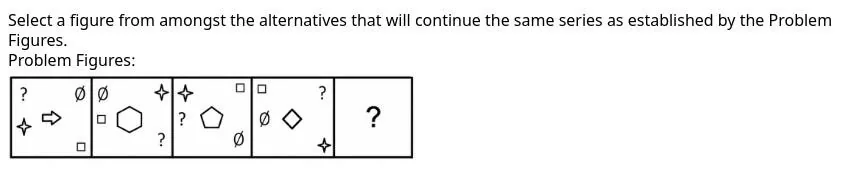
The central polygon in the second, third and fourth problem figures has 6 sides (hexagon), then 5 sides (pentagon), then 4 sides (diamond). The next figure in the series has 3 sides, a triangle, which is option B. The arrow in the first figure and the small symbols around the boxes were not used. This is a provisional reading of the rule. Option B.
उत्तर: B
प्रश्न आकृतियों की दूसरी, तीसरी और चौथी आकृति के केंद्रीय बहुभुज में क्रमशः 6 भुजाएँ (षट्भुज), 5 भुजाएँ (पंचभुज) और 4 भुजाएँ (समचतुर्भुज) हैं। श्रृंखला में अगली आकृति में 3 भुजाएँ होंगी, यानी त्रिभुज, जो विकल्प B है। पहली आकृति का तीर और चारों ओर के छोटे चिह्न इस नियम में उपयोग नहीं किए गए। यह नियम का अनुमानित पाठ है। विकल्प B।