CGL 2026 Tier 1EzSSC Practice
Learn › Shift-wise papers

14 Oct 2026 10:00 AM (Shift-1)

SSC CGL Tier 1 2026 · 100 questions · read with answers, or take it as a timed mock.

Tap an option to check your answer, or use “Show answer”. Switch to Hindi with the हिं button at the top.अंग्रेज़ी के लिए ऊपर EN बटन दबाएँ।
Q1Strengthen and Weaken Conclusionsmoderate
A biotechnology firm observed that teams using advanced simulation software completed drug-development projects faster than teams using conventional modeling techniques. The firm concluded that the software itself caused the increase in efficiency.

Which of the following, if true, would most weaken the firm’s conclusion?
Answer: A
The firm concludes that the software itself caused the faster completion. To weaken this, we need a rival explanation for the speed-up. Option A gives one: the software teams were given less complex projects, so the speed-up may come from easier work rather than the software. Options B (licence cost), C (conventional techniques still in use) and D (positive experiences) do not explain why the projects finished faster, so they do not weaken the causal claim. Answer: A. Option A.
एक जैव-प्रौद्योगिकी कंपनी ने देखा कि उन्नत सिमुलेशन सॉफ़्टवेयर का उपयोग करने वाली टीमों ने पारंपरिक मॉडलिंग तकनीकों का उपयोग करने वाली टीमों की तुलना में दवा-विकास परियोजनाएँ अधिक तेज़ी से पूरी कीं। कंपनी ने निष्कर्ष निकाला कि दक्षता में यह वृद्धि स्वयं सॉफ़्टवेयर के कारण हुई है।

निम्नलिखित में से कौन-सा कथन, यदि सत्य हो, तो कंपनी के निष्कर्ष को सबसे अधिक कमजोर करेगा?
उत्तर: A
कंपनी का निष्कर्ष है कि सॉफ़्टवेयर के कारण परियोजनाएँ तेज़ी से पूरी हुईं। इसे कमज़ोर करने के लिए तेज़ी का कोई वैकल्पिक कारण चाहिए। विकल्प A बताता है कि सॉफ़्टवेयर वाली टीमों को कम जटिल परियोजनाएँ मिली थीं, इसलिए तेज़ी सॉफ़्टवेयर के बजाय आसान कार्य से आ सकती है। विकल्प B, C और D यह नहीं समझाते कि परियोजनाएँ तेज़ी से क्यों पूरी हुईं, इसलिए वे कारण-संबंधी दावे को कमज़ोर नहीं करते। उत्तर: A। विकल्प A।
🔗 Link
Q2Strengthen and Weaken Conclusionsmoderate
A hospital implemented electronic prescription systems and later observed fewer medication errors. Administrators concluded that electronic prescriptions directly reduced such errors.

Which of the following, if true, would most strengthen the administrators’ conclusion?
Answer: A
The administrators conclude that electronic prescriptions directly reduced errors. To strengthen this, we need a direct mechanism connecting the system to fewer errors. Option A says the system automatically flagged harmful drug interactions, which provides exactly that link. Options B (emergency facilities) and C (higher demand for medicines) are unrelated to the system. Option D would change how errors are recorded and weakens the conclusion rather than strengthening it. Answer: A. Option A.
एक अस्पताल ने इलेक्ट्रॉनिक प्रिस्क्रिप्शन प्रणाली लागू की और बाद में दवाओं से संबंधित त्रुटियों में कमी देखी। प्रशासकों ने निष्कर्ष निकाला कि इलेक्ट्रॉनिक प्रिस्क्रिप्शन ने सीधे तौर पर ऐसी त्रुटियों को कम किया।

निम्नलिखित में से कौन-सा कथन, यदि सत्य हो, तो प्रशासकों के निष्कर्ष को सर्वाधिक सुदृढ़ करेगा?
उत्तर: A
प्रशासकों का निष्कर्ष है कि इलेक्ट्रॉनिक प्रिस्क्रिप्शन ने सीधे तौर पर त्रुटियाँ कम कीं। इसे सुदृढ़ करने के लिए प्रणाली और त्रुटियों में कमी के बीच सीधा तंत्र चाहिए। विकल्प A बताता है कि प्रणाली हानिकारक दवा-अंतःक्रियाओं को स्वतः पहचानती थी, जो यही सीधा संबंध देता है। विकल्प B और C का प्रणाली से संबंध नहीं है। विकल्प D त्रुटियों की रिपोर्टिंग बदल देता है, इसलिए वह निष्कर्ष को कमज़ोर करता है। उत्तर: A। विकल्प A।
🔗 Link
Q3Strengthen and Weaken Conclusionseasy
A hotel chain introduced mobile room-key access through smartphones and later received higher guest satisfaction ratings. Executives concluded that mobile key access directly improved guest experience.

Which of the following, if true, would most strengthen the executives’ conclusion?
Answer: A
The executives attribute the rise in satisfaction directly to mobile key access. To strengthen this, we need evidence that the feature itself improved the guest experience. Option A links the feature to a better guest outcome: shorter check-in waiting times for guests who use mobile keys. Options B (holiday occupancy), C (smartphone use among business travellers) and D (restaurant upgrades) are alternative or unrelated factors and do not support the claim. Answer: A. Option A.
एक होटल चेन ने स्मार्टफोन के माध्यम से मोबाइल रूम-की की सुविधा शुरू की और बाद में उसे अतिथि संतुष्टि की उच्च रेटिंग मिली। अधिकारियों ने निष्कर्ष निकाला कि मोबाइल रूम-की की सुविधा ने सीधे तौर पर अतिथि अनुभव में सुधार किया।

निम्नलिखित में से कौन-सा कथन, यदि सत्य हो, तो अधिकारियों के निष्कर्ष को सर्वाधिक सुदृढ़ करेगा?
उत्तर: A
अधिकारी अतिथि संतुष्टि में वृद्धि का श्रेय सीधे मोबाइल रूम-की को देते हैं। इसे सुदृढ़ करने के लिए यह दिखाना होगा कि इस सुविधा ने ही अतिथि अनुभव बेहतर किया। विकल्प A सुविधा को बेहतर परिणाम से जोड़ता है: मोबाइल रूम-की का उपयोग करने वाले अतिथियों का चेक-इन प्रतीक्षा समय कम रहा। विकल्प B, C और D अन्य या असंबंधित कारक हैं और दावे का समर्थन नहीं करते। उत्तर: A। विकल्प A।
🔗 Link
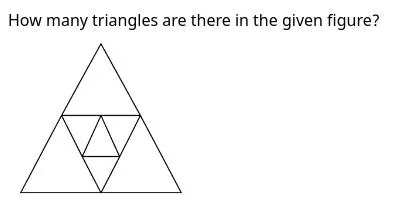
Q4Trianglesmoderate
figure
Answer: C
The figure has 9 triangles: (1) the whole big triangle; (2) the top corner triangle; (3) the bottom-left corner triangle; (4) the bottom-right corner triangle; (5) the inverted central triangle whose top side is the middle horizontal line and whose bottom vertex is the midpoint of the base; (6) the small upright triangle inside it; (7) and (8) the two triangles on either side of the small upright triangle; (9) the small inverted triangle below it. Total 9. Answer: C (9). Option C.
figure
उत्तर: C
आकृति में 9 त्रिभुज हैं: (1) पूरा बड़ा त्रिभुज; (2) ऊपरी कोने का त्रिभुज; (3) निचले बाएँ कोने का त्रिभुज; (4) निचले दाएँ कोने का त्रिभुज; (5) उल्टा केंद्रीय त्रिभुज, जिसकी ऊपरी भुजा बीच की क्षैतिज रेखा है और निचला शीर्ष आधार के मध्य-बिंदु पर है; (6) उसके भीतर का छोटा सीधा त्रिभुज; (7) और (8) छोटे सीधे त्रिभुज के दोनों ओर के दो त्रिभुज; (9) उसके नीचे का छोटा उल्टा त्रिभुज। कुल 9। उत्तर: C (9)। विकल्प C।
🔗 Link
Q5Left-Right Positioneasy
In a row of people, Rahul is 11th from the left, and Aman is 10th from the right. After exchanging places, Rahul becomes 25th from the left. Find the total number of people.
Answer: B
Let the total number of people be N. Aman is 10th from the right, so his position from the left is N - 10 + 1 = N - 9. After exchanging places, Rahul takes Aman's position, which is 25th from the left. So N - 9 = 25, giving N = 34. Answer: B (34). Option B.
व्यक्तियों की एक पंक्ति में, राहुल बाएँ से 11वें स्थान पर है और अमन दाएँ से 10वें स्थान पर है। उनके स्थान बदलने के बाद, राहुल बाएँ से 25वें स्थान पर हो जाता है। कुल व्यक्तियों की संख्या ज्ञात कीजिए।
उत्तर: B
मान लीजिए कुल व्यक्ति N हैं। अमन दाएँ से 10वें स्थान पर है, इसलिए बाएँ से उसका स्थान N - 9 है। स्थान बदलने पर राहुल अमन के स्थान पर पहुँचता है, जो बाएँ से 25वाँ है। अतः N - 9 = 25, यानी N = 34। उत्तर: B (34)। विकल्प B।
🔗 Link
Q6Triangles in a Gridhard
figure
Answer: D
Each triangle needs three non-parallel sides drawn along the figure lines. The figure has the outer square, three inner vertical lines running full height, the middle horizontal line across the full width, two shorter horizontal lines spanning only the middle two columns, and both full diagonals. Counting by the three directions: 16 triangles with horizontal, vertical and main-diagonal sides; 16 with horizontal, vertical and anti-diagonal sides; 4 with horizontal and both diagonals; and 4 with vertical and both diagonals. Total 40. This matches none of the printed options (12, 18, 24, 28), so the keyed option D (28) cannot be confirmed. Option D.
figure
उत्तर: D
प्रत्येक त्रिभुज की तीन भुजाएँ आकृति की खिंची हुई, गैर-समांतर रेखाएँ होनी चाहिए। आकृति में बाहरी वर्ग, तीन भीतरी ऊर्ध्वाधर रेखाएँ, पूरी चौड़ाई में बीच की क्षैतिज रेखा, बीच के दो स्तंभों में फैली दो छोटी क्षैतिज रेखाएँ और दोनों पूरे विकर्ण हैं। तीनों दिशाओं के आधार पर गिनने पर: क्षैतिज, ऊर्ध्वाधर और मुख्य विकर्ण भुजाओं वाले 16; क्षैतिज, ऊर्ध्वाधर और प्रतिविकर्ण भुजाओं वाले 16; क्षैतिज और दोनों विकर्णों वाले 4; तथा ऊर्ध्वाधर और दोनों विकर्णों वाले 4 त्रिभुज हैं। कुल 40। यह दिए गए किसी भी विकल्प (12, 18, 24, 28) से मेल नहीं खाता, इसलिए कुंजी का विकल्प D (28) सत्यापित नहीं हो सकता। विकल्प D।
🔗 Link
Q7Figural Pattern Completionhard
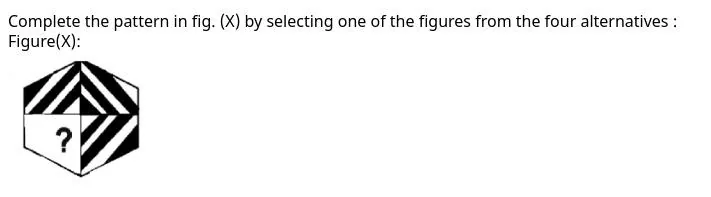
figure
Answer: B
Figure X is a hexagon split into four quadrant pieces, with the lower-left piece blank and marked with a question mark. The upper-left and lower-right pieces carry diagonal stripes running bottom-left to top-right, while the upper-right piece carries stripes running top-left to bottom-right. Reading the arrangement as a checkerboard of stripe directions, the missing lower-left piece (diagonally opposite the upper-right piece) should carry top-left to bottom-right stripes. Options 2, 3 and 4 have that direction and option 1 has an L-shaped band, so option 2 is chosen on stripe spacing and black-white rhythm. This is a low-confidence visual judgement from low-resolution images and is not verified. Option B.
figure
उत्तर: B
आकृति (X) एक षट्भुज है जो चार चतुर्थांश खंडों में बँटा है, और निचला बायाँ खंड खाली है तथा उस पर प्रश्न चिह्न है। ऊपरी बाएँ और निचले दाएँ खंडों में बाएँ-नीचे से दाएँ-ऊपर जाने वाली तिरछी धारियाँ हैं, जबकि ऊपरी दाएँ खंड में ऊपर-बाएँ से नीचे-दाएँ जाने वाली धारियाँ हैं। दिशाओं को शतरंज-पट्टी की तरह देखें तो विकर्ण पर स्थित ऊपरी दाएँ खंड के अनुसार लुप्त निचले बाएँ खंड में ऊपर-बाएँ से नीचे-दाएँ जाने वाली धारियाँ होनी चाहिए। विकल्प 2, 3 और 4 में यही दिशा है और विकल्प 1 में L-आकार की पट्टी है, इसलिए धारियों के अंतराल और काली-सफ़ेद क्रम के आधार पर विकल्प 2 चुना गया है। यह कम रिज़ॉल्यूशन की छवियों पर आधारित कम-विश्वास वाला दृश्य अनुमान है और सत्यापित नहीं है। विकल्प B।
🔗 Link
Q8Custom Operation on Two Numberseasy
If 5 Δ 4 = 41 and 7 Δ 3 = 58, then find the value of 9 Δ 2.
Answer: B
Test a Δ b = a^{2} + b^{2}. Then 5 Δ 4 = 25 + 16 = 41 and 7 Δ 3 = 49 + 9 = 58, which match the given values. So 9 Δ 2 = 81 + 4 = 85. Answer: B (85). Option B.
यदि 5 Δ 4 = 41 और 7 Δ 3 = 58 है, तो 9 Δ 2 का मान ज्ञात कीजिए।
उत्तर: B
मान लीजिए a Δ b = a^{2} + b^{2}। तब 5 Δ 4 = 25 + 16 = 41 और 7 Δ 3 = 49 + 9 = 58, जो दिए गए मानों से मेल खाते हैं। अतः 9 Δ 2 = 81 + 4 = 85। उत्तर: B (85)। विकल्प B।
🔗 Link
Q9Operators to Make Valid Equationmoderate
Choose the correct sequence of mathematical operators to replace the asterisks (*) in order to make the following expression a valid equation.
96 * 6 * 3 * 45 * 3 * 63
Answer: A
Apply BODMAS to each option. Option A gives 96 ÷ 6 × 3 + 45 ÷ 3 = 48 + 15 = 63, which is a valid equation. Option B gives 96 + 6 ÷ 3 − 45 × 3 = −37, Option C gives about 573 and Option D gives 96 ÷ 6 × 3 − 45 × 3 = −87, so none of them equals 63. Answer: A. Option A.
निम्नलिखित अभिव्यक्ति को एक मान्य समीकरण बनाने के लिए तारांक (*) के स्थान पर गणितीय संक्रियाओं का सही क्रम चुनें।
96 * 6 * 3 * 45 * 3 * 63
उत्तर: A
प्रत्येक विकल्प पर BODMAS लागू कीजिए। विकल्प A से 96 ÷ 6 × 3 + 45 ÷ 3 = 48 + 15 = 63 मिलता है, जो मान्य समीकरण है। विकल्प B से −37, विकल्प C से लगभग 573 और विकल्प D से 96 ÷ 6 × 3 − 45 × 3 = −87 मिलता है, इसलिए इनमें से कोई 63 नहीं देता। उत्तर: A। विकल्प A।
🔗 Link
Q10Inference from Statementeasy
In the following question, one statement is given, followed by certain inferences. Consider the statement to be true even if it seems to contradict commonly known facts. Read the inferences carefully and decide which of them logically follow from the given statement.
Statement:
In a T-20 cricket match, the number of runs scored by the Indian team was 212 and out of these, 160 runs were scored by spinners.
Inferences:
I. 10% of the Indian team consists of spinners.
II. The opening batters were spinners.
Answer: D
The statement says only that 160 of the 212 runs were scored by spinners. It gives no count of spinning players, so Inference I (10% of the team are spinners) does not follow. It also says nothing about the opening batters, so Inference II does not follow. Neither inference follows. Answer: D. Option D.
निम्नलिखित प्रश्न में एक कथन दिया गया है, जिसके बाद कुछ निष्कर्ष दिए गए हैं। कथन को सत्य मानिए, भले ही वह सामान्यतः ज्ञात तथ्यों के विपरीत प्रतीत होता हो। निष्कर्षों को ध्यानपूर्वक पढ़िए और निर्णय कीजिए कि उनमें से कौन-सा/कौन-से निष्कर्ष दिए गए कथन से तार्किक रूप से अनुसरण करते हैं।
कथन:
एक T-20 क्रिकेट मैच में भारतीय टीम द्वारा बनाए गए कुल रनों की संख्या 212 थी और इनमें से 160 रन स्पिन गेंदबाजों द्वारा बनाए गए थे।
निष्कर्ष:
I. भारतीय टीम के 10% खिलाड़ी स्पिन गेंदबाज हैं।
II. सलामी बल्लेबाज स्पिन गेंदबाज थे।
उत्तर: D
कथन केवल इतना बताता है कि 212 में से 160 रन स्पिन गेंदबाजों ने बनाए। इससे स्पिन खिलाड़ियों की संख्या नहीं पता चलती, इसलिए निष्कर्ष I सही नहीं है। सलामी बल्लेबाजों के बारे में कथन कुछ नहीं कहता, इसलिए निष्कर्ष II भी सही नहीं है। उत्तर: D। विकल्प D।
🔗 Link
Q11Cognitive Distortionseasy
After failing an important entrance exam, a student tells themselves, "I always fail at everything I try. I am never going to succeed in life." This specific pattern of negative thinking demonstrates which of the following mental habits?
Answer: B
The student generalises one failure into 'I always fail at everything' and 'never going to succeed', which is overgeneralization, a cognitive distortion. Option A, C and D describe healthy skills (emotional regulation, empathy, active listening) that the student is not showing. Answer: B. Option B.
एक महत्वपूर्ण प्रवेश परीक्षा में असफल होने के बाद, एक छात्र खुद से कहता है, "मैं जो भी कोशिश करता हूँ, हमेशा उसमें असफल हो जाता हूँ। मैं जीवन में कभी सफल नहीं होने वाला हूँ।" नकारात्मक सोच का यह विशिष्ट पैटर्न निम्नलिखित में से किस मानसिक आदत को प्रदर्शित करता है?
उत्तर: B
छात्र एक असफलता को 'मैं हमेशा हर चीज़ में असफल होता हूँ' तक सामान्यीकृत कर रहा है, जो अति-सामान्यीकरण नामक संज्ञानात्मक विकृति है। विकल्प A, C और D स्वस्थ कौशलों (संवेग नियमन, सहानुभूति, सक्रिय श्रवण) का वर्णन करते हैं, जो छात्र में नहीं दिखते। उत्तर: B। विकल्प B।
🔗 Link
Q12Emotionally Intelligent Responseeasy
During a department-wide meeting, a colleague receives sole praise from top management for a successful project that was actually a collaborative team effort. You immediately feel a wave of intense resentment.

Which of the following actions demonstrates the most emotionally intelligent first step?
Answer: C
The first step in emotional intelligence is to recognise and process the feeling before acting on it. Option C does this: it pauses to understand the resentment and its trigger, then moves to a constructive solution. Options A (interrupting in public) and D (venting about a colleague) react impulsively, and B suppresses the feeling instead of processing it. Answer: C. Option C.
एक विभाग-व्यापी बैठक के दौरान, एक सहकर्मी को एक सफल परियोजना के लिए शीर्ष प्रबंधन से एकमात्र प्रशंसा मिलती है जो वास्तव में एक सहयोगात्मक टीम प्रयास था। आप तुरंत तीव्र आक्रोश की एक लहर महसूस करते हैं।

निम्नलिखित में से कौन सी कार्रवाई सबसे भावनात्मक रूप से बुद्धिमान पहले कदम को प्रदर्शित करती है?
उत्तर: C
भावनात्मक बुद्धिमत्ता का पहला कदम किसी भावना पर कार्य करने से पहले उसे पहचानना और समझना है। विकल्प C यही करता है: वह आक्रोश और उसके कारण को समझने के लिए रुकता है, फिर रचनात्मक समाधान की ओर बढ़ता है। विकल्प A और D आवेग में प्रतिक्रिया देते हैं, जबकि B भावना को दबाता है, उसे समझता नहीं। उत्तर: C। विकल्प C।
🔗 Link
Q13Mirror Image of Seriesmoderate
figure
Answer: B
This is a figure-based question. The official key is the figure in the option given below; the figure details in the source image are too small to state the rule reliably here, so compare the option figures with the question figure. Option B.
figure
उत्तर: B
यह आकृति-आधारित प्रश्न है। आधिकारिक उत्तर नीचे दिया गया विकल्प है; स्रोत चित्र में विवरण बहुत छोटे हैं, अतः नियम विश्वसनीय रूप से नहीं लिखा जा सका—विकल्प आकृतियों की प्रश्न आकृति से तुलना करें। विकल्प B।
🔗 Link
Q14Figure Series Continuationhard
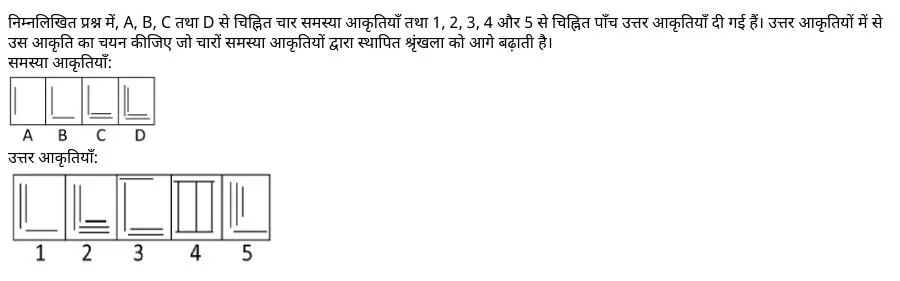
figure
Answer: B
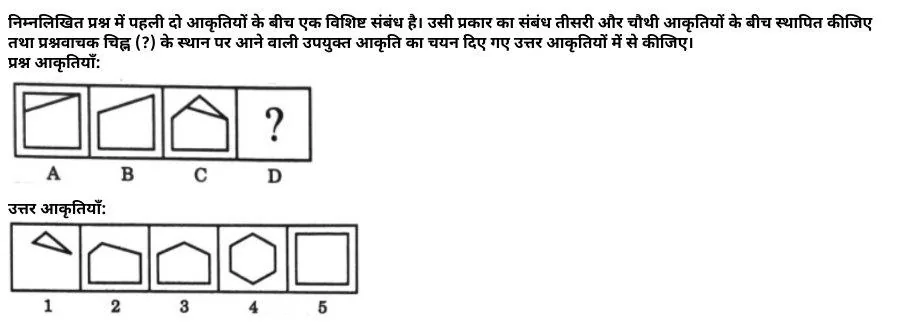
Each problem figure is an open L made of strokes, and each figure adds exactly one stroke: A has 1 stroke, B has 2, C has 3 and D has 4. The next term should have 5 strokes. Answer figure 1 has 3 strokes, figure 3 has 4, figure 5 has 4 and figure 2 has 5 (two verticals and three horizontals). Figure 2 is the only printed option with 5 strokes. Figure 4 (a box) is not among the printed options. This stroke-count rule is a visual judgement from small images, so confidence is moderate. Option B.
figure
उत्तर: B
प्रत्येक समस्या आकृति एक खुला L है जिसमें रेखाएँ बनी हैं, और हर आकृति में ठीक एक रेखा जुड़ती है: A में 1 रेखा, B में 2, C में 3 और D में 4 रेखाएँ हैं। अगली आकृति में 5 रेखाएँ होनी चाहिए। उत्तर आकृति 1 में 3 रेखाएँ हैं, आकृति 3 में 4, आकृति 5 में 4, और आकृति 2 में 5 (दो ऊर्ध्वाधर और तीन क्षैतिज)। मुद्रित विकल्पों में केवल आकृति 2 में 5 रेखाएँ हैं। आकृति 4 (बॉक्स) मुद्रित विकल्पों में नहीं है। रेखाओं की गिनती वाला यह नियम छोटी छवियों पर आधारित दृश्य अनुमान है, इसलिए विश्वास मध्यम है। विकल्प B।
🔗 Link
Q15Column Relationshipsmoderate
figure
Answer: D
Column I holds 9, 8, 7, 6, 5 and column II holds 729, 512, 343, 216, 125, which are their cubes (9^3, 8^3, ...). Column V holds 81, 64, 49, 36, 25, which are the squares of the same numbers. So columns I, II and V are related. Columns III and IV show no such link with them. Answer: D (Columns I, II and V). Option D.
figure
उत्तर: D
स्तंभ I में 9, 8, 7, 6, 5 हैं और स्तंभ II में 729, 512, 343, 216, 125 हैं, जो उन्हीं संख्याओं के घन (9^3, 8^3, ...) हैं। स्तंभ V में 81, 64, 49, 36, 25 हैं, जो उन्हीं संख्याओं के वर्ग हैं। अतः स्तंभ I, II और V संबंधित हैं, जबकि III और IV का इनसे ऐसा संबंध नहीं दिखता। उत्तर: D (स्तंभ I, II और V)। विकल्प D।
🔗 Link
Q16Mirror Image of Letters and Digitsmoderate
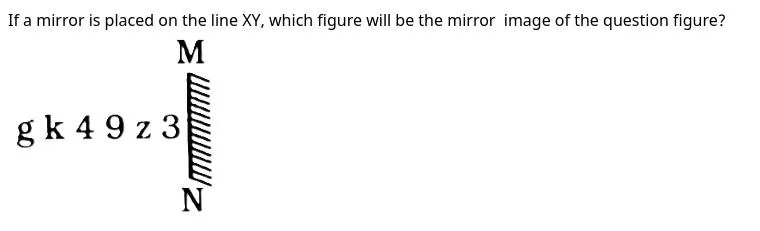
figure
Answer: D
The combination is d z 7 2 b 9 with the mirror on MN at its right end. A mirror image reverses the order and reflects each character, so the answer reads (mirror of 9), (mirror of b = d), (mirror of 2), (mirror of 7), (mirror of z), (mirror of d = b). Option 4 (e d 2 7 z b) has this order with the reflected 9 shown as e and the other characters reflected correctly. Option 1 starts with 6, which is a 180-degree rotation of 9 rather than its mirror image, so it is wrong. Option 2 has q and p and option 3 has b in the second place, so both are wrong. Answer: 4. Option D.
figure
उत्तर: D
संयोजन d z 7 2 b 9 है और दर्पण MN पर उसके दाएँ सिरे पर है। दर्पण प्रतिबिंब में क्रम उलट जाता है और हर अक्षर पलट जाता है, इसलिए उत्तर (9 का प्रतिबिंब), (b का प्रतिबिंब = d), (2 का प्रतिबिंब), (7 का प्रतिबिंब), (z का प्रतिबिंब), (d का प्रतिबिंब = b) होना चाहिए। विकल्प 4 (e d 2 7 z b) में 9 का प्रतिबिंब e के रूप में है और बाकी अक्षर सही पलटे हुए हैं। विकल्प 1 का पहला अक्षर 6 है, जो 9 का दर्पण प्रतिबिंब नहीं बल्कि 180 डिग्री घुमाव है, इसलिए वह गलत है। विकल्प 2 में q और p हैं, और विकल्प 3 में दूसरे स्थान पर b है, इसलिए दोनों गलत हैं। उत्तर: 4। विकल्प D।
🔗 Link
Q17Figure Embedded in Optionmoderate
figure
Answer: D
Figure X is a V-shape with a small dome-shaped arc sitting on its vertex inside a square outline. Option D contains the same V with the dome on its vertex, so it is chosen. This is a visual judgement from small images, and the square outline of Figure X is not clearly visible in the options. Option D.
figure
उत्तर: D
आकृति (X) एक V-आकार है जिसके शीर्ष पर एक छोटा गुंबद-आकार चाप है, और वह एक वर्गाकार रेखा के भीतर है। विकल्प 4 में वही V है जिसके शीर्ष पर गुंबद है, इसलिए उसे चुना गया। यह छोटी छवियों पर आधारित दृश्य अनुमान है, और विकल्पों में वर्गाकार रेखा स्पष्ट नहीं दिखती। विकल्प D।
🔗 Link
Q18Minimum and Maximum in Two Setseasy
In an office of 60 employees, 40 like Tea and 35 like Coffee. Based on this data alone, what are the mathematical minimum and maximum numbers of employees who could like BOTH Tea and Coffee?
Answer: A
Minimum overlap = 40 + 35 − 60 = 15, because at least 15 people must like both. Maximum overlap cannot exceed the smaller group, so it is 35 (all coffee lovers also like tea). Answer: A (Minimum 15, Maximum 35). Option A.
60 कर्मचारियों वाले एक कार्यालय में, 40 कर्मचारी चाय पसंद करते हैं और 35 कर्मचारी कॉफी पसंद करते हैं। केवल इस आँकड़े के आधार पर, उन कर्मचारियों की न्यूनतम तथा अधिकतम संभावित संख्या क्या हो सकती है जो चाय और कॉफी दोनों पसंद करते हैं?
उत्तर: A
न्यूनतम प्रतिच्छेद = 40 + 35 − 60 = 15, क्योंकि कम से कम 15 लोग दोनों पसंद करेंगे। अधिकतम प्रतिच्छेद छोटे समूह से अधिक नहीं हो सकता, इसलिए वह 35 है (सभी कॉफी पसंद करने वाले चाय भी पसंद करते हैं)। उत्तर: A (न्यूनतम 15, अधिकतम 35)। विकल्प A।
🔗 Link
Q19Odd Figure Outmoderate
figure
Answer: B
This is a figure-based question. The official key is the figure in the option given below; the figure details in the source image are too small to state the rule reliably here, so compare the option figures with the question figure. Option B.
figure
उत्तर: B
यह आकृति-आधारित प्रश्न है। आधिकारिक उत्तर नीचे दिया गया विकल्प है; स्रोत चित्र में विवरण बहुत छोटे हैं, अतः नियम विश्वसनीय रूप से नहीं लिखा जा सका—विकल्प आकृतियों की प्रश्न आकृति से तुलना करें। विकल्प B।
🔗 Link
Q20Odd Figure Outhard
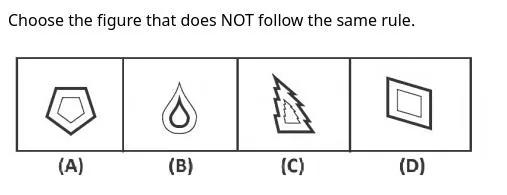
figure
Answer: C
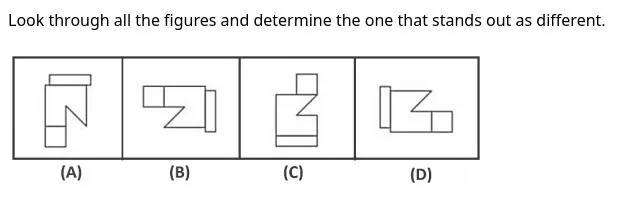
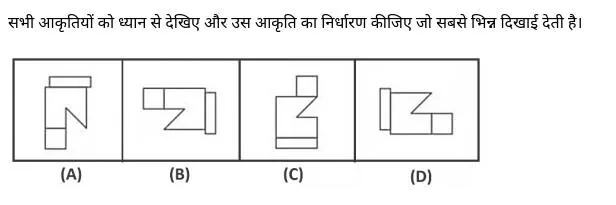
Each figure is built from straight line segments forming a stepped outline with one or more enclosed compartments. Figure C has a different arrangement of its compartments and bottom bar from the others, so it is the one that stands out. This is a low-confidence visual judgement from small images. Option C.
figure
उत्तर: C
प्रत्येक आकृति सीधी रेखाखंडों से बनी सीढ़ीदार रूपरेखा है जिसमें एक या अधिक बंद खाने हैं। आकृति C में खानों और नीचे की पट्टी की व्यवस्था बाकी से भिन्न है, इसलिए वह अलग दिखती है। यह छोटी छवियों पर आधारित कम-विश्वास वाला दृश्य अनुमान है। विकल्प C।
🔗 Link
Q21Figure Analogymoderate
figure
Answer: A
This is a figure-based question. The official key is the figure in the option given below; the figure details in the source image are too small to state the rule reliably here, so compare the option figures with the question figure. Option A.
figure
उत्तर: A
यह आकृति-आधारित प्रश्न है। आधिकारिक उत्तर नीचे दिया गया विकल्प है; स्रोत चित्र में विवरण बहुत छोटे हैं, अतः नियम विश्वसनीय रूप से नहीं लिखा जा सका—विकल्प आकृतियों की प्रश्न आकृति से तुलना करें। विकल्प A।
🔗 Link
Q22Ethical Dilemma in Workplacemoderate
Scenario: In a tense multi-party workplace negotiation, Manager X has maintained a strictly neutral public stance to keep the peace between Team Y and Team Z. However, Manager X privately realizes that Team Z’s proposal is objectively more viable. Publicly endorsing Team Z now will cause Team Y to feel betrayed, destroying Manager X's reputation as a fair, unbiased leader.

What is the most socially intelligent and logical course of action for Manager X?
Answer: C
Manager X must avoid publicly betraying Team Y while still moving toward the better proposal. Option C works privately, highlights shared goals to reduce conflict, and then offers a unified team solution, which protects trust on both sides. Option A sacrifices Team Y's trust, option B accepts a deadlock that the question does not require, and option D turns the matter into a contest against Team Y. Answer: C. Option C.
परिदृश्य: कार्यस्थल पर कई पक्षों के बीच हो रही एक तनावपूर्ण बातचीत में, मैनेजर X ने टीम Y और टीम Z के बीच शांति बनाए रखने के लिए सार्वजनिक रूप से पूरी तरह निष्पक्ष रुख अपनाया है। हालाँकि, मैनेजर X निजी तौर पर महसूस करते हैं कि टीम Z का प्रस्ताव वस्तुनिष्ठ रूप से अधिक व्यावहारिक है। अगर वे अभी सबके सामने टीम Z का समर्थन करते हैं, तो टीम Y को लगेगा कि उनके साथ विश्वासघात हुआ है, जिससे एक निष्पक्ष लीडर के रूप में मैनेजर X की साख नष्ट हो जाएगी।

मैनेजर X के लिए सबसे अधिक सामाजिक रूप से बुद्धिमान और तार्किक कदम क्या है?
उत्तर: C
मैनेजर X को टीम Y के साथ सार्वजनिक विश्वासघात से बचना चाहिए और फिर भी बेहतर प्रस्ताव की ओर बढ़ना चाहिए। विकल्प C निजी तौर पर साझा लक्ष्यों पर ज़ोर देकर टकराव कम करता है और फिर एकीकृत समाधान रखता है, जिससे दोनों पक्षों का विश्वास बना रहता है। विकल्प A टीम Y का विश्वास खोता है, B अनावश्यक गतिरोध स्वीकार करता है, और D मामले को टीम Y के विरुद्ध प्रतियोगिता बना देता है। उत्तर: C। विकल्प C।
🔗 Link
Q23Applying Eligibility Criteriaeasy
Read the given situation carefully and consider all the relevant facts, conditions and constraints. Choose the option that represents the most appropriate, practical and logical decision based solely on the information provided.

A sports academy offers elite badminton scholarships to applicants who are under 16 years of age, have won at least one state-level championship tournament and have maintained a clean disciplinary record. Rohit is 14 years old, has won two state-level championship titles and has never faced any disciplinary issues in his career.

What decision should the academy make?
Answer: A
Check each condition for Rohit: he is 14, which is under 16; he has won two state-level titles, which is at least one; and he has a clean disciplinary record. All three conditions are met, so the candidate should be selected. Options B and D ignore the facts given, and option C is unnecessary because the criteria are fully answered. Answer: A. Option A.
दिए गए परिस्थिति को ध्यानपूर्वक पढ़ें और सभी महत्वपूर्ण तथ्यों, शर्तों और सीमाओं पर विचार करें। केवल दी गई जानकारी के आधार पर सबसे उचित, व्यावहारिक और तार्किक निर्णय को दर्शाने वाले विकल्प का चयन करें।

एक खेल अकादमी उन आवेदकों को उत्कृष्ट बैडमिंटन छात्रवृत्ति प्रदान करती है जो 16 वर्ष से कम आयु के हैं, जिन्होंने कम से कम एक राज्य स्तरीय चैम्पियनशिप टूर्नामेंट जीता है और एक स्वच्छ अनुशासनात्मक रिकॉर्ड बनाए रखा है। रोहित 14 वर्ष के हैं, उन्होंने दो राज्य स्तरीय चैम्पियनशिप खिताब जीते हैं और अपने करियर में कभी भी किसी अनुशासनात्मक समस्या का सामना नहीं किया है।

अकादमी को क्या निर्णय लेना चाहिए?
उत्तर: A
रोहित की हर शर्त जाँचिए: वह 14 वर्ष के हैं, जो 16 से कम है; उन्होंने दो राज्य स्तरीय खिताब जीते हैं, जो कम से कम एक की शर्त पूरी करता है; और उनका अनुशासनात्मक रिकॉर्ड स्वच्छ है। तीनों शर्तें पूरी होती हैं, इसलिए उम्मीदवार का चयन होना चाहिए। विकल्प B और D दिए गए तथ्यों की अनदेखी करते हैं, और C अनावश्यक है क्योंकि मानदंड पूरी तरह तय हो जाते हैं। उत्तर: A। विकल्प A।
🔗 Link
Q24Word Hierarchy Sequenceeasy
Choose the word from the options that logically completes the given intensity sequence.
Newspaper → Section → Column → [?]
Answer: B
The sequence narrows down a newspaper step by step: a newspaper has sections, a section has columns, and a column holds articles. So the next term is Article (option B). Edition and Publisher are not parts of a column, and Headline is a part of an article rather than the next container in the sequence. Answer: B. Option B.
दिए गए क्रम को तार्किक रूप से पूरा करने वाले शब्द का चयन करें।
समाचार-पत्र → अनुभाग → स्तंभ → [?]
उत्तर: B
यह क्रम समाचार-पत्र को चरणबद्ध रूप से छोटा करता है: समाचार-पत्र में अनुभाग होते हैं, अनुभाग में स्तंभ होते हैं, और स्तंभ में लेख होते हैं। अतः अगला शब्द लेख (विकल्प B) है। संस्करण और प्रकाशक स्तंभ के भाग नहीं हैं, और हेडलाइन लेख का हिस्सा है, स्तंभ के बाद का अगला क्रम नहीं। उत्तर: B। विकल्प B।
🔗 Link
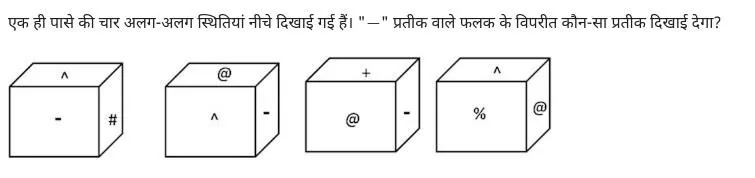
Q25Opposite Facesmoderate
figure
Answer: D
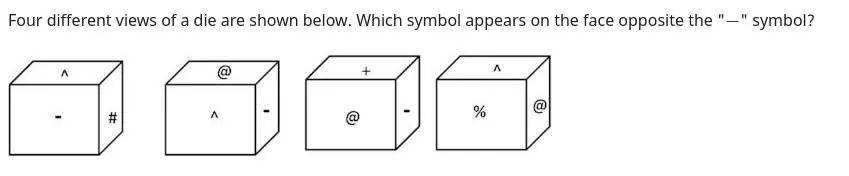
In the four views, the face with '-' sits next to ^, #, @ and + (the top, right and front faces of the different views). The only symbol never seen next to '-' is %, so % is opposite '-'. Answer: D (%). Option D.
figure
उत्तर: D
चारों स्थितियों में '-' वाला फलक ^, #, @ और + के साथ आसपास दिखता है। केवल % कभी '-' के साथ नहीं दिखता, इसलिए % उसके विपरीत है। उत्तर: D (%)। विकल्प D।
🔗 Link