CGL 2026 Tier 1EzSSC Practice
Learn › Shift-wise papers

13 Oct 2026 01:30 PM (Shift-2)

SSC CGL Tier 1 2026 · 100 questions · read with answers, or take it as a timed mock.

Tap an option to check your answer, or use “Show answer”. Switch to Hindi with the हिं button at the top.अंग्रेज़ी के लिए ऊपर EN बटन दबाएँ।
Q1Opposite Faces of a Cube from Neteasy
figure
Answer: C
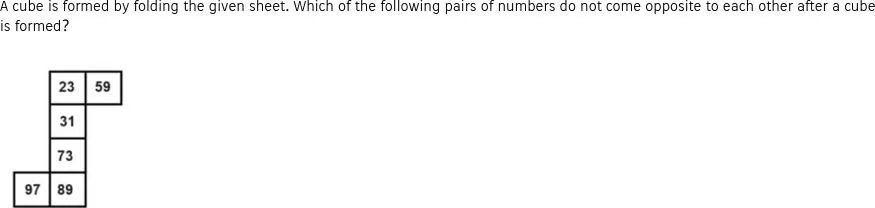
The net has a strip of four squares in a column (23, 31, 73, 89). In a strip of four, the 1st and 3rd faces are opposite and the 2nd and 4th are opposite, so 23-73 and 31-89 are opposite pairs. The square 59 is attached to the right of 23 and the square 97 is attached to the left of 89, so these two lie on the remaining pair of faces and are opposite each other: 59-97. Hence 59-97, 23-73 and 89-31 are opposite pairs. The pair that does not come opposite is 31-59 (option C), since 31 is opposite 89 and 59 is opposite 97. Option C.
figure
उत्तर: C
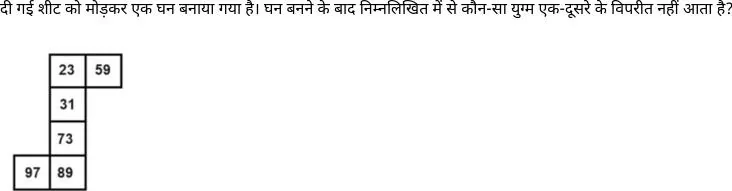
नेट में 23, 31, 73, 89 की एक पंक्ति में चार वर्ग हैं। ऐसी पंक्ति में पहला और तीसरा फलक, तथा दूसरा और चौथा फलक एक-दूसरे के विपरीत होते हैं, इसलिए 23-73 और 31-89 विपरीत युग्म हैं। 59 वर्ग 23 के दाईं ओर और 97 वर्ग 89 के बाईं ओर जुड़े हैं, इसलिए ये शेष दो फलक हैं और एक-दूसरे के विपरीत हैं: 59-97। अतः 59-97, 23-73 और 89-31 विपरीत युग्म हैं। जो युग्म विपरीत नहीं आता, वह 31-59 (विकल्प C) है। विकल्प C।
🔗 Link
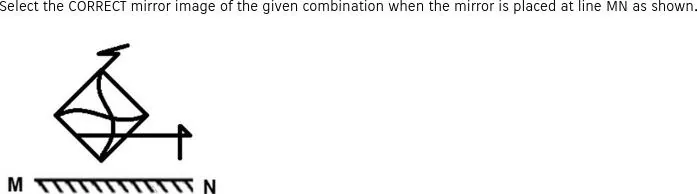
Q2Mirror Image in a Horizontal Mirrormoderate
figure
Answer: C
The mirror is the horizontal line MN, so the image is the reflection of the figure in a horizontal line, i.e. a vertical flip. The top tail becomes a tail at the bottom, the flag at the right end of the bar now points up with its stem above the bar, and the bar moves to the upper part of the rhombus. Option C matches all of these: the bar is in the upper part, the flag stem is above the bar, and the zig-zag tail hangs down-right from the bottom vertex. Option A has the tail pointing down-left, option B has a vertical stem tail instead of a zig-zag, and option D is a left-right reversal. Option C.
figure
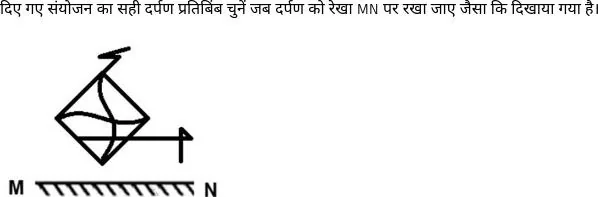
उत्तर: C
दर्पण क्षैतिज रेखा MN है, इसलिए प्रतिबिंब आकृति का ऊर्ध्वाधर उलटाव होगा। ऊपर वाली पूँछ नीचे जाएगी, दंड के दाएँ सिरे का झंडा ऊपर की ओर होगा और दंड रॉम्बस के ऊपरी भाग में आएगा। विकल्प C सभी शर्तें पूरी करता है। विकल्प A में पूँछ बाईं ओर जाती है, विकल्प B में पूँछ सीधी छड़ी जैसी है, और विकल्प D बाएँ-दाएँ उलटा है। विकल्प C।
🔗 Link
Q3Mirror Symmetry in Figure Patternhard
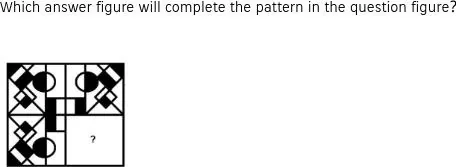
figure
Answer: A
The question figure is left-right symmetric about the central vertical line: the circles, the rectangles and the diagonal shapes in the top-left mirror those in the top-right, and the bottom-left block mirrors into the empty bottom-right cell marked '?'. So the answer should be the left-right mirror image of the bottom-left block. Comparing the mirrored bottom-left block with the four options by pixel agreement, option A matches best (about 85 percent) while B, C and D match less well (about 77 to 81 percent). Options C and D have the black block at the top-left corner, the reverse of the required white-then-black arrangement. Option A.
figure
उत्तर: A
प्रश्न आकृति केंद्रीय ऊर्ध्वाधर रेखा के बाईं-दाईं ओर सममित है। ऊपर-बाएँ और ऊपर-दाएँ के वृत्त, आयत और तिरछे आकार एक-दूसरे के दर्पण प्रतिबिंब हैं, और नीचे-बाएँ खंड का दर्पण प्रतिबिंब '?' वाले खाली भाग में आना चाहिए। तुलना करने पर विकल्प A सबसे अधिक मेल खाता है, पर यह निष्कर्ष कम विश्वास के साथ है। विकल्प A।
🔗 Link
Q4Square Embedded in a Figureeasy
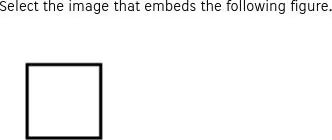
figure
Answer: D
The given figure is a plain square. Option A is an eight-spoke asterisk, option B is a triangle and option C is a four-sided figure with no right angles, so none of them contains a square. Option D is a square divided into four equal parts by a cross, and its outer boundary is a square of the same shape. Hence option D embeds the figure. Option D.
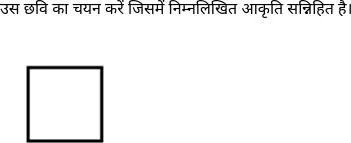
figure
उत्तर: D
दी गई आकृति एक सादा वर्ग है। विकल्प A एक आठ भुजाओं वाला तारा है, विकल्प B त्रिभुज है और विकल्प C में समकोण नहीं हैं, इसलिए इनमें से किसी में वर्ग नहीं है। विकल्प D एक वर्ग है जो क्रॉस रेखाओं से चार भागों में बँटा है, और उसकी बाहरी सीमा वही वर्ग है। अतः विकल्प D आकृति को समाहित करता है। विकल्प D।
🔗 Link
Q5Two-set Venn Diagrameasy
In a class of 100 students, 60 like tea, 50 like coffee, and 30 like both. How many like only tea?
Answer: A
Students who like tea are 60, and 30 of them also like coffee. So the number who like only tea is 60 - 30 = 30. Option A is correct. Option B (40) would be 60 - 20 and wrongly subtracts the coffee-only count, while C (45) and D (35) do not follow from the data. Option A.
100 छात्रों की एक कक्षा में, 60 को चाय, 50 को कॉफ़ी और 30 को दोनों पसंद हैं। कितने छात्रों को केवल चाय पसंद है?
उत्तर: A
चाय पसंद करने वाले 60 छात्र हैं, जिनमें से 30 कॉफ़ी भी पसंद करते हैं। केवल चाय पसंद करने वाले छात्र 60 - 30 = 30 हैं। अतः सही उत्तर विकल्प A है। विकल्प A।
🔗 Link
Q6Two-set Venn Diagrameasy
Among 30 students, 18 like Math, 12 like Science, and 6 like both. How many like only Science?
Answer: A
Students who like Science are 12, and 6 of them also like Math. So those who like only Science = 12 - 6 = 6. Option A is correct. Option B (12) is the total Science count and ignores the overlap; C (9) and D (10) do not follow from the data. Option A.
30 छात्रों में से, 18 गणित, 12 विज्ञान और 6 दोनों पसंद हैं। कितने छात्रों को केवल विज्ञान पसंद है?
उत्तर: A
विज्ञान पसंद करने वाले 12 छात्र हैं, जिनमें से 6 गणित भी पसंद करते हैं। केवल विज्ञान पसंद करने वाले 12 - 6 = 6 हैं। अतः सही उत्तर विकल्प A है। विकल्प A।
🔗 Link
Q7Sum of Even Numberseasy
The sum of even numbers up to 242 is?
Answer: D
The even numbers are 2, 4, 6, ..., 242, which is 242/2 = 121 terms. Their sum is 2(1 + 2 + ... + 121) = 2 x 121 x 122 / 2 = 121 x 122 = 14762. Option D is correct. Option D.
242 तक सम संख्याओं का योग क्या है?
उत्तर: D
सम संख्याएँ 2, 4, 6, ..., 242 हैं, जो कुल 242/2 = 121 पद हैं। इनका योग 2(1 + 2 + ... + 121) = 121 × 122 = 14762 है। सही उत्तर विकल्प D है। विकल्प D।
🔗 Link
Q8Series with Squared Differencesmoderate
Find the missing number in the following series: 9, 9, 12, ?, 35, 59
Answer: B
Find the differences between consecutive terms: 9 to 9 is 0, 9 to 12 is 3, 12 to ? is 8, ? to 35 is 15, and 35 to 59 is 24. These differences are 0, 3, 8, 15, 24, which are 1^2-1, 2^2-1, 3^2-1, 4^2-1, 5^2-1. So the missing term is 12 + 8 = 20, and 20 + 15 = 35 checks out. Option B is correct. Option B.
निम्न श्रेणी में लुप्त संख्या ज्ञात कीजिए: 9, 9, 12, ?, 35, 59
उत्तर: B
क्रमागत पदों के बीच अंतर निकालें: 9 से 9 तक 0, 9 से 12 तक 3, 12 से लुप्त पद तक 8, लुप्त पद से 35 तक 15, और 35 से 59 तक 24। ये अंतर 0, 3, 8, 15, 24 हैं, जो 1²-1, 2²-1, 3²-1, 4²-1, 5²-1 हैं। अतः लुप्त पद 12 + 8 = 20 है, और 20 + 15 = 35 से जाँच सही है। सही उत्तर विकल्प B है। विकल्प B।
🔗 Link
Q9Total from Two Positionseasy
Anil stands 10th from the top and 21st from the bottom. How many students are there in the class?
Answer: C
Total students = position from top + position from bottom - 1 = 10 + 21 - 1 = 30. Option C is correct. Option C.
अनिल ऊपर से 10वें स्थान पर और नीचे से 21वें स्थान पर है। कक्षा में कुल कितने विद्यार्थी हैं?
उत्तर: C
कुल विद्यार्थी = ऊपर से स्थान + नीचे से स्थान - 1 = 10 + 21 - 1 = 30। सही उत्तर विकल्प C है। विकल्प C।
🔗 Link
Q10Interchanging Signsmoderate
Which two signs should be interchanged to make the given equation correct?
40 ÷ 8 × 5 + 15 − 2 = 30
Answer: D
Swapping x and - in 40 ÷ 8 × 5 + 15 − 2 gives 40 ÷ 8 − 5 + 15 × 2. Now 40 ÷ 8 = 5 and 15 × 2 = 30, so the expression is 5 − 5 + 30 = 30, which is correct. The other swaps give 78 (× and +), 40 + 8 × 5 ÷ 15 − 2 (÷ and +) and 12 (+ and −), none of which equals 30. Option D is correct. Option D.
निम्नलिखित समीकरण को सही बनाने के लिए किन दो चिन्हों को आपस में बदला जाना चाहिए?
40 ÷ 8 × 5 + 15 − 2 = 30
उत्तर: D
समीकरण 40 ÷ 8 × 5 + 15 − 2 में × और − को बदलने पर 40 ÷ 8 − 5 + 15 × 2 बनता है। यहाँ 40 ÷ 8 = 5 और 15 × 2 = 30 है, तो व्यंजक 5 − 5 + 30 = 30 होता है, जो सही है। अन्य विकल्प 30 नहीं देते। सही उत्तर विकल्प D है। विकल्प D।
🔗 Link
Q11Backup Before Software Updateeasy
In the following question a statement is given followed by some assumptions. Read the assumptions carefully and choose the appropriate option.
Statement:
Kindly save a backup of all project files before updating the software.
Assumptions:
I. Updating the software may affect existing files.
II. Preserving project files is important.
Answer: D
The statement asks for a backup before updating, which only makes sense if the update could harm project files, so assumption I is implicit. The backup is meant to keep project files safe, so assumption II is also implicit. Both are implicit, so option D is correct. Option D.
निम्नलिखित प्रश्न में एक कथन दिया गया है, जिसके बाद कुछ मान्यताएँ दी गई हैं। मान्यताओं को ध्यानपूर्वक पढ़िए और उपयुक्त विकल्प का चयन कीजिए।
कथन:
सॉफ़्टवेयर को अद्यतन करने से पहले कृपया सभी परियोजना फ़ाइलों का बैकअप सुरक्षित कर लें।
मान्यताएँ:
I. सॉफ़्टवेयर को अद्यतन करने से मौजूदा फ़ाइलें प्रभावित हो सकती हैं।
II. परियोजना फ़ाइलों को सुरक्षित रखना महत्वपूर्ण है।
उत्तर: D
कथन में अद्यतन से पहले बैकअप माँगा गया है, जो तभी उचित है जब अद्यतन से फ़ाइलों को नुकसान हो सकता हो, इसलिए मान्यता I निहित है। बैकअप परियोजना फ़ाइलों को सुरक्षित रखने के लिए है, इसलिए मान्यता II भी निहित है। अतः सही उत्तर विकल्प D है। विकल्प D।
🔗 Link
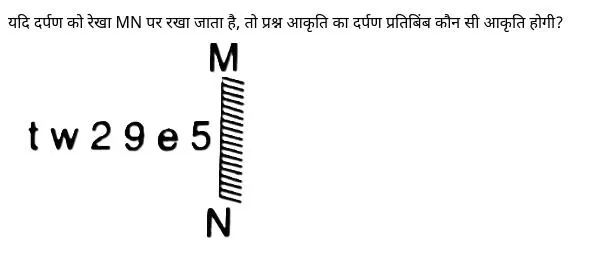
Q12Mirror Image in a Vertical Mirrormoderate
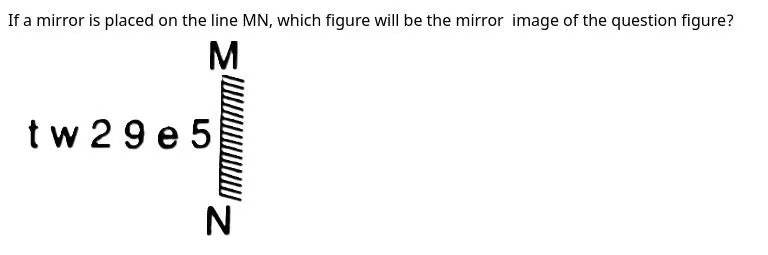
figure
Answer: A
The mirror MN is vertical, so the image is a left-right reflection: the string order reverses and each character is flipped horizontally. Flipping the question string gives 5, e-mirror, 9-mirror, 2-mirror, w, t in that order. Option A matches this glyph sequence. Option B shows the 9 rotated into a 6, which is a vertical flip rather than a horizontal one; the other options were judged to differ in glyph shape. Option A.
figure
उत्तर: A
दर्पण MN ऊर्ध्वाधर है, इसलिए प्रतिबिंब बाएँ-दाएँ उलटा होगा: अक्षरों का क्रम उलटा होगा और हर अक्षर क्षैतिज रूप से पलटा होगा। विकल्प A यही क्रम दिखाता है। सही उत्तर विकल्प A है। विकल्प A।
🔗 Link
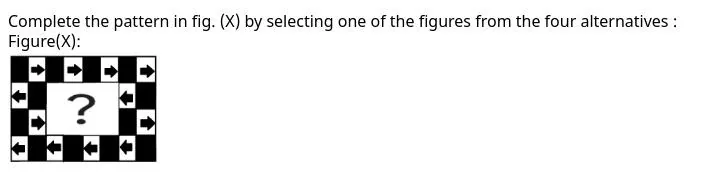
Q13Arrow and Colour Alternation Patternhard
figure
Answer: B
Ring cells alternate black and white (black where row+column is even). The arrows on white cells alternate by row: row 1 right, row 2 left, row 3 right, row 4 left. So the centre 4x2 block has, in its top row, white-left-arrow, black, white-left-arrow, black, and in its bottom row, black, white-right-arrow, black, white-right-arrow. Option B matches both rows exactly, so option B is correct. Option B.
figure
उत्तर: B
बॉर्डर के खाने काली और सफ़ेद बारी-बारी से हैं (जहाँ पंक्ति+स्तंभ सम हो वहाँ काला)। सफ़ेद खानों के तीर पंक्ति-दर-पंक्ति बदलते हैं: पंक्ति 1 दाएँ, पंक्ति 2 बाएँ, पंक्ति 3 दाएँ, पंक्ति 4 बाएँ। अतः केंद्र के 4x2 भाग की ऊपरी पंक्ति में बाएँ तीर वाला सफ़ेद, काला, बाएँ तीर वाला सफ़ेद, काला; और निचली पंक्ति में काला, दाएँ तीर वाला सफ़ेद, काला, दाएँ तीर वाला सफ़ेद होना चाहिए। विकल्प B दोनों पंक्तियों से मेल खाता है, इसलिए B सही है। विकल्प B।
🔗 Link
Q14Column Relationship in a Tablemoderate
Which of the following rows/columns are connected/related with each other in some way?
RowsColumns
IIIIIIIVV
1214231530
2184242040
3244852550
4275463060
5306073570
Answer: C
Column III has 3, 4, 5, 6, 7. Column IV is 5 times column III (15, 20, 25, 30, 35), and column V is 10 times column III (30, 40, 50, 60, 70). So III, IV and V are related. Columns I (21, 18, 24, 27, 30) and II (42, 42, 48, 54, 60) do not follow the same n, 5n, 10n pattern, so they are excluded. Option C is correct. Option C.
निम्नलिखित में से कौन-सी पंक्तियाँ/स्तंभ किसी न किसी प्रकार से एक-दूसरे से संबंधित हैं?
पंक्तियाँस्तंभ
IIIIIIIVV
1214231530
2184242040
3244852550
4275463060
5306073570
उत्तर: C
स्तंभ III में 3, 4, 5, 6, 7 हैं। स्तंभ IV उसका 5 गुना (15, 20, 25, 30, 35) और स्तंभ V उसका 10 गुना (30, 40, 50, 60, 70) है। अतः III, IV और V संबंधित हैं। सही उत्तर विकल्प C है। विकल्प C।
🔗 Link
Q15Resistance to Manipulationeasy
From a psychological perspective, which type of individual is typically the hardest to manipulate or influence?
Answer: A
A person with deep self-awareness of their own motives and values has a stable inner reference point, so outside pressure and flattery are less likely to steer them. The other options describe people who are more open to influence: those driven by emotional impulses, those who conform to social proof, and those who are confused and seeking direction. Option A.
मनोवैज्ञानिक परिप्रेक्ष्य के अनुसार, सामान्यतः किस प्रकार के व्यक्ति को मैनिपुलेट या प्रभावित करके उसको नियंत्रित करना सबसे कठिन होता है?
उत्तर: A
जिस व्यक्ति को अपने उद्देश्यों और मूल्यों का गहरा आत्मबोध होता है, उसका आंतरिक मार्गदर्शक स्थिर होता है, इसलिए बाहरी दबाव उसे आसानी से नहीं मोड़ पाता। अन्य विकल्प ऐसे लोगों के हैं जो प्रभाव के प्रति अधिक संवेदनशील हैं। अतः सही उत्तर विकल्प A है। विकल्प A।
🔗 Link
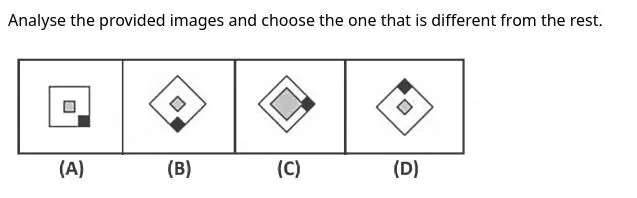
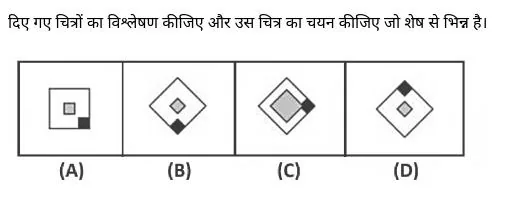
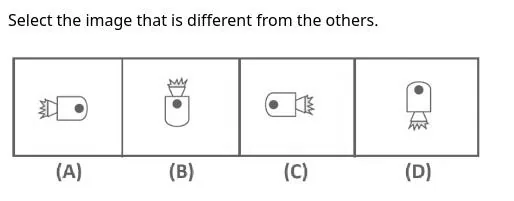
Q16Odd Figure Out by Orientationeasy
figure
Answer: C
A, B and D are the same figure (outer square, small inner square, black marker at a corner) shown in different rotations. In C the inner square is much larger than in the others, so C is the odd one out. Option C.
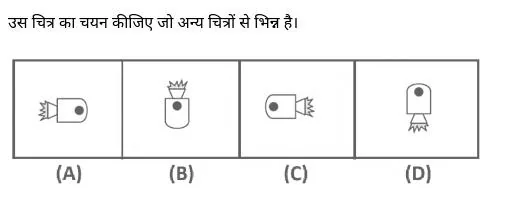
figure
उत्तर: C
A, B और D एक ही आकृति (बाहरी वर्ग, छोटा भीतरी वर्ग, कोने पर काला चिह्न) के अलग-अलग घुमाव हैं। C में भीतरी वर्ग बाकी की तुलना में बहुत बड़ा है, इसलिए C भिन्न है। विकल्प C।
🔗 Link
Q17Odd Figure Out by Dot Positionmoderate
figure
Answer: B
A, C and D can be obtained from one another by rotation with the flame always on the end away from the dot and the body shape unchanged; in B the body/flame arrangement does not match the rotated form of the others (the flame end is attached differently), so B is the odd one out. Option B.
figure
उत्तर: B
A, C और D एक-दूसरे को घुमाकर प्राप्त किए जा सकते हैं; B की व्यवस्था घुमाए गए रूप से मेल नहीं खाती, इसलिए B भिन्न है। विकल्प B।
🔗 Link
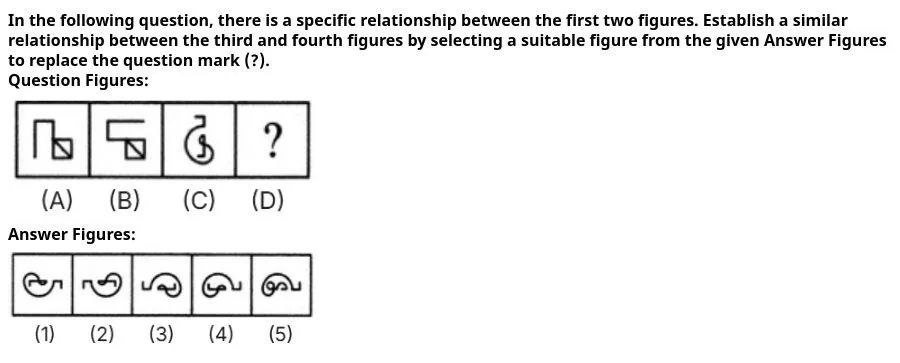
Q18Figure Analogy with Mirror Relationhard
figure
Answer: B
Figure (B) is figure (A) rotated through 90 degrees. Rotating figure (C) in the same way gives answer figure (3), which is printed as option B ("3"). Option B.
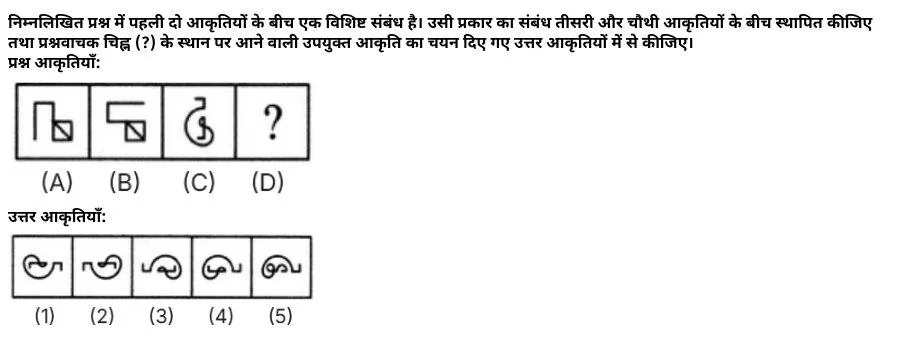
figure
उत्तर: B
आकृति (B), आकृति (A) को 90 डिग्री घुमाने से बनती है। आकृति (C) को उसी प्रकार घुमाने पर उत्तर आकृति (3) मिलती है, जो विकल्प B ("3") है। विकल्प B।
🔗 Link
Q19Figure Analogy with Mirror Relationhard
figure
Answer: A
Figure (B) is the lateral (mirror) image of figure (A). Taking the mirror image of figure (C) gives answer figure (2), printed as option A ("2"). Option A.
figure
उत्तर: A
आकृति (B), आकृति (A) का दर्पण प्रतिबिंब है। आकृति (C) का दर्पण प्रतिबिंब उत्तर आकृति (2) है, जो विकल्प A ("2") है। विकल्प A।
🔗 Link
Q20Fill the Blanks in Letter Seriesmoderate
Fill in the blanks (_) using one of the following four options such that the series follows a specific pattern in the given order. m_om mn_m _nom mn_m
Answer: B
Put the letters of each option into the four blanks in order. With option B (nomo), the blanks become n, o, m, o, giving the groups mnom, mnom, mnom, mnom. Every group then reads m-n-o-m, so the series is consistent. Option B is correct. Option B.
निम्नलिखित चार विकल्पों में से एक का प्रयोग करके रिक्त स्थानों (_) को इस प्रकार भरिए कि श्रेणी दिए गए क्रम में एक निश्चित पैटर्न का पालन करे। m_om mn_m _nom mn_m
उत्तर: B
प्रत्येक विकल्प के अक्षरों को क्रम से चार रिक्त स्थानों में रखें। विकल्प B (nomo) से रिक्त स्थान n, o, m, o बनते हैं, और हर समूह mnom बनता है। अतः सही उत्तर विकल्प B है। विकल्प B।
🔗 Link
Q21Figure X in Answer Figuresmoderate
figure
Answer: C
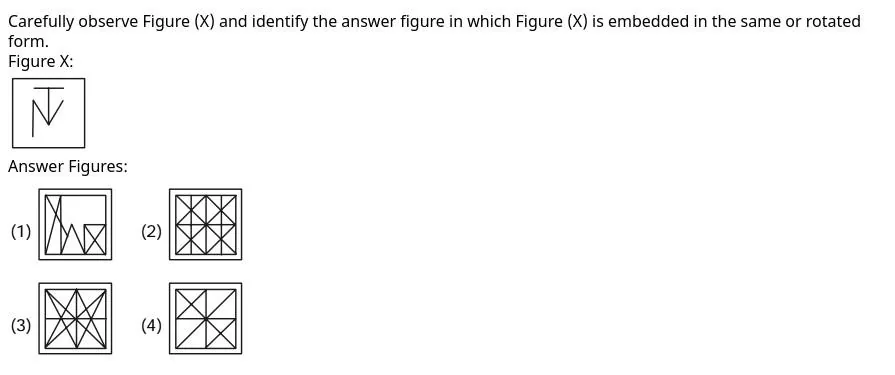
The T-bar with the N-shaped zigzag of figure X can be traced in answer figure (2), whose grid lines and cell diagonals contain the vertical stroke, the top bar and the slanting lines in the same arrangement. Answer figure (2) is printed as option C ("2"). Option C.
figure
उत्तर: C
आकृति X का T-आकार और N-आकार की टेढ़ी रेखाएँ उत्तर आकृति (2) में उसी व्यवस्था में दिखाई देती हैं। उत्तर आकृति (2) विकल्प C ("2") है। विकल्प C।
🔗 Link
Q22Symbol Position Cyclehard
figure
Answer: B
Track the symbols by position across the five problem figures. The bottom-left symbol cycles arrow, cross, triangle, equals, arrow, so the sixth figure has a cross there. The top-right symbol cycles triangle, equals, arrow, cross, triangle, so the sixth has an equals sign there. Option B has a cross bottom-left and an equals top-right, so it continues the series. Confidence is medium. Option B.
figure
उत्तर: B
पाँच प्रश्न आकृतियों में स्थिति के अनुसार चिह्नों को देखें। निचले बाएँ चिह्न का चक्र तीर, क्रॉस, त्रिभुज, बराबर, तीर है, इसलिए छठी आकृति में क्रॉस होगा। ऊपर दाएँ चिह्न का चक्र त्रिभुज, बराबर, तीर, क्रॉस, त्रिभुज है, इसलिए छठी में बराबर होगा। अतः सही उत्तर विकल्प B है। विकल्प B।
🔗 Link
Q23Eligibility Based Decisioneasy
Read the given situation carefully and consider all the relevant facts, conditions and constraints. Choose the option that represents the most appropriate, practical and logical decision based solely on the information provided. A non-profit foundation provides medical treatment grants to senior citizens who are above 60 years old, do not have any active health insurance policy and have an annual household income under $15,000. Mrs. Sharma is 67 years old, does not have any health insurance coverage and has a documented annual household income of $12,500. What decision should the foundation take?
Answer: C
Mrs. Sharma meets all three conditions: she is 67 (above 60), she has no active health insurance, and her documented household income of $12,500 is under $15,000. The data is complete, so no referral or rejection is needed. The answer is option C, the senior citizen should be selected. Option C.
दिए गए परिस्थिति को ध्यानपूर्वक पढ़ें और सभी महत्वपूर्ण तथ्यों, शर्तों और सीमाओं पर विचार करें। केवल दी गई जानकारी के आधार पर सबसे उचित, व्यावहारिक और तार्किक निर्णय को दर्शाने वाले विकल्प का चयन करें। एक गैर-लाभकारी फाउंडेशन उन वरिष्ठ नागरिकों को चिकित्सा उपचार अनुदान प्रदान करता है जो 60 वर्ष से अधिक आयु के हैं, उनके पास कोई सक्रिय स्वास्थ्य बीमा पॉलिसी नहीं है और उनकी वार्षिक घरेलू आय $15,000 से कम है। श्रीमती शर्मा 67 वर्ष की हैं, उनके पास कोई स्वास्थ्य बीमा कवर नहीं है और उनकी दस्तावेज़ वाली वार्षिक घरेलू आय $12,500 है। फाउंडेशन को क्या निर्णय लेना चाहिए?
उत्तर: C
श्रीमती शर्मा तीनों शर्तें पूरी करती हैं: वह 67 वर्ष की हैं (60 से अधिक), उनके पास कोई सक्रिय स्वास्थ्य बीमा नहीं है, और उनकी दस्तावेज़ी घरेलू आय $12,500 है जो $15,000 से कम है। डेटा पूरा है, इसलिए न तो अध्यक्ष को भेजने की और न ही खारिज करने की आवश्यकता है। अतः सही उत्तर विकल्प C है। विकल्प C।
🔗 Link
Q24Odd Letter Groupeasy
Choose the odd group.
Answer: C
ACEG, BDFH and DFHJ each move forward by two letters at every step (A, C, E, G; B, D, F, H; D, F, H, J). In CEGJ, the steps are C to E (2), E to G (2) and G to J (3), which breaks the pattern. So CEGJ is the odd group, option C. Option C.
असंगत समूह का चयन कीजिए।
उत्तर: C
ACEG, BDFH और DFHJ में हर चरण पर दो अक्षर आगे बढ़ते हैं। CEGJ में G से J तक तीन अक्षर का अंतर है, जो पैटर्न तोड़ता है। अतः असंगत समूह विकल्प C है। विकल्प C।
🔗 Link
Q25Unfolding Punched Paperhard
figure
Answer: D
The paper is folded down (horizontal fold) and then left (vertical fold), so when opened the single punched symbol becomes four symbols: a mirror pair across each fold line. The correct answer must show the symbol mirrored horizontally in the top row and vertically between rows. Option D is chosen because its 2x2 arrangement appears to have this mirror relation. Confidence is low because the glyph orientations are too small to verify with certainty. Option D.
figure
उत्तर: D
कागज़ को पहले नीचे की ओर (क्षैतिज मोड़) और फिर बाईं ओर (ऊर्ध्वाधर मोड़) मोड़ा गया है, इसलिए खोलने पर एक पंच के चार चिह्न बनेंगे जो हर मोड़ रेखा के आर-पार दर्पण युग्म होंगे। विकल्प D इस संबंध से मेल खाता है। विश्वास कम है। विकल्प D।
🔗 Link