Tap an option to check your answer, or use “Show answer”. Switch to Hindi with the हिं button at the top.अंग्रेज़ी के लिए ऊपर EN बटन दबाएँ।
Q1Interchanging Signseasy
Correct the equation by interchanging the two signs.
$15 + 9 - 6 \times 3 \div 2 = 20$
Answer: A
Check each swap. Swapping $\times$ and $\div$ gives $15 + 9 - 6 \div 3 \times 2$; here $6 \div 3 = 2$ and $2 \times 2 = 4$, so the value is $24 - 4 = 20$, which is correct. Option B ($+$ and $-$) gives $15$, option C ($-$ and $\times$) gives $67.5$, and option D ($\div$ and $-$) gives $17.5$. Hence A. Option A.
दोनों चिह्नों को आपस में बदलकर समीकरण को सही करें।
$15 + 9 - 6 \times 3 \div 2 = 20$
उत्तर: A
सबसे पहले हर विकल्प की जाँच करें। A में × और ÷ बदलने पर $15 + 9 - 6 \div 3 \times 2$ बनता है। यहाँ $6 \div 3 = 2$ और $2 \times 2 = 4$ है, तो मान $24 - 4 = 20$ होता है, जो सही है। B (+ और −) से मान 15, C (− और ×) से $67.5$ और D (÷ और −) से $17.5$ आता है। अतः उत्तर A है। विकल्प A।
Both 8 and 27 are cubes: $8 = 2^{3}$ and $27 = 3^{3}$. The pair $8 : 28$ fits the rule $n^{3} \to (n+1)^{3} + 1$, since $2^{3} \to 3^{3} + 1 = 28$. Applying the same rule to $27 = 3^{3}$ gives $4^{3} + 1 = 65$, which is option B. Options A (63), C (67) and D (68) do not follow this rule. Option B.
लुप्त संख्या ज्ञात कीजिए: $8 : 28 :: 27 : ?$
उत्तर: B
दोनों संख्याएँ घन हैं: $8 = 2^{3}$ और $27 = 3^{3}$। जोड़ा $8 : 28$ नियम $n^{3} \to (n+1)^{3} + 1$ से मेल खाता है, क्योंकि $2^{3} \to 3^{3} + 1 = 28$। इसी नियम को $27 = 3^{3}$ पर लगाने से $4^{3} + 1 = 65$ मिलता है, यानी विकल्प B। विकल्प A (63), C (67) और D (68) इस नियम से नहीं मिलते। विकल्प B।
A man introduces a woman saying, “She is the daughter of the only son of my father’s wife.” How is the woman related to the man?
Answer: A
The man’s father’s wife is his mother. The only son of his mother is the man himself, so the woman is the man’s daughter. Option A (Daughter) is correct; B (Sister), C (Niece) and D (Cousin) are wrong. Option A.
एक आदमी एक औरत का परिचय देते हुए कहता है, “वह मेरे पिता की पत्नी के इकलौते बेटे की बेटी है।” औरत का उस आदमी से क्या रिश्ता है?
उत्तर: A
आदमी के पिता की पत्नी उसकी माँ है। माँ का इकलौता बेटा स्वयं वह आदमी है, इसलिए वह औरत उसकी बेटी है। विकल्प A (बेटी) सही है; B (बहन), C (भतीजी) और D (चचेरा) गलत हैं। विकल्प A।
In the question below three statements are given followed by four conclusions numbered I, II, III and IV. You must take the given statements to be true even if they seem to be at variance with commonly known facts and then decide which of the given conclusions logically follows from the given statements, disregarding commonly known facts.
Statements:
All doctors attend conferences.
Some conference attendees are not experienced.
All experienced people lead research teams.
Conclusions:
I. Some doctors are not experienced.
II. Some conference attendees lead research teams.
III. All experienced people attend conferences.
IV. Some research team leaders are not conference attendees.
Answer: D
Statements: all doctors are attendees; some attendees are not experienced; all experienced people lead research teams. I: the non-experienced attendees need not include any doctor, so it is not forced. II: nothing links the non-experienced attendees to the leaders, so it is not forced. III: the statements place attendees inside the doctors' group, not the reverse, so experienced people need not attend. IV: nothing forces leaders to lie outside the attendees. None follows, so option D. Option D.
नीचे दिए गए प्रश्न में तीन कथन दिए गए हैं और उनके बाद I, II, III और IV संख्यांकित चार निष्कर्ष दिए गए हैं। आपको दिए गए कथनों को सत्य मानना है, भले ही वे सामान्यतः ज्ञात तथ्यों से भिन्न प्रतीत होते हों, और फिर सामान्यतः ज्ञात तथ्यों की उपेक्षा करते हुए यह तय कीजिए कि दिए गए निष्कर्षों में से कौन-सा निष्कर्ष, तार्किक रूप से दिए गए कथनों का अनुसरण करता है।
कथन:
सभी डॉक्टर सम्मेलनों में भाग लेते हैं।
सम्मेलनों में भाग लेने वाले कुछ लोग अनुभवी नहीं हैं।
सभी अनुभवी लोग अनुसंधान टीमों का नेतृत्व करते हैं।
निष्कर्ष:
I. कुछ डॉक्टर अनुभवी नहीं हैं।
II. सम्मेलनों में भाग लेने वाले कुछ लोग अनुसंधान टीमों का नेतृत्व करते हैं।
III. सभी अनुभवी लोग सम्मेलनों में भाग लेते हैं।
IV. अनुसंधान टीमों का नेतृत्व करने वाले कुछ लोग सम्मेलनों में भाग लेने वाले नहीं हैं।
उत्तर: D
कथनों से केवल इतना पता है कि सभी डॉक्टर सम्मेलनों में जाते हैं, कुछ सम्मेलन-भागीदार अनुभवी नहीं हैं, और सभी अनुभवी लोग नेतृत्व करते हैं। I, II, III और IV में से कोई भी निश्चित रूप से नहीं निकलता। अतः उत्तर D (कोई भी अनुसरण नहीं करता) है। विकल्प D।
Which of the following numbers will replace the question mark (?) in the given series?
$1, 9, 65, 457, ?$
Answer: B
The differences between consecutive terms are $8$, $56$ and $392$, and each is 7 times the one before ($8 \times 7 = 56$, $56 \times 7 = 392$). The next difference is $392 \times 7 = 2744$, so the missing term is $457 + 2744 = 3201$, option B. Option B.
निम्न श्रेणी में प्रश्न चिन्ह (?) के स्थान पर कौन-सी संख्या आएगी?
$1, 9, 65, 457, ?$
उत्तर: B
पदों के बीच अंतर $8$, $56$ और $392$ है, जो हर बार पिछले अंतर का 7 गुना है। अगला अंतर $392 \times 7 = 2744$ होगा, तो प्रश्न चिह्न की संख्या $457 + 2744 = 3201$ है, यानी विकल्प B।
How many letters will remain at the same position in the word ‘PRINTER’ when arranged alphabetically?
Answer: A
Alphabetical order of PRINTER is E, I, N, P, R, R, T. Comparing position by position: P with E, R with I, I with N, N with P, T with R, E with R, R with T. None matches, so no letter stays in place. Option A.
शब्द ‘PRINTER’ के अक्षरों को वर्णानुक्रम में व्यवस्थित करने पर कितने अक्षर अपने मूल स्थान पर बने रहेंगे?
उत्तर: A
PRINTER के अक्षरों का वर्णानुक्रम E, I, N, P, R, R, T है। मूल शब्द और वर्णानुक्रम के हर स्थान की तुलना करने पर कोई भी अक्षर मेल नहीं खाता। अतः 0 अक्षर अपने मूल स्थान पर रहेंगे, यानी विकल्प A।
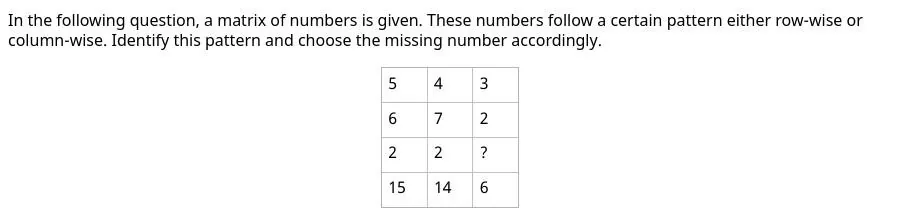
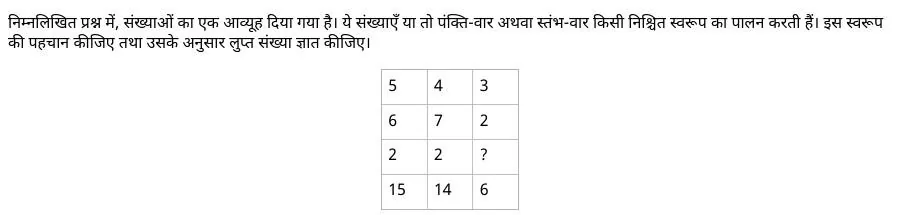
In each column, the product of the top two numbers equals the product of the bottom two. Column 1: $5 \times 6 = 30 = 2 \times 15$. Column 2: $4 \times 7 = 28 = 2 \times 14$. Column 3: $3 \times 2 = 6$, so $? \times 6 = 6$ and $? = 1$. Option B.
उत्तर: B
हर स्तंभ में ऊपर की दो संख्याओं का गुणनफल नीचे की दो संख्याओं के गुणनफल के बराबर है। स्तंभ 1: $5 \times 6 = 30 = 2 \times 15$। स्तंभ 2: $4 \times 7 = 28 = 2 \times 14$। स्तंभ 3: $3 \times 2 = 6$, अतः $? \times 6 = 6$ से $? = 1$ है, यानी विकल्प B।
Read the following information carefully and answer the question that follows.
1. A + B means “A is the brother of B”
2. A * B means “A is the father of B”
3. A / B means “A is the mother of B”
Which of the following expressions correctly represents the relationship that P is the son of S?
Answer: D
$S * P$ says S is the father of P. $P + Q$ says P is the brother of Q, which makes P a male child, so P is S’s son. Option D is correct. Option A (P brother of Q, Q father of S) and option C (P brother of Q, Q mother of S) both make P an uncle of S, not the son. Option B makes P the father of Q. Option D.
नीचे दी गई जानकारी को ध्यान से पढ़ें और उसके बाद पूछे गए सवाल का जवाब दें।
1. A + B का मतलब है “A, B का भाई है”
2. A * B का मतलब है “A, B का पिता है”
3. A / B का मतलब है “A, B की माँ है”
इनमें से कौन-सा एक्सप्रेशन सही ढंग से यह बताता है कि P, S का बेटा है?
उत्तर: D
$S * P$ से S, P का पिता है और $P + Q$ से P, Q का भाई है, यानी P पुरुष संतान है। अतः P, S का बेटा है और विकल्प D सही है। A और C में P, S का चाचा बनता है, जबकि B में P, Q का पिता बनता है। विकल्प D।
Read the following instructions and answer the question that follows:
1. A + B, then A is the brother of B.
2. A % B, then A is the son of B.
3. A & B, then A is the wife of B.
4. A = B, then A is the husband of B.
5. A @ B, then A is the daughter of B.
If C & D + E @ F = G @ H, then which of the following options is not correct?
Answer: C
C & D: C is the wife of D. D + E: D is the brother of E. E @ F: E is the daughter of F. F = G: F is the husband of G. G @ H: G is the daughter of H. So E is the daughter of F and G, and G is H’s daughter, making E the granddaughter of H (A is correct). C is D’s wife, so she is F’s daughter-in-law (B is correct). D is E’s brother, so D is the son of F and G (D is correct). But F is G’s husband and E’s father, so F is not the mother of E. Option C is the incorrect statement. Option C.
नीचे दिए गए निर्देशों को पढ़ें और उसके बाद पूछे गए सवाल का जवाब दें:
1. A + B, तो A, B का भाई है।
2. A % B, तो A, B का बेटा है।
3. A & B, तो A, B की पत्नी है।
4. A = B, तो A, B का पति है।
5. A @ B, तो A, B की बेटी है।
अगर C & D + E @ F = G @ H है, तो इनमें से कौन-सा विकल्प सही नहीं है?
उत्तर: C
C & D से C, D की पत्नी है। D + E से D, E का भाई है। E @ F से E, F की बेटी है। F = G से F, G का पति है। G @ H से G, H की बेटी है। अतः E, H की पोती है (A सही है); C, F की बहू है (B सही है); D, F और G का बेटा है (D सही है)। लेकिन F, G का पति और E का पिता है, माँ नहीं। अतः C गलत है। विकल्प C।
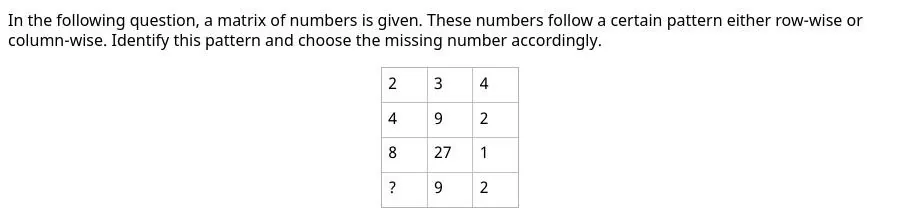
In rows 1 to 3, the product of the first and third numbers is always 8: $2 \times 4 = 8$, $4 \times 2 = 8$, $8 \times 1 = 8$. So $? \times 2 = 8$, giving $? = 4$, option C. Option D (16) would only fit doubling down the first column, which breaks the row rule. The middle column (3, 9, 27, 9) fits neither rule clearly. Option C.
उत्तर: C
पहली तीन पंक्तियों में पहले और तीसरे अंक का गुणनफल हमेशा 8 है: $2 \times 4 = 8$, $4 \times 2 = 8$, $8 \times 1 = 8$। अतः $? \times 2 = 8$ से $? = 4$ है, यानी विकल्प C। विकल्प D (16) केवल पहले स्तंभ के दोगुने होने से मिलता है, पर वह पंक्ति वाले नियम से मेल नहीं खाता। विकल्प C।
In a secure database, roll numbers follow the format: [Digit A] [Digit B] [Digit C] where $A \times C = B + 2$. Which of the following roll number is invalid?
Answer: D
The rule is $A \times C = B + 2$. For 373: $3 \times 3 = 9 = 7 + 2$ (valid). For 462: $4 \times 2 = 8 = 6 + 2$ (valid). For 582: $5 \times 2 = 10 = 8 + 2$ (valid). 6112 has four digits, but the format has three, so it is invalid. Read as 6, 1, 1 it also fails, since $6 \times 1 = 6 \neq 3$. Option D.
एक सुरक्षित डेटाबेस में, रोल नंबर इस फ़ॉर्मैट में होते हैं: [अंक A] [अंक B] [अंक C] जहाँ $A \times C = B + 2$ है। इनमें से कौन-सा रोल नंबर अमान्य है?
उत्तर: D
नियम है $A \times C = B + 2$। 373: $3 \times 3 = 9 = 7 + 2$ (मान्य)। 462: $4 \times 2 = 8 = 6 + 2$ (मान्य)। 582: $5 \times 2 = 10 = 8 + 2$ (मान्य)। 6112 में चार अंक हैं, जबकि फ़ॉर्मैट में तीन अंक हैं, अतः यह अमान्य है। उत्तर D। विकल्प D।
Study the pattern in the given series and find the next set of letters in the series.
KAN, OZR, SYV, ?
Answer: A
Take each position separately. First letters: K (11), O (15), S (19) rise by 4, so the next is W (23). Second letters: A (1), Z (26), Y (25) fall by 1 each, so the next is X (24). Third letters: N (14), R (18), V (22) rise by 4, so the next is Z (26). The answer is WXZ, option A. Option A.
दी गई श्रृंखला के प्रतिरूप का अध्ययन कीजिए तथा श्रृंखला में अक्षरों के अगले समूह का पता लगाइए।
KAN, OZR, SYV, ?
उत्तर: A
हर स्थान के अक्षर अलग-अलग देखें। पहले अक्षर K (11), O (15), S (19) में 4 जुड़ता है, अगला W है। दूसरे अक्षर A (1), Z (26), Y (25) में 1 घटता है, अगला X है। तीसरे अक्षर N (14), R (18), V (22) में 4 जुड़ता है, अगला Z है। अतः उत्तर WXZ, यानी विकल्प A है। विकल्प A।
Select the odd number pair from the given alternatives.
Answer: C
In each pair the second number is $n^{2} + n$ for the first number $n$: $25^{2} + 25 = 650$, $16^{2} + 16 = 272$, $20^{2} + 20 = 420$. For 13, $13^{2} + 13 = 182$, not 186. So (13, 186) is the odd pair, option C. Option C.
निम्नलिखित विकल्पों में से विषम संख्या युग्म का चयन कीजिए।
उत्तर: C
हर युग्म में दूसरी संख्या पहली संख्या $n$ के लिए $n^{2} + n$ है: $25^{2} + 25 = 650$, $16^{2} + 16 = 272$, $20^{2} + 20 = 420$। परंतु $13^{2} + 13 = 182$ है, 186 नहीं। अतः विषम युग्म (13, 186) है, यानी विकल्प C।
Read the question carefully and choose the most appropriate option.
You are managing a community cleanliness drive. Participation is lower than expected because many residents believe the effort will not make a difference. What would you do?
Answer: D
The problem is low participation because residents think the drive will achieve nothing. The best response addresses that belief directly by engaging residents positively and explaining the benefits. Option A (public criticism) damages trust, option B (cancelling) gives up too early, and option C (continuing silently) ignores the low involvement. Option D is best. Option D.
प्रश्न को ध्यानपूर्वक पढ़ें और सबसे उपयुक्त विकल्प का चयन करें।
आप एक सामुदायिक स्वच्छता अभियान का प्रबंधन कर रहे हैं। अपेक्षा से कम भागीदारी हो रही है क्योंकि अनेक निवासी यह मानते हैं कि इस प्रयास से कोई विशेष परिवर्तन नहीं आएगा। आप क्या करेंगे?
उत्तर: D
समस्या निवासियों के इस विश्वास की है कि अभियान से कोई बदलाव नहीं आएगा। सबसे उपयुक्त उत्तर उसी विश्वास को सकारात्मक संवाद और लाभों की व्याख्या से दूर करना है। A में सार्वजनिक आलोचना भरोसा तोड़ती है, B में अभियान जल्दी रद्द होता है और C में कम भागीदारी की अनदेखी होती है। अतः उत्तर D है। विकल्प D।
What should come in place of question mark (?) in the following analogy?
$G7M : N14T :: U21A : ?$
Answer: A
Each element of G7M moves forward by 7 to give N14T: G to N (7 to 14), 7 to 14, and M to T (13 to 20). Applying the same step to U21A: U to B (21 + 7 = 28, wrapping to 2), 21 to 28, and A to H (1 + 7 = 8). The answer is B28H, option A. Option A.
निम्नलिखित सादृश्य में प्रश्न चिह्न (?) के स्थान पर क्या आएगा?
$G7M : N14T :: U21A : ?$
उत्तर: A
G7M के हर घटक को 7 स्थान आगे बढ़ाने से N14T बनता है: G→N (7→14), 7→14 और M→T (13→20)। इसी चरण को U21A पर लगाने से U→B (21+7=28, वर्णमाला में लौटकर B), 21→28 और A→H (1+7=8) मिलता है। अतः उत्तर B28H, यानी विकल्प A है। विकल्प A।
In the given question, a few statements have been given followed by conclusions based on them. Consider the statements to be true and answer which of the given conclusions logically follow the statement.
Statements
1. All architects are planners.
2. All planners are visionaries.
3. No visionary is impractical.
Conclusions
I. All architects are visionaries.
II. No architect is impractical.
III. Some visionaries are architects.
IV. No planner is impractical.
Answer: C
Architects lie inside planners, and planners lie inside visionaries; no visionary is impractical. I: all architects are visionaries - follows. II: architects are visionaries, so no architect is impractical - follows. III: since all architects are visionaries and the class of architects is taken as non-empty (standard convention in these questions), some visionaries are architects - follows. IV: all planners are visionaries, so no planner is impractical - follows. All four follow. Option C.
दिए गए प्रश्न में, कुछ कथन दिए गए हैं और उनके बाद उन पर आधारित निष्कर्ष दिए गए हैं। कथनों को सत्य मानते हुए यह तय कीजिए कि दिए गए निष्कर्षों में से कौन-से निष्कर्ष तार्किक रूप से कथनों का अनुसरण करते हैं।
कथन:
1. सभी वास्तुकार, योजनाकार हैं।
2. सभी योजनाकार, दूरदर्शी हैं।
3. कोई भी दूरदर्शी, अव्यावहारिक (impractical) नहीं है।
निष्कर्ष:
I. सभी वास्तुकार, दूरदर्शी हैं।
II. कोई भी वास्तुकार, अव्यावहारिक नहीं है।
III. कुछ दूरदर्शी, वास्तुकार हैं।
IV. कोई भी योजनाकार, अव्यावहारिक नहीं है।
उत्तर: C
आर्किटेक्ट, प्लानर के अंदर हैं और प्लानर, विज़नरी के अंदर हैं; कोई विज़नरी अव्यावहारिक नहीं है। I: सभी आर्किटेक्ट विज़नरी हैं - अनुसरण करता है। II: आर्किटेक्ट विज़नरी हैं, अतः कोई आर्किटेक्ट अव्यावहारिक नहीं - अनुसरण करता है। III: सभी आर्किटेक्ट विज़नरी हैं और आर्किटेक्ट वर्ग को (मानक परिपाटी के अनुसार) रिक्त नहीं माना जाता, अतः कुछ विज़नरी आर्किटेक्ट हैं - अनुसरण करता है। IV: सभी प्लानर विज़नरी हैं, अतः कोई प्लानर अव्यावहारिक नहीं - अनुसरण करता है। चारों अनुसरण करते हैं। विकल्प C।
In the given question, a few statements have been given followed by conclusions based on them. Consider the statements to be true and answer which of the given conclusions logically follow the statement.
Statements
1. No antibiotic is harmless.
2. Some medicines are antibiotics.
3. All prescribed drugs are medicines.
Conclusions
I. Some medicines are not harmless.
II. No prescribed drug is harmless.
III. Some prescribed drugs are antibiotics.
IV. Some antibiotics are prescribed drugs.
Answer: C
Some medicines are antibiotics, and no antibiotic is harmless, so those medicines are not harmless. Conclusion I follows. II is not forced, since nothing says whether prescribed drugs are harmless. III and IV are not forced, because the antibiotic medicines need not be prescribed drugs and vice versa. Only I follows: option C. Option C.
दिए गए प्रश्न में, कुछ कथन दिए गए हैं और उनके बाद उन पर आधारित निष्कर्ष दिए गए हैं। कथनों को सत्य मानते हुए यह तय कीजिए कि दिए गए निष्कर्षों में से कौन-से निष्कर्ष तार्किक रूप से कथनों का अनुसरण करते हैं।
कथन:
1. कोई भी प्रतिजैविक हानिरहित नहीं है।
2. कुछ मेडिसिन, प्रतिजैविक हैं।
3. सभी निर्धारित दवाएँ, मेडिसिन हैं।
निष्कर्ष:
I. कुछ मेडिसिन हानिरहित नहीं हैं।
II. कोई भी निर्धारित (prescribed) दवा हानिरहित नहीं है।
III. कुछ निर्धारित दवाएँ प्रतिजैविक हैं।
IV. कुछ प्रतिजैविक निर्धारित दवाएँ हैं।
उत्तर: C
कुछ मेडिसिन प्रतिजैविक हैं और कोई भी प्रतिजैविक हानिरहित नहीं है, अतः वे मेडिसिन हानिरहित नहीं हैं। निष्कर्ष I सही है। II, III और IV निश्चित नहीं हैं, क्योंकि निर्धारित दवाओं और प्रतिजैविकों के बीच संबंध नहीं बताया गया है। अतः उत्तर C (केवल I) है। विकल्प C।
Which two signs should be interchanged to make the equation below mathematically correct?
$16 - 8 \div 4 + 5 \times 2 = 8$
Answer: B
Swapping $-$ and $+$ gives $16 + 8 \div 4 - 5 \times 2$. Doing division and multiplication first: $8 \div 4 = 2$ and $5 \times 2 = 10$, so the value is $16 + 2 - 10 = 8$, which is correct. Option A gives $-13.5$, option C gives $35$, and option D gives $9.6$. Option B is correct. Option B.
निम्नलिखित समीकरण को गणितीय रूप से सही बनाने के लिए किन दो चिह्नों का आपस में अदल-बदल किया जाना चाहिए?
$16 - 8 \div 4 + 5 \times 2 = 8$
उत्तर: B
$-$ और $+$ बदलने पर $16 + 8 \div 4 - 5 \times 2$ बनता है। पहले भाग और गुणा करने पर $8 \div 4 = 2$ और $5 \times 2 = 10$ है, तो $16 + 2 - 10 = 8$ होता है, जो सही है। A से $-13.5$, C से $35$ और D से $9.6$ आता है। उत्तर B है। विकल्प B।
Read the statement carefully and assume it to be true. Then examine the two conclusions given below it and decide which conclusion(s), if any, logically follow from the statement. Statement:
In a T-20 cricket match, the total wickets taken by a team were 9. Out of these, 6 wickets were taken by spinners. Conclusions:
I. 80% of the bowlers in the team were spinners.
II. The opening bowlers of the team were spinners.
Answer: B
The statement says the team took 9 wickets, 6 of them by spinners. It says nothing about how many bowlers were spinners or who opened the bowling, so 80% and the opening pair cannot be determined. Neither conclusion follows: option B. Option B.
निम्नलिखित प्रश्न में एक कथन दिया गया है, जिसके बाद दो निष्कर्ष दिए गए हैं। कथन को ध्यानपूर्वक पढ़िए और उसे सत्य मानिए। फिर नीचे दिए गए निष्कर्षों का परीक्षण कीजिए और निर्णय कीजिए कि कौन-सा/से निष्कर्ष तार्किक रूप से उस कथन से अनुसरण करता/करते हैं। कथन:
एक T-20 क्रिकेट मैच में, एक टीम द्वारा लिए गए कुल विकेट 9 थे। इनमें से 6 विकेट स्पिनरों द्वारा लिए गए थे। निष्कर्ष:
I. टीम के 80% गेंदबाज़ स्पिनर थे।
II. टीम के ओपनिंग गेंदबाज़ स्पिनर थे।
उत्तर: B
कथन में केवल इतना है कि 9 विकेटों में से 6 स्पिनरों ने लिए। इससे गेंदबाज़ों की कुल संख्या या ओपनिंग गेंदबाज़ों के बारे में कुछ तय नहीं होता। अतः न निष्कर्ष I और न निष्कर्ष II निकलता है; उत्तर B। विकल्प B।
In the following question a statement is given followed by some assumptions. Read the assumptions carefully and choose the appropriate option. Statement:
A transport company is launching a new fleet of electric buses and promoting the service extensively. To finance the project, it plans to reduce non-essential expenses and obtain funding from financial institutions. Assumptions:
I. The new electric bus service is likely to attract passengers.
II. Financial institutions will surely provide the required funding.
Answer: A
Extensive promotion of a new service implies the company expects it to attract passengers, so I is implicit. The plan to obtain funding from institutions does not mean they will surely provide it; ‘surely’ goes beyond the statement, so II is not implicit. Option A.
निम्नलिखित प्रश्न में एक कथन दिया गया है, जिसके पश्चात कुछ मान्यताएँ दी गई हैं। मान्यताओं को ध्यानपूर्वक पढ़िए और उपयुक्त विकल्प का चयन कीजिए। कथन:
एक परिवहन कंपनी इलेक्ट्रिक बसों के नए बेड़े की शुरुआत कर रही है और इस सेवा का व्यापक प्रचार-प्रसार कर रही है। परियोजना के वित्तपोषण के लिए, वह गैर-आवश्यक व्ययों में कटौती करने तथा वित्तीय संस्थानों से धन प्राप्त करने की योजना बना रही है। मान्यताएँ:
I. नई इलेक्ट्रिक बस सेवा के यात्रियों को आकर्षित करने की संभावना है।
II. वित्तीय संस्थान निश्चित रूप से आवश्यक धन उपलब्ध कराएँगे।
उत्तर: A
नई सेवा का व्यापक प्रचार यह मानकर चलता है कि कंपनी को यात्री आकर्षित होने की उम्मीद है, अतः I निहित है। वित्तीय संस्थान निश्चित रूप से धन देंगे, यह कथन में नहीं है, अतः II निहित नहीं है। उत्तर A। विकल्प A।
What government action yields the highest increase in crop productivity in areas where traditional farming techniques predominate?
Answer: B
Precision farming (such as targeted irrigation, correct fertiliser use and data-based planning) raises yield per hectare where traditional methods are common. Debt waivers ease farmers’ finances but do not raise output; stopping exports cuts incentives and income; more imports do not raise domestic yields. Option B.
सरकार की कौन-सी कार्रवाई उन क्षेत्रों में फसल उत्पादकता में सर्वाधिक वृद्धि कर सकती है, जहाँ पारंपरिक कृषि तकनीकों का प्रभुत्व है?
उत्तर: B
स्मार्ट परिशुद्ध कृषि (जैसे लक्षित सिंचाई, उर्वरक का सही उपयोग और डेटा आधारित योजना) पारंपरिक तरीकों वाले क्षेत्रों में प्रति हेक्टेयर उत्पादन बढ़ाती है। ऋण माफ़ी किसानों की आर्थिक स्थिति सुधारती है, पर उत्पादन नहीं बढ़ाती। निर्यात बंद करने या अधिक आयात से घरेलू उत्पादकता नहीं बढ़ती। उत्तर B। विकल्प B।
Select the option that is related to the third word in the same way as the second word is related to the first word.
Clove : Flower bud :: Cinnamon : ?
Answer: B
Clove is the dried flower bud of the clove tree, and cinnamon is obtained from the inner bark of a cinnamon tree. So the second word names the plant part that gives the first item. Stem, root and seed are not the source of cinnamon. Option B (Bark). Option B.
उस विकल्प का चयन कीजिए जो तीसरे शब्द से उसी प्रकार संबंधित हो, जिस प्रकार दूसरा शब्द पहले शब्द से संबंधित है।
Clove : Flower bud :: Cinnamon : ?
उत्तर: B
लौंग (Clove) पौधे की सूखी हुई फूल की कली है, और दालचीनी (Cinnamon) पेड़ की भीतरी छाल से मिलती है। अतः सही संबंध वाला भाग Bark है, यानी विकल्प B।
In a specific casing code, the letter K is written in lowercase. All letters appearing before K in the alphabet are written in uppercase, while all letters from K onwards alternate between lowercase and uppercase (i.e., ..., I, J, k, L, m, N...). Under this rule, how will the word 'MONDAY' be written?
Answer: C
K is the 11th letter. Letters before K are uppercase. From K onwards the case alternates, starting with lowercase at K, so letters at odd positions (K=11, M=13, O=15, Y=25) are lowercase and letters at even positions (N=14) are uppercase. Applying this to MONDAY: M becomes m, O becomes o, N stays N, D and A stay uppercase (they come before K), and Y becomes y. The result is moNDAy, option C. Option C.
एक विशिष्ट अक्षर-रूप कूट में, अक्षर K को छोटे अक्षर (lowercase) में लिखा जाता है। वर्णमाला में K से पहले आने वाले सभी अक्षरों को बड़े अक्षरों (uppercase) में लिखा जाता है, जबकि K से आगे आने वाले अक्षरों को क्रमशः छोटे और बड़े अक्षरों में बारी-बारी से लिखा जाता है (अर्थात् ..., I, J, k, L, m, N...)। इस नियम के अनुसार, शब्द 'MONDAY' को कैसे लिखा जाएगा?
उत्तर: C
K वर्णमाला का 11वाँ अक्षर है। K से पहले के अक्षर बड़े (uppercase) लिखे जाते हैं, और K से आगे विषम क्रम वाले अक्षर (K, M, O, Y) छोटे (lowercase) तथा सम क्रम वाले (N) बड़े (uppercase) होते हैं। अतः MONDAY का रूप moNDAy होगा, यानी विकल्प C।
Direction:
Choose the most logical course of action.
Scenario:
A company saves $15\%$ by using Supplier X, but Supplier X’s defect rate recently rose from $1\%$ to $5\%$, causing production delays. Alternative suppliers are highly reliable but charge standard market rates. The company operates on tight profit margins and strict delivery schedules.
What is the most appropriate action?
Answer: C
Supplier X’s defect rate is now 5% and is causing delays, a serious risk for a firm with tight margins and strict schedules. Switching everything at once (A) is abrupt and costly at market rates, continuing unchanged (B) ignores the problem, and halting everything (D) is impractical. Splitting the order (C) keeps supply flowing, reduces dependence on the weaker supplier, and the deadline gives Supplier X a chance to improve. Option C.
निर्देश:
सबसे तार्किक कार्रवाई का चयन कीजिए।
परिदृश्य:
एक कंपनी सप्लायर X का उपयोग करके 15 प्रतिशत की बचत करती है, लेकिन सप्लायर X की दोष दर हाल ही में 1 प्रतिशत से बढ़कर 5 प्रतिशत हो गई है, जिसके कारण उत्पादन में देरी हो रही है। वैकल्पिक सप्लायर अत्यधिक विश्वसनीय हैं, लेकिन वे सामान्य बाजार दरों पर शुल्क लेते हैं। कंपनी बहुत कम लाभ मार्जिन और सख्त आपूर्ति समय-सारणी के साथ काम करती है।
सबसे उपयुक्त कार्रवाई क्या है?
उत्तर: C
सप्लायर X की दोष दर 5% हो गई है और इससे देरी हो रही है, जो कम लाभ मार्जिन और सख्त समय-सारणी वाली कंपनी के लिए बड़ा जोखिम है। A में सब कुछ एकदम बदलना महँगा और झटकेदार है, B में समस्या की अनदेखी है और D में उत्पादन रोकना अव्यावहारिक है। C में आपूर्ति जारी रहती है, जोखिम घटता है, और समय-सीमा से सप्लायर X को सुधार का मौका मिलता है। उत्तर C। विकल्प C।
In AZBY, CXDW and EVFU, the steps between positions alternate in sign and grow by 1 each time (wrapping after Z): AZBY is $1 \to 26$ ($-1$), $26 \to 2$ ($+2$), $2 \to 25$ ($-3$); CXDW gives $-5, +6, -7$ and EVFU gives $-9, +10, -11$. In GSHR the steps are $+12, -11, +10$, which shrink rather than grow. So GSHR is the different sequence: option D. Option D.
कौन-सा अनुक्रम अन्य से असंगत है?
उत्तर: D
AZBY, CXDW और EVFU में अक्षरों की स्थिति-संख्याओं के बीच अंतर चिह्न बदलते हैं और हर बार 1 बढ़ते हैं (AZBY: $-1, +2, -3$)। GSHR में अंतर $+12, -11, +10$ हैं, जो घटते जाते हैं। अतः GSHR अन्य से भिन्न है, यानी विकल्प D।