CGL 2026 Tier 1EzSSC Practice
Learn › General Intelligence & Reasoning

Classificationवर्गीकरण

118 questions from all 53 shifts of SSC CGL Tier 1 2026 · Reasoning

⏱ Take a timed quiz on this topic

Tap an option to check your answer, or use “Show answer”. Switch to Hindi with the हिं button at the top.अंग्रेज़ी के लिए ऊपर EN बटन दबाएँ।
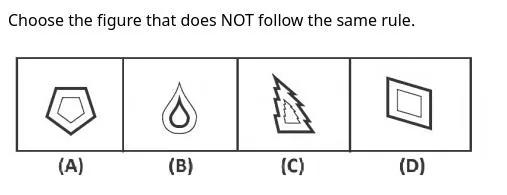
Q6109 Oct 2026 10:00 AM (Shift-1) · Q17Odd Figure Outeasy
figure
Answer: D
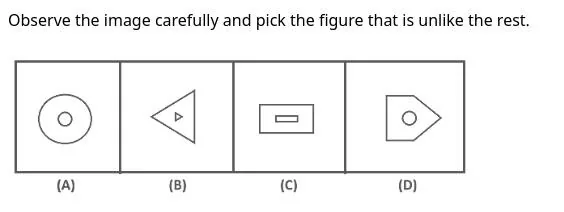
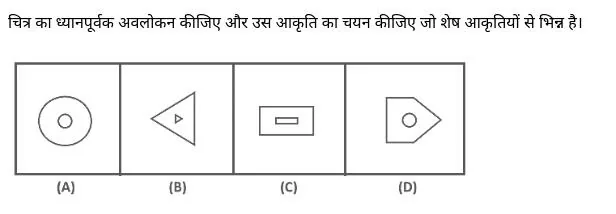
In A, B and C the inner shape is a smaller copy of the outer shape (circle in circle, triangle in triangle, rectangle in rectangle). In D the outer shape is a pentagon but the inner shape is a circle, so D is unlike the rest. Option D.
figure
उत्तर: D
A, B और C में भीतरी आकृति बाहरी आकृति की छोटी प्रति है (वृत्त में वृत्त, त्रिभुज में त्रिभुज, आयत में आयत)। D में बाहरी आकृति पंचभुज है परंतु भीतरी आकृति वृत्त है, अतः D भिन्न है। विकल्प D।

🔗 Link
Q6210 Oct 2026 05:00 PM (Shift-3) · Q17Odd Figure Outmoderate
figure
Answer: C
Figures (a), (b), (d) and (e) share a cross-like internal division with a common symmetric outline. Figure (c), the hexagon, has a different outline structure and is treated as the odd one. This is a low-confidence read of the figures. Option C.
figure
उत्तर: C
आकृतियाँ (a), (b), (d) और (e) में आंतरिक क्रॉस जैसी विभाजन रेखाएँ समान ढंग से हैं। आकृति (c), षट्भुज, की संरचना अलग दिखती है, इसलिए इसे विषम माना गया है। यह पठन कम विश्वसनीय है। विकल्प C।
🔗 Link
Q6310 Oct 2026 05:00 PM (Shift-3) · Q19Odd Figure Outmoderate
figure
Answer: B
In each figure a small circle and a black dot sit on two opposite points of the outline: square (opposite corners), star (top point and the inner vertex directly below), diamond (top and bottom), four-point star (left and right). In the hexagon (c) the dot is on the left vertex, not opposite the circle at the top, so (c) is different. Option B.
figure
उत्तर: B
प्रत्येक आकृति में छोटा वृत्त और काला बिंदु आकृति के आमने-सामने के बिंदुओं पर हैं: वर्ग (विपरीत कोने), तारा (ऊपरी शीर्ष और ठीक नीचे का भीतरी शीर्ष), विषमकोण (ऊपर-नीचे), चार-कोणीय तारा (बाएँ-दाएँ)। षट्भुज (c) में बिंदु बाएँ शीर्ष पर है, ऊपर के वृत्त के सामने नहीं, अतः (c) भिन्न है। विकल्प B।
🔗 Link
Q6414 Oct 2026 10:00 AM (Shift-1) · Q19Odd Figure Outmoderate
figure
Answer: B
This is a figure-based question. The official key is the figure in the option given below; the figure details in the source image are too small to state the rule reliably here, so compare the option figures with the question figure. Option B.
figure
उत्तर: B
यह आकृति-आधारित प्रश्न है। आधिकारिक उत्तर नीचे दिया गया विकल्प है; स्रोत चित्र में विवरण बहुत छोटे हैं, अतः नियम विश्वसनीय रूप से नहीं लिखा जा सका—विकल्प आकृतियों की प्रश्न आकृति से तुलना करें। विकल्प B।
🔗 Link
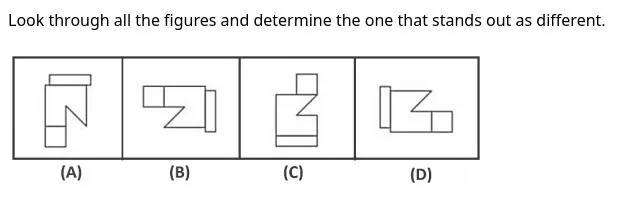
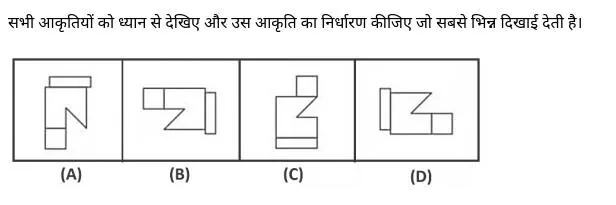
Q6514 Oct 2026 10:00 AM (Shift-1) · Q20Odd Figure Outhard
figure
Answer: C
Each figure is built from straight line segments forming a stepped outline with one or more enclosed compartments. Figure C has a different arrangement of its compartments and bottom bar from the others, so it is the one that stands out. This is a low-confidence visual judgement from small images. Option C.
figure
उत्तर: C
प्रत्येक आकृति सीधी रेखाखंडों से बनी सीढ़ीदार रूपरेखा है जिसमें एक या अधिक बंद खाने हैं। आकृति C में खानों और नीचे की पट्टी की व्यवस्था बाकी से भिन्न है, इसलिए वह अलग दिखती है। यह छोटी छवियों पर आधारित कम-विश्वास वाला दृश्य अनुमान है। विकल्प C।
🔗 Link
Q6623 Oct 2026 10:00 AM (Shift-1) · Q16Odd Figure Outeasy
figure
Answer: C
Figures A, B and D are each made of four equal squares, while figure C is made of five squares. So C is the odd one out. Option C.
figure
उत्तर: C
आकृतियाँ A, B और D प्रत्येक चार समान वर्गों से बनी हैं, जबकि आकृति C पाँच वर्गों से बनी है। अतः C असंगत है। विकल्प C।
🔗 Link
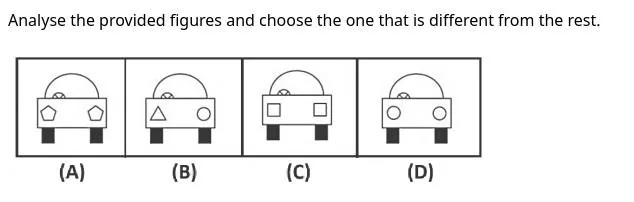
Q6723 Oct 2026 10:00 AM (Shift-1) · Q17Odd Figure Outeasy
figure
Answer: B
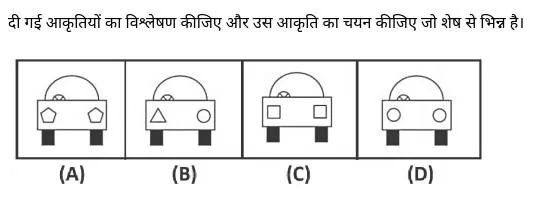
In figures A, C and D both 'headlights' of the car are the same shape (two pentagons, two squares, two circles). In figure B they are different (a triangle and a circle). So B is the odd one out. Option B.
figure
उत्तर: B
आकृतियों A, C और D में कार की दोनों 'हेडलाइट' एक ही आकार की हैं (दो पंचभुज, दो वर्ग, दो वृत्त)। आकृति B में वे अलग हैं (त्रिभुज और वृत्त)। अतः B असंगत है। विकल्प B।
🔗 Link
Q6815 Oct 2026 05:00 PM (Shift-3) · Q20Odd Figure Out (Arrow Type)easy
figure
Answer: C
Figures (a), (b), (c) and (e) each contain a straight arrow inside a closed outline. Figure (d) has a curved arrow, which is the only one of its kind, so it is different. Option C (d) is correct. Option C.
figure
उत्तर: C
आकृतियाँ (a), (b), (c) और (e) में से हर एक में एक सीधा तीर एक बंद आकार के भीतर है। आकृति (d) में घुमावदार तीर है, जो अकेली ऐसी आकृति है, इसलिए वही भिन्न है। उत्तर विकल्प C (d) है। विकल्प C।
🔗 Link
Q6915 Oct 2026 05:00 PM (Shift-3) · Q22Odd Figure Out (Line and Dot)hard
figure
Answer: D
This is a figure-based question. The official key is the figure in the option given below; the figure details in the source image are too small to state the rule reliably here, so compare the option figures with the question figure. Option D.
figure
उत्तर: D
यह आकृति-आधारित प्रश्न है। आधिकारिक उत्तर नीचे दिया गया विकल्प है; स्रोत चित्र में विवरण बहुत छोटे हैं, अतः नियम विश्वसनीय रूप से नहीं लिखा जा सका—विकल्प आकृतियों की प्रश्न आकृति से तुलना करें। विकल्प D।
🔗 Link
Q7005 Oct 2026 05:00 PM (Shift-3) · Q20Odd Figure Out by Dot and Notchmoderate
figure
Answer: A
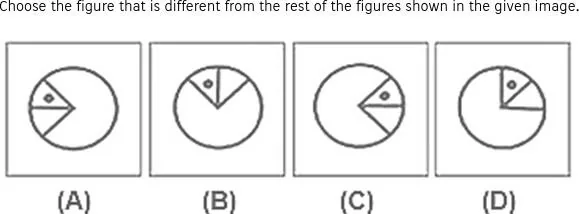
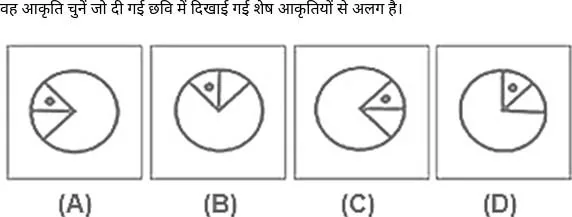
Each figure is a circle with three radii, giving one large sector and two small sectors, and one small dot sits in a small sector. Reading counter-clockwise from the large sector, figures B, C and D each show an empty small sector followed by the dotted small sector. Figure A shows the dotted sector first, so it is the mirror arrangement and is the figure that differs from the rest. Figure B does have a dot, so the earlier reason was wrong. Option A is the answer. Option A.
figure
उत्तर: A
प्रत्येक आकृति में एक वृत्त है जिसमें तीन त्रिज्याएँ हैं, जो एक बड़ा और दो छोटे खंड बनाती हैं, और एक छोटा बिंदु एक छोटे खंड में है। बड़े खंड से वामावर्त पढ़ने पर आकृति B, C और D में पहले खाली छोटा खंड और फिर बिंदु वाला छोटा खंड आता है। आकृति A में पहले बिंदु वाला खंड आता है, इसलिए वह दर्पण-विन्यास है और बाकी से भिन्न है। आकृति B में भी बिंदु है, अतः पहले दिया गया कारण गलत था। उत्तर विकल्प A है। विकल्प A।
🔗 Link
Q7113 Oct 2026 01:30 PM (Shift-2) · Q17Odd Figure Out by Dot Positionmoderate
figure
Answer: B
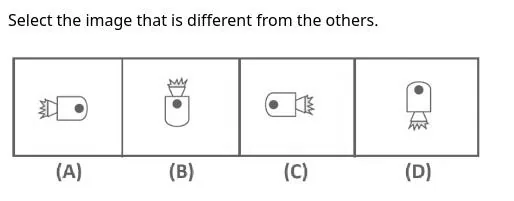
A, C and D can be obtained from one another by rotation with the flame always on the end away from the dot and the body shape unchanged; in B the body/flame arrangement does not match the rotated form of the others (the flame end is attached differently), so B is the odd one out. Option B.
figure
उत्तर: B
A, C और D एक-दूसरे को घुमाकर प्राप्त किए जा सकते हैं; B की व्यवस्था घुमाए गए रूप से मेल नहीं खाती, इसलिए B भिन्न है। विकल्प B।
🔗 Link
Q7213 Oct 2026 01:30 PM (Shift-2) · Q16Odd Figure Out by Orientationeasy
figure
Answer: C
A, B and D are the same figure (outer square, small inner square, black marker at a corner) shown in different rotations. In C the inner square is much larger than in the others, so C is the odd one out. Option C.
figure
उत्तर: C
A, B और D एक ही आकृति (बाहरी वर्ग, छोटा भीतरी वर्ग, कोने पर काला चिह्न) के अलग-अलग घुमाव हैं। C में भीतरी वर्ग बाकी की तुलना में बहुत बड़ा है, इसलिए C भिन्न है। विकल्प C।
🔗 Link
Q7305 Oct 2026 05:00 PM (Shift-3) · Q19Odd Figure Out by Sideseasy
figure
Answer: D
Each figure has an outer shape with an inner shape. In A, B and C the inner shape has one more side than the outer shape: square with pentagon in A, triangle with square in B, and pentagon with hexagon in C. In D the inner triangle has one fewer side than the outer square, so D is the odd figure. Option D.
figure
उत्तर: D
हर आकृति में बाहर एक आकार और भीतर दूसरा आकार है। A, B और C में भीतरी आकार की भुजाएँ बाहरी से एक अधिक हैं: A में वर्ग के भीतर पंचभुज, B में त्रिभुज के भीतर वर्ग, C में पंचभुज के भीतर षट्भुज। D में भीतरी त्रिभुज की भुजाएँ बाहरी वर्ग से एक कम हैं, इसलिए D विषम आकृति है। विकल्प D।
🔗 Link
Q7413 Oct 2026 01:30 PM (Shift-2) · Q24Odd Letter Groupeasy
Choose the odd group.
Answer: C
ACEG, BDFH and DFHJ each move forward by two letters at every step (A, C, E, G; B, D, F, H; D, F, H, J). In CEGJ, the steps are C to E (2), E to G (2) and G to J (3), which breaks the pattern. So CEGJ is the odd group, option C. Option C.
असंगत समूह का चयन कीजिए।
उत्तर: C
ACEG, BDFH और DFHJ में हर चरण पर दो अक्षर आगे बढ़ते हैं। CEGJ में G से J तक तीन अक्षर का अंतर है, जो पैटर्न तोड़ता है। अतः असंगत समूह विकल्प C है। विकल्प C।
🔗 Link
Q7516 Oct 2026 05:00 PM (Shift-3) · Q25Odd Letter Groupeasy
Find the odd one out.
Answer: D
BDFH, JLNP and TVXZ each step forward by 2 letters at every position: B, D, F, H; J, L, N, P; T, V, X, Z. CEIK does not fit, since C to E is +2, E to I is +4 and I to K is +2. Answer: D (CEIK). Option D.
असंगत की पहचान कीजिए।
उत्तर: D
BDFH, JLNP और TVXZ में हर अक्षर अगले अक्षर से 2 स्थान आगे है: B, D, F, H; J, L, N, P; T, V, X, Z। CEIK में यह नियम नहीं चलता, क्योंकि C से E +2, E से I +4 और I से K +2 है। उत्तर: D (CEIK)। विकल्प D।
🔗 Link